
For Australian Muslims, Ramadan 2027 Australia planning means more than circling a date. The month is expected to begin in early February, when summer is still warm and children in Sydney, Melbourne, Brisbane, Adelaide and Perth have just returned to school. Fajr may arrive before 5 am, while some families will not break their fast until after 8 pm. This guide brings together expected dates, city-by-city fasting hours, verified 2027 school calendars and a realistic Quran learning plan that fits Australian family life.
Need a learning plan before Ramadan? Quran Arabiya offers live online Quran classes in Australia arranged around the learner’s local time. Families can book a free trial to identify a suitable starting point rather than committing to a generic Ramadan target.
Ramadan 2027 Australia: Expected Start and Eid Dates
Monday 8 February 2027 is a widely published expected first fasting day for Ramadan 1448 AH in Australia. That would mean the first Taraweeh prayers on Sunday evening, 7 February. However, the date is provisional: some Australian communities may begin on Tuesday 9 February, depending on their religious authority and approach to moon sighting. Islamic Relief Australia publishes the 8 February expectation; local announcements take precedence.
| Event | Planning date | What to remember |
|---|---|---|
| First possible Taraweeh | Sunday evening, 7 February | Only if the first fast is 8 February |
| Expected first fast | Monday, 8 February | Tuesday, 9 February is also possible |
| Last ten nights | Approximately late February to early March | Count from your confirmed first fast |
| Expected Eid al-Fitr | Around 9–11 March | Confirm with your local mosque or Islamic authority |
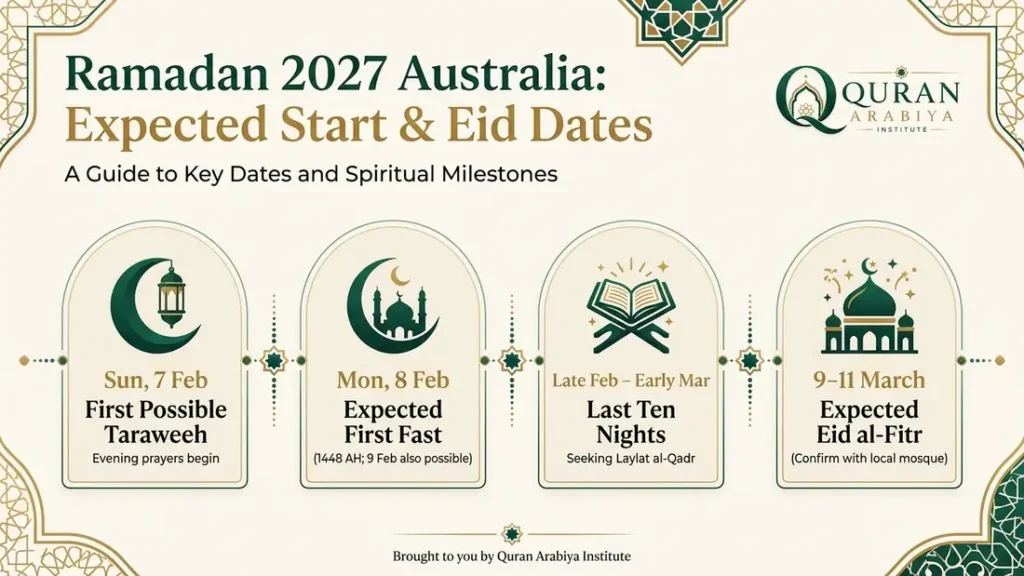
Dates are not official announcements. A lunar month lasts 29 or 30 days: an 8 February start can mean Eid on 9–10 March; a 9 February start can mean Eid on 10–11 March. Do not book leave using only an online countdown.
Before Ramadan, online Quran classes for kids can establish whether a child needs help with letters, connected reading, Tajweed or recalling memorised verses.
For stronger readers, Quran Arabiya’s Juz Amma Memorization Course focuses on correct recitation, manageable memorisation and review. Set goals according to what the learner retains.
Why Australian Ramadan Dates May Differ Between Mosques
Islamic months follow the lunar calendar, but communities use different criteria to establish them. Some follow a council’s calculations; others follow particular crescent-sighting standards or religious authorities. The difference may affect both the first fast and Eid.
Choose the mosque or authority your family follows, check its announcement near the end of Sha’ban, and use its local timetable. Give schools and employers provisional dates, then confirm them. A social-media graphic or overseas calendar is not an Australian announcement.
Ramadan 2027 Fasting Hours in Sydney, Melbourne, Brisbane, Adelaide and Perth
A February Ramadan in Australia means relatively long summer fasts, particularly in southern cities. Melbourne is projected to have about 15 hours 25 minutes between Fajr and Maghrib on 8 February, compared with approximately 14 hours 37 minutes in Brisbane. These are sample first-day estimates, not a universal Ramadan timetable or a promise of exact prayer times.
| City | Fajr / suhoor ends | Maghrib / iftar | Approximate fast | Local time on 8 Feb |
|---|---|---|---|---|
| Sydney, NSW | 4:51 am | 7:55 pm | 15 h 04 min | AEDT |
| Melbourne, VIC | 5:02 am | 8:27 pm | 15 h 25 min | AEDT |
| Brisbane, QLD | 4:01 am | 6:38 pm | 14 h 37 min | AEST |
| Adelaide, SA | 5:08 am | 8:17 pm | 15 h 09 min | ACDT |
| Perth, WA | 4:18 am | 7:13 pm | 14 h 55 min | AWST |
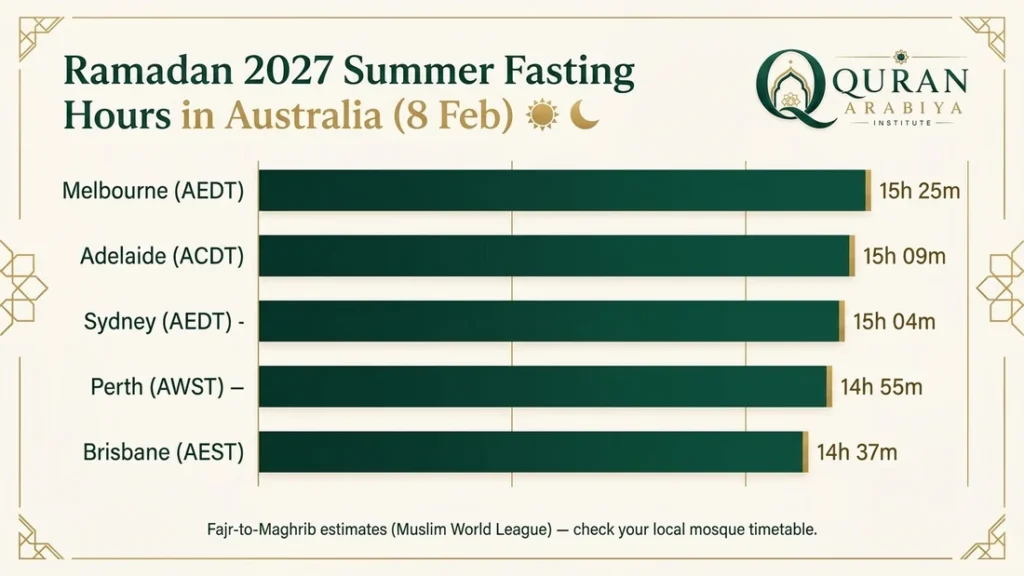
Source and calculation note: These are the Muslims Around the World (MATW) Australia Ramadan 2027 timetable estimates for Monday 8 February, using the Muslim World League prayer-time method. Each time is local to its city. Different Fajr calculation methods and local mosque timetables may differ by several minutes; follow the timetable your community uses. If your first fast is 9 February, check that day’s times instead.
These are Fajr-to-Maghrib durations, not daylight hours from sunrise to sunset. As Australia moves towards autumn, the days generally shorten. Plan around your city’s times, not a national average.
Why Sydney and Brisbane Have Different Clocks
Sydney and Melbourne use Australian Eastern Daylight Time (AEDT, UTC+11) in February, while Brisbane remains on Australian Eastern Standard Time (AEST, UTC+10). Adelaide uses Australian Central Daylight Time (ACDT, UTC+10:30), and Perth stays on Australian Western Standard Time (AWST, UTC+8). Queensland and Western Australia do not observe daylight saving.
A Sydney family cannot copy Brisbane’s prayer times or lesson schedule. Daylight saving ends on 4 April 2027, after Ramadan, in participating states. See the NSW Government guide and confirm every online lesson in your local zone.
Ramadan Begins During Term 1: What Families Should Prepare
Most Australian families enter Ramadan shortly after summer holidays. School lunches, homework, sport and iftar will overlap. Term 1 starts on different dates, and independent or Catholic schools may follow different calendars.
| State / school system | First student day of Term 1, 2027 | Implication for Ramadan |
|---|---|---|
| New South Wales — eastern division | Wednesday, 3 February | Most students return five days before 8 February |
| New South Wales — western division | Wednesday, 10 February | Students may return after Ramadan has begun |
| Victoria — government schools | Thursday, 28 January | Routines are established before the first fast |
| Queensland — state schools | Wednesday, 27 January | Discuss heat, sport and fatigue ahead of time |
| South Australia — state schools | Wednesday, 27 January | Early starts and after-school commitments overlap |
| Western Australia — public schools | Monday, 1 February | Families have roughly one school week to settle |
Official calendar checks: NSW Department of Education, Victorian Government, Queensland Department of Education, South Australian Department for Education and WA Department of Education. Check your individual school’s pupil-free days and calendar.
A Useful School Conversation Before February
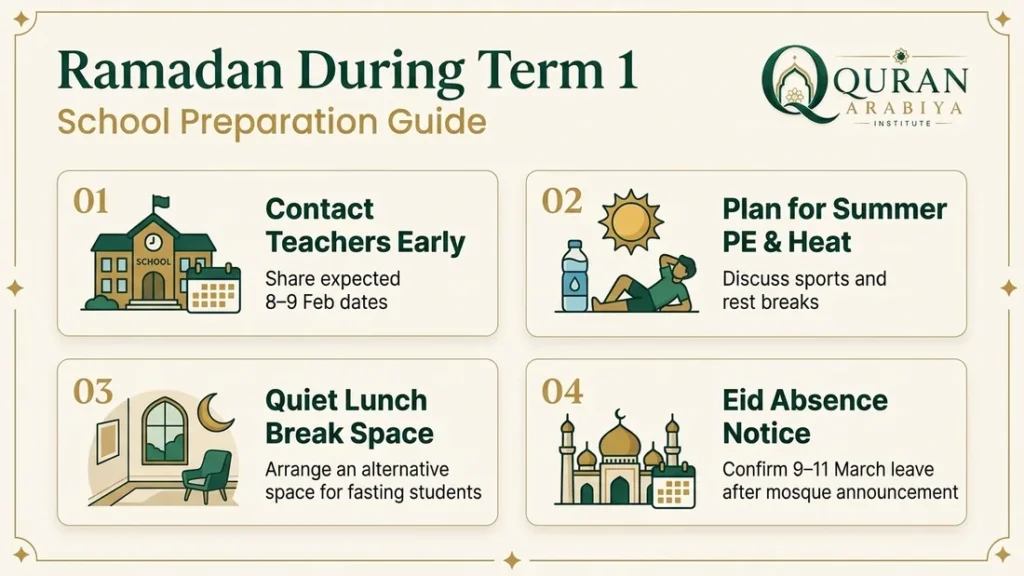
Parents can contact the teacher before Ramadan, explain whether their child plans to fast, and discuss physical education, a quiet break at lunch, and possible Eid absence. The NSW Department of Education’s guidance on supporting Muslim students advises schools to consider fasting students’ concentration and allows principals to grant leave for recognised religious occasions.
A useful message: “Our family expects Ramadan around 8–9 February, subject to confirmation. Could we discuss PE arrangements and how to notify the school about possible Eid leave? We’ll confirm the date after our mosque announces it.” Policies vary, so do not assume Eid is an automatic school holiday.
A child who is not fasting can still join by learning a surah or helping prepare iftar. Avoid comparing children’s fasting or recitation achievements.
Summer Fasting: Hydration, Heat and Safer Daily Routines
Summer heat increases the importance of planning. Drink fluids between iftar and suhoor, eat balanced meals and limit avoidable exertion in the hottest hours; drinking before dawn does not guarantee protection from dehydration.
Prepare suhoor ahead, adjust outdoor tasks and discuss demanding school sport with staff. People managing diabetes, pregnancy, kidney disease, medicines or other conditions should seek individual medical advice before fasting. If someone becomes unwell or shows signs of dehydration, prioritise safety and seek medical care as appropriate.
The Australian Islamic Medical Association recommends hydration planning and clinical advice for existing conditions. The Quran recognises concessions for illness and travel in Al-Baqarah 2:185. Consult a qualified scholar about individual religious obligations. This is general information, not personal medical or religious advice.
A Four-Week Ramadan Quran Plan That Fits Australian School Days
Measure a Quran plan by improved reading or retention, not completed boxes. Ten minutes most days may be more sustainable during school term than an ambitious schedule abandoned after a week.
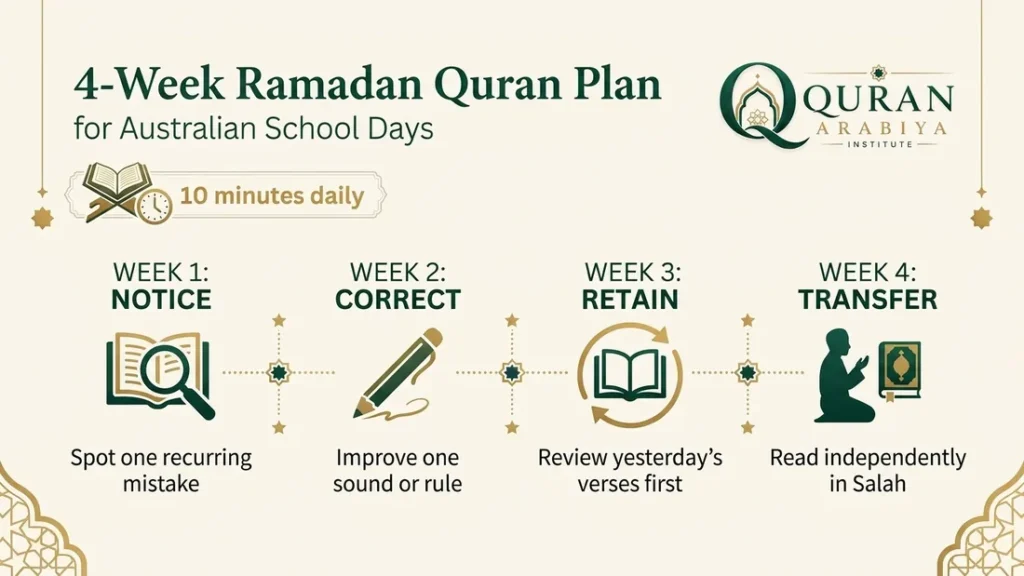
Quran Arabiya’s published approach starts with the learner’s level, isolates a correction target and tests it in fresh recitation. This four-week plan adapts that approach for home; it is a suggested routine, not a fixed academy programme.
| Week | Main Quran goal | Short home activity | What to check |
|---|---|---|---|
| 1 — Notice | Identify one weak skill | Read or recite a familiar short passage; note one repeated mistake | Can the learner recognise the issue when prompted? |
| 2 — Correct | Improve one sound or rule | Hear a correct model, imitate it, then try it in context | Does the mistake occur less often without prompting? |
| 3 — Retain | Review instead of rushing ahead | Recall yesterday’s and last week’s verses before adding new work | Can the learner recite accurately after a delay? |
| 4 — Transfer | Use the skill independently | Read a different passage or recite in Salah, then review | Does the improvement survive outside practice? |
Choose a Target by Readiness, Not by Age Alone
A beginner who still guesses vowel sounds needs a different goal from a teenager already memorising Juz Amma. Parents can use this quick decision table to avoid setting identical expectations for everyone in the family.
| Learner’s current ability | Useful Ramadan goal | Avoid this trap |
|---|---|---|
| Recognises letters but cannot join them | Read a few connected words accurately | Pushing page counts before decoding is secure |
| Reads but mixes up similar sounds | Focus on one recurring pronunciation issue | Correcting every error in the same sitting |
| Recites short surahs from memory | Strengthen previously learned surahs | Adding new verses while old ones are unstable |
| Reads fluently and knows basic Tajweed | Apply one rule consistently in new verses | Mistaking knowledge of a rule for accurate application |
| Busy adult restarting Quran study | Create a repeatable 10-minute reading habit | Comparing progress with a child’s schedule |
Try a two-day check: have the learner recite three familiar verses; note one letter, vowel or pause to improve; practise against a correct model and retest after two days. If the error persists, reduce the task. A qualified teacher can distinguish an isolated slip from a recurring pronunciation habit.
When Should Families Practise?
Choose an easy window: after Fajr, after school and rest, or after iftar. Match the lesson to local prayer times and the learner’s energy; avoid demanding practice when a child is exhausted.
For families spread across Australian states or travelling during Ramadan, Quran Arabiya offers online learning rather than a physical Australian classroom. The academy’s published Australian service page describes private live lessons, learner placement and local-time scheduling; ask for suitable times rather than assuming a fixed national timetable.
Preparing in January: Three Checks Before Ramadan
In January, make three checks before school routines become crowded.
- Check the calendar: Save the expected 8–9 February start, your state’s Term 1 dates and a provisional 9–11 March Eid window. Ask the mosque which announcement to follow.
- Check the routine: Trial one school-day schedule with enough time for food preparation, sleep, prayer and a 10-minute Quran activity. Adjust it after a realistic day, not an idealised one.
- Check the Quran skill: Listen to a short recitation. Identify whether reading, Tajweed or retention is the priority. Choose a small outcome that can be retested at the end of Ramadan.
One measurable target might be reading joined words accurately, applying a Tajweed rule independently or recalling a surah several days later—not completing a page quota.
Eid al-Fitr 2027 Australia: School Leave and Family Arrangements
Eid al-Fitr is expected around 9–11 March 2027, depending on the confirmed start and whether Ramadan lasts 29 or 30 days. Eid is not a nationwide Australian public holiday, so most schools and workplaces will normally follow their regular calendars. Discuss possible leave early and give a provisional date range rather than claiming that one projected day is final.
Follow the school’s absence procedure and check applicable workplace leave arrangements. Update everyone once Eid is confirmed. A flexible plan for prayer and family time is safer than travel that depends on a provisional date.
Conclusion
Ramadan 2027 in Australia is likely to begin on 8 or 9 February, bringing summer fasting into the first weeks of Term 1. Use a reliable local mosque for final dates and prayer times, prepare for the different schedules in Sydney, Melbourne, Brisbane, Adelaide and Perth, and tell schools about likely needs before Eid. Above all, build a Quran routine that is small enough to sustain and clear enough to measure. If your family wants guidance on reading, Tajweed or memorisation, book a Quran Arabiya free trial to discuss a suitable next step.
Frequently Asked Questions
When does Ramadan 2027 Australia begin?
Monday 8 February 2027 is a widely used expected first fasting day. Some communities may begin Tuesday 9 February. Confirm with your mosque or Islamic authority before treating either date as final.
When is Eid al-Fitr 2027 in Australia?
Plan provisionally for 9–11 March 2027. The actual date depends on the confirmed beginning of Ramadan, the length of the lunar month and the authority followed by your community.
How long will Muslims fast in Sydney in Ramadan 2027?
On the projected first day, 8 February, one Muslim World League calculation gives approximately 15 hours 4 minutes, from 4:51 am Fajr to 7:55 pm Maghrib. Check the current local timetable before fasting.
Will Melbourne have longer fasting hours than Brisbane?
Yes. The cited first-day estimates are 15 hours 25 minutes for Melbourne and 14 hours 37 minutes for Brisbane. Calculations and daily times can vary.
Does daylight saving affect Ramadan prayer times in Australia?
Yes. Sydney, Melbourne and Adelaide observe daylight saving in February; Brisbane and Perth do not. Always use your city’s Fajr and Maghrib times.
Is Ramadan 2027 during Australian school holidays?
Mostly no. Term 1 is under way across the major states by 8 February. An important exception is western-division NSW government schools, where students are scheduled to return on 10 February.
Can Australian students take a day off for Eid?
Schools can consider leave for recognised religious occasions, but procedures differ. NSW government guidance allows principals to grant leave; contact your individual school and follow its notification requirements.
Should children fast during a hot Australian summer?
Children should not be pressured into fasting, and health and individual circumstances come first. Ask an appropriate healthcare professional and religious adviser if you are uncertain about a child’s needs or readiness.
What is a realistic Quran goal for a busy family in Ramadan?
Choose one measurable improvement—such as correcting a repeated sound, reading joined words more confidently or retaining a familiar surah—and practise briefly most days. Retest after a few days rather than only counting minutes.
Can a Quran teacher help if my child already knows short surahs?
Yes. A teacher can correct pronunciation, test delayed recall and advise whether to revise or memorise more. A live trial clarifies the starting level.
References
- Islamic Relief Australia — Ramadan 2027 Expected Dates
- Muslims Around the World — Australia Ramadan 2027 City Timetable
- NSW Government — Daylight Saving in 2026 and 2027
- NSW Department of Education — 2027 School Term Dates
- Victoria Government — School Term Dates and Holidays
- Queensland Department of Education — Future School Dates
- South Australian Department for Education — School Term Dates
- Western Australian Department of Education — Term Dates
- NSW Department of Education — Supporting Muslim Students
- Australian Islamic Medical Association — Healthy Fast, Healthy Ramadan
- Quran.com — Surah Al-Baqarah 2:185