The Abbasid Caliphate course online follows the revolution that ended Umayyad rule in the central caliphate, the shift of political gravity toward Iraq, the rise of Baghdad, changing forms of administration and elite culture, later decentralization, military power and the long afterlife of Abbasid legitimacy.
The course does not reduce five centuries to a single Golden Age story. Scholarship and culture belong inside the history, but the political Abbasid history course keeps governance, social change, regional powers and major ruptures visible – while the separate Golden Age page owns the deeper science-and-civilization intent.
An Abbasid Caliphate course online should explain how power moved from the Umayyad center in Syria toward a new dynasty whose revolution drew crucial strength from Khurasan. The year 750 is a transition, not a reset button; older institutions, populations and rivalries continue into the new order.
The course can compare the new dynasty's political base and claims with the Umayyad period without retelling the entire previous course.

An Abbasid Caliphate course online should explain how power moved from the Umayyad center in Syria toward a new dynasty whose revolution drew. The year 750 is a transition, not a reset button; older institutions, populations and rivalries continue into the new order. The aim is to connect the detail to its wider chronology and historical context.
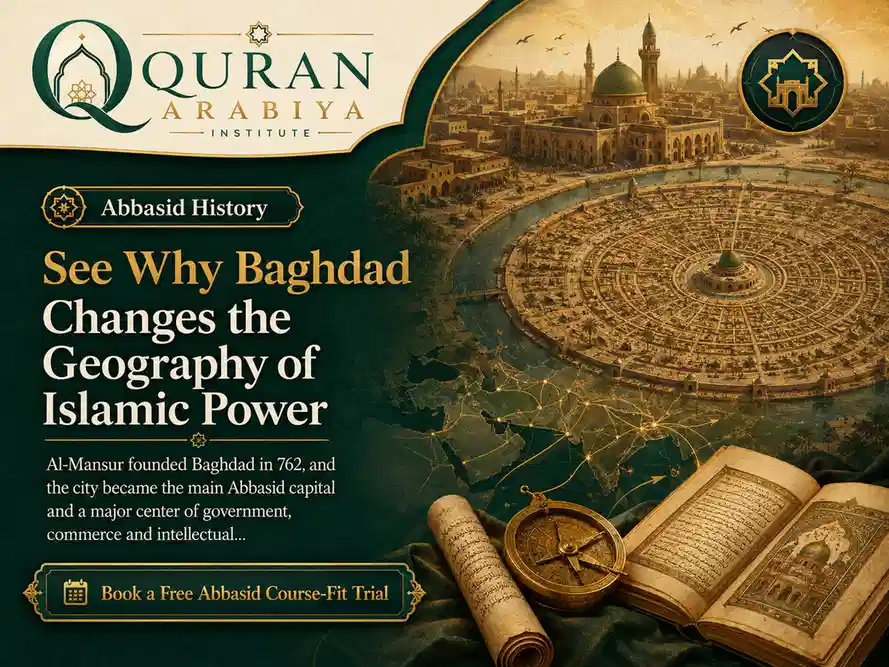
Al-Mansur founded Baghdad in 762, and the city became the main Abbasid capital and a major center of government, commerce and intellectual life. Its location in Iraq connected the caliphate to Persian administrative traditions and important trade networks.
Students can use maps to follow this eastward shift and understand why the history of Abbasid dynasty cannot be told as a continuation of Damascus with different rulers.
Baghdad Caliphate history is useful only when Baghdad is treated as a political, economic and intellectual center within a wider empire and network of regions, rather than as shorthand for every Abbasid century.
The visual organizer is there to reduce cognitive load, not to replace explanation. Places become useful when the learner can explain why location changed the story.
The Abbasid state relied on increasingly complex administration, viziers, secretaries, provincial officials and military structures. Non-Arab Muslims became more visible in political and cultural elites, and the court interacted with diverse ethnic and religious communities.
A focused history course can examine how this bureaucracy helped govern a large realm and how court politics also created new rivalries and dependencies.
The Abbasid state relied on increasingly complex administration, viziers, secretaries, provincial officials and military structures. Non-Arab Muslims became more visible in political and cultural elites, and the court interacted with diverse ethnic and religious communities. The aim is to connect the detail to its wider chronology and historical context.
Baghdad became associated with translation, medicine, mathematics, philosophy, literature and other fields, especially in the early Abbasid centuries. These developments matter, but they are one layer of the period rather than the whole Abbasid story.
Students who want a course centered on Muslim scholars, science, culture and institutions should continue to Islamic Civilization & the Golden Age. The Abbasid page keeps the political and social chronology in control.
The Abbasid state experienced major internal conflicts, including the civil war after Harun al-Rashid and later changes in military organization. Samarra became the capital from 836 to 892, reflecting the growing importance of new military elites and tensions in Baghdad.
These changes show why the dynasty cannot be described as one uninterrupted 'golden' political system.
The section should finish with one short recap in the learner’s own words so the new detail stays connected to the wider historical framework.
Baghdad became associated with translation, medicine, mathematics, philosophy, literature and other fields, especially in the.
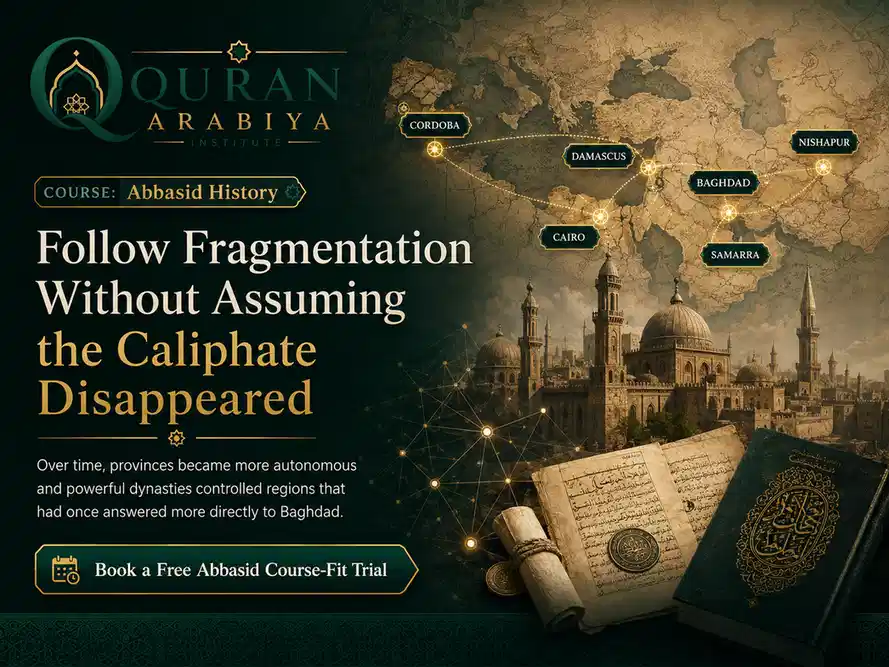
Over time, provinces became more autonomous and powerful dynasties controlled regions that had once answered more directly to Baghdad. Later, Buyid and Seljuk rulers held substantial political and military power while Abbasid caliphs retained varying degrees of authority and prestige.
This distinction between symbolic, religious and practical political authority is essential for understanding Abbasid empire history beyond a simple map of borders.
The Mongol sack of Baghdad in 1258 ended Abbasid rule in the city and is a major historical turning point. It did not erase the scholarship, institutions, texts and cultural networks developed across the preceding centuries.
Depending on the approved syllabus, the teacher may briefly explain later Abbasid caliphal continuity in Cairo, then route the learner back to the full history course for the wider post-1258 Muslim world.
Students who want to learn Abbasid history online should be able to explain how Abbasid authority changed across phases instead of treating 750-1258 as one unchanging political system.
Explain the Abbasid Revolution and the political shift from Syria to Iraq.
Describe why Baghdad mattered to government, commerce and intellectual life.
Recognize major changes in bureaucracy, military power and provincial autonomy across Abbasid phases.
Separate Abbasid political history from the specialist Golden Age science/culture intent.
Explain why 1258 is a major rupture while recognizing the dynasty's wider historical legacy.
Book a free trial and tell the academy whether your interest is Baghdad, governance, political fragmentation, scholarship in context or the transition from Umayyad rule. The teacher can check your chronology and recommend the right depth.
The core Baghdad-centered Abbasid period is conventionally dated from 750 to 1258 CE. The exact inclusion of later Cairo Abbasid continuity should follow the academy’s approved syllabus.
No. The Abbasid page owns political and social history. The Golden Age page centers scholarship, science, culture and institutions across the wider Islamic civilization.
Baghdad and intellectual life are important parts of the period. The course should explain them in context without making the entire dynasty a science-achievements module.
There was no single cause. The course can examine civil wars, military change, provincial autonomy, rival dynasties and shifting power relationships across different periods.
Basic Umayyad/Rashidun chronology helps. A beginner can receive a short bridge, but the Umayyad course is the strongest direct prerequisite for a specialist sequence.
Teens and adults with basic Islamic-history chronology who want a focused Baghdad-centered dynasty course rather than a broad Golden Age achievements page.
The starting point does not have to be lesson one. In a live one-to-one setting, the teacher can identify what is already clear, locate the first real gap and adjust the depth without changing the course’s central historical focus.
Chronology is used as an organizing spine rather than a memorization target. Timelines, cause-and-consequence notes and short recaps help the learner explain how one event prepares the next and why a turning point matters.
The course should distinguish well-established chronology from interpretive or disputed details and avoid turning a debated reading into a marketing promise. Where the source document flags caution, the teacher can explain that difference rather than flatten it into certainty.
Arabic is not assumed as a universal prerequisite for this category. If a selected text, edition or reading route requires a particular language level, that should be confirmed during the course-fit conversation before regular study begins.
The academic focus stays intact while explanation, pacing and depth can change. One-to-one teaching allows the teacher to spend more time on names, relationships, maps, source questions or analytical discussion according to the learner’s age and prior study.
The conversation can clarify age, prior knowledge, preferred depth, learning goal and suitable scheduling before the route is chosen. It is a starting-level discussion, not a promise of a fixed syllabus length or certificate.
Progress should become visible in explanation, sequence and context rather than page count alone. A useful checkpoint is whether the learner can explain the abbasid revolution and the political shift from syria to iraq. describe why baghdad mattered to government, commerce and intellectual life.
The next step depends on the intent this page deliberately does not absorb. Do not make every H2 about inventions and famous scholars. Do not retell all Islamic history before/after the Abbasids. Avoid presenting 750-1258 as one stable political condition. The teacher can use the final lessons to identify the most logical sibling course instead of stretching this page beyond its purpose.
By the end of this course, you should be able to explain how Abbasid power began, why Baghdad mattered, how administration and military power changed across the centuries and why 1258 was a major rupture. If your main interest becomes scholarship, science and culture, continue to the Islamic Golden Age pathway.