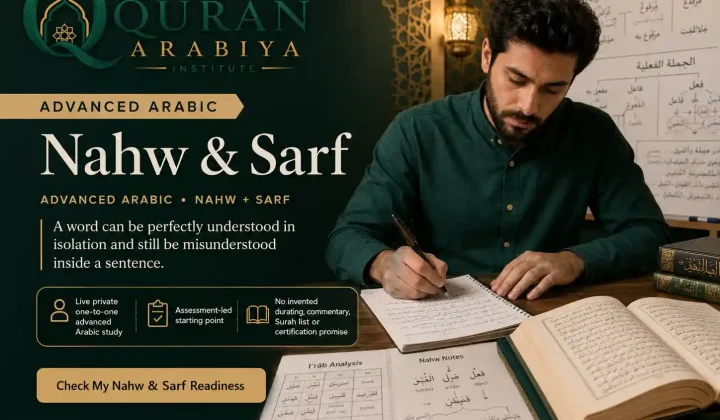
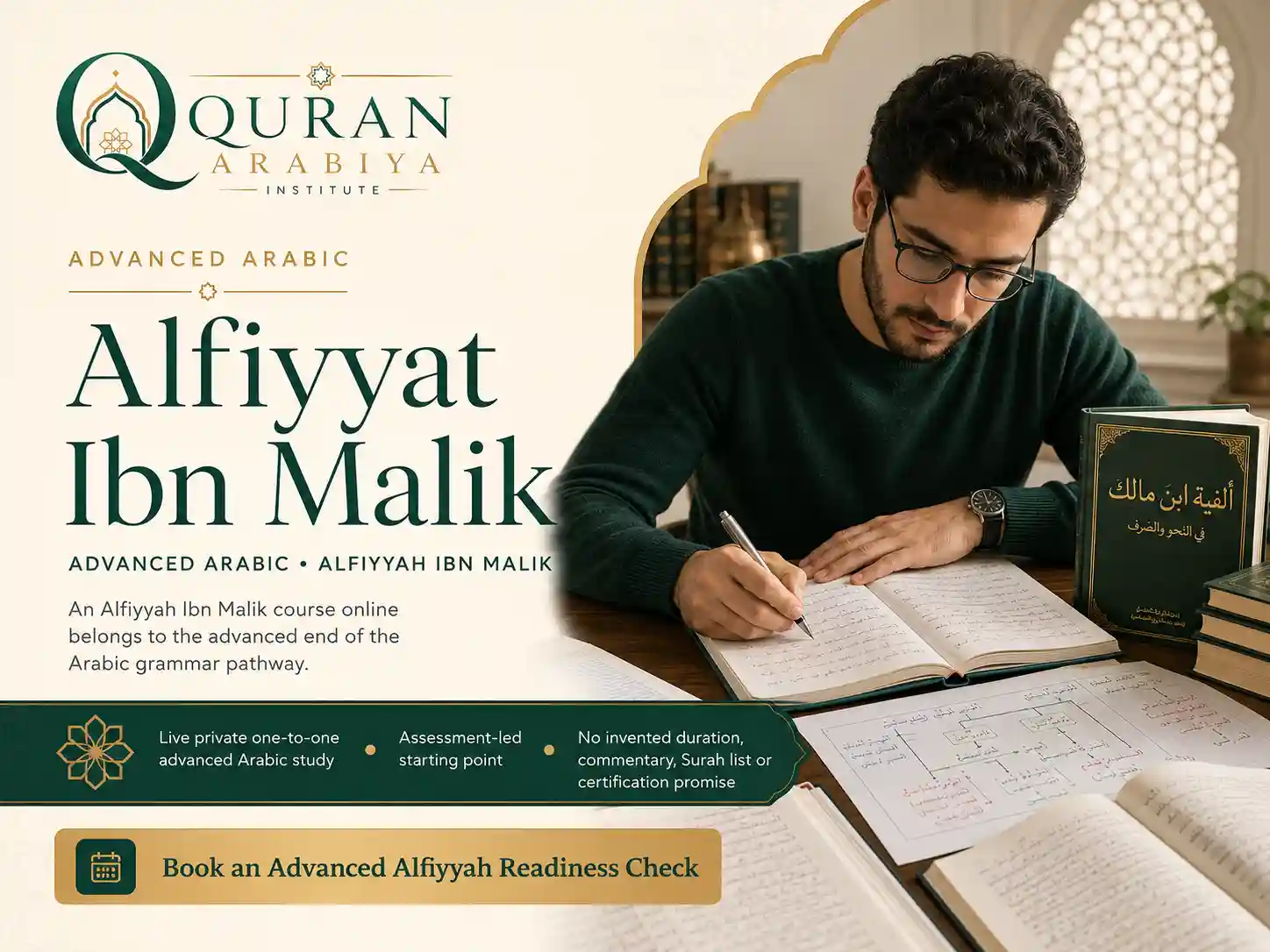
An Alfiyyah Ibn Malik course online belongs to the advanced end of the Arabic grammar pathway. The poem compresses a large body of grammatical material into approximately a thousand verses, so useful study requires more than reading a translation or memorizing lines. The learner needs a strong Nahw foundation, clear explanation and repeated application.
This course is built around that advanced task: read the bayt carefully, unpack the rule, identify conditions and exceptions, compare related issues and test the analysis on Arabic examples.
An Alfiyyah Nahw course assumes that basic terminology is already familiar. The student should not have to relearn the meaning of subject, predicate, object, grammatical state or common particles every time the poem refers to them.
That prerequisite is not a barrier for its own sake. It protects lesson time for what makes Alfiyyah valuable: dense organization, advanced distinctions, exceptions and the way multiple rules relate across the grammar system.
An Alfiyyah Nahw course assumes that basic terminology is already familiar. The student should not have to relearn the meaning of subject, predicate, object, grammatical state or common particles every. The aim is to make the analysis repeatable in a fresh Arabic example rather than leave the rule as terminology remembered in isolation.
Strong Alfiyyah Ibn Malik lessons do not stop at a paraphrase. The teacher first clarifies the wording, then identifies the grammatical rule the verse encodes, any condition attached to it and whether later lines qualify or limit the initial statement.
The learner can keep a structured note: bayt, core rule, condition, exception, example and one contrast case. This transforms the poem from compressed memory material into an analytical reference.
A useful check is whether the learner can explain the relationship, test it on a fresh example and correct the reasoning when the first analysis fails. That is stronger evidence than recalling the rule name alone.
An Ibn Malik Alfiyyah explanation needs supporting commentary because poetry leaves many relationships implicit. A teacher may use one or more recognized explanations, but Your teacher may draw on one or more recognized commentaries to explain the Alfiyyah. The exact Sharh and supporting materials can be confirmed before you begin regular study.
Whatever commentary is chosen, the method should remain consistent: explain only what helps the learner understand the grammatical point, distinguish the commentator's expansion from the wording of the poem and return to examples.
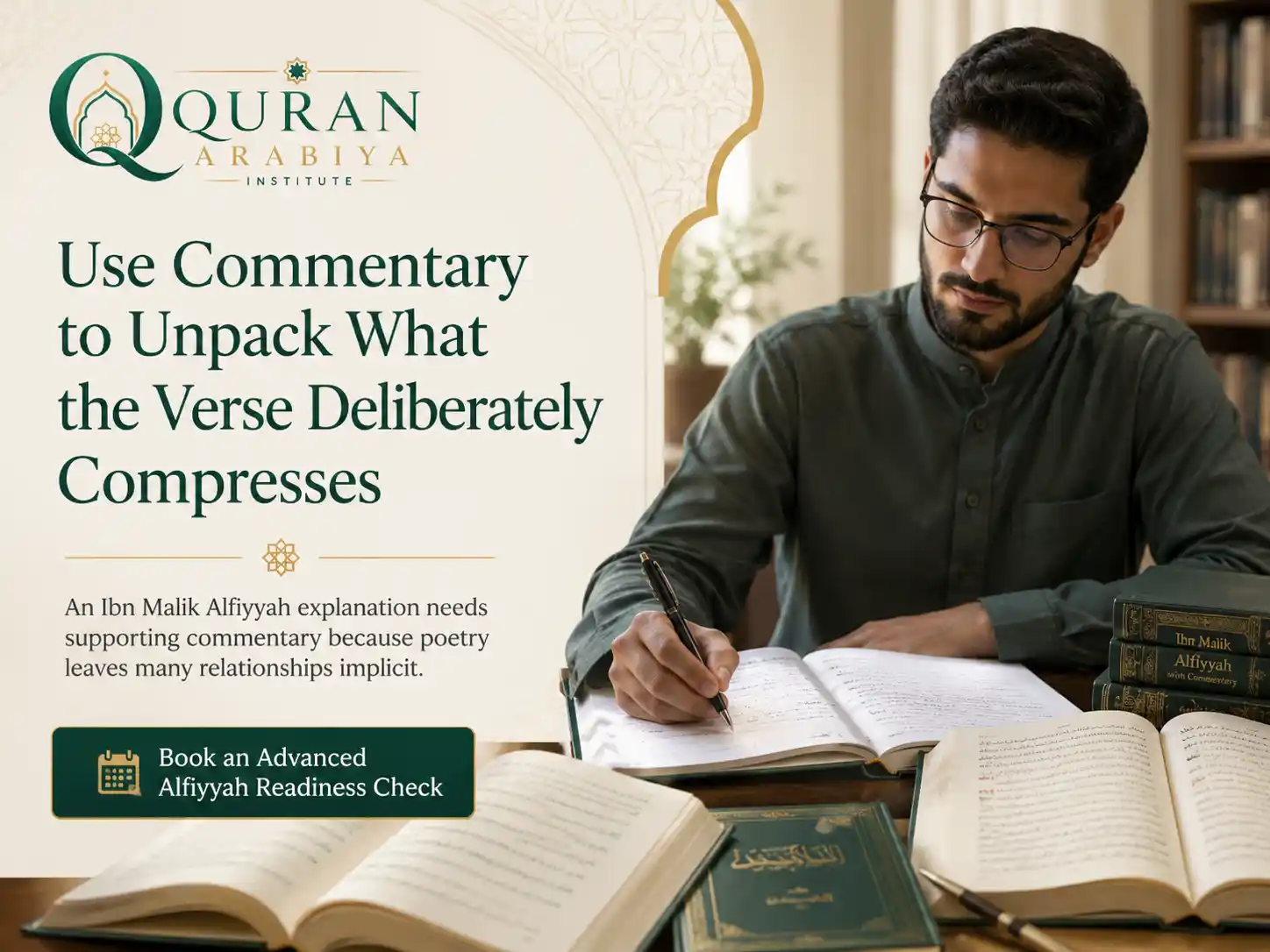
An Ibn Malik Alfiyyah explanation needs supporting commentary because poetry leaves many relationships implicit. A teacher may use one or more recognized explanations, but the course page should not name a specific Sharh. The aim is to make the analysis repeatable in a fresh Arabic example rather than leave the rule as terminology remembered in isolation.
Advanced grammar becomes difficult when every rule is stored in isolation. The course therefore creates comparison tables and oral questions that connect related topics: what changes between two governing particles, how similar dependents differ, or why one construction allows an alternative that another does not.
These comparisons help students build a system rather than a chapter-by-chapter memory.
The learner should increasingly defend an answer. Instead of saying, “this is the object because the answer key says so,” you should be able to identify the governing verb, explain the syntactic relationship and point to the grammatical evidence for your analysis. When more than one analysis is discussed in the teaching material, state the evidence and conditions carefully.
This is where an Ibn Malik grammar poem course becomes serious advanced study: the student learns to reason inside the grammar framework, not merely admire the density of the poem.
A useful check is whether the learner can explain the relationship, test it on a fresh example and correct the reasoning when the first analysis fails. That is stronger evidence than recalling the rule name alone.
Instead of saying, “this is the object because the answer key says so,” you should be able to identify the governing verb, explain the syntactic relationship and point to the grammatical evidence for your analysis. When more than one analysis is discussed in the teaching material, state the evidence and conditions carefully. The aim is to make the analysis repeatable in a fresh Arabic example rather than leave the rule as terminology remembered in isolation.
Some students pursue memorization of Alfiyyah as part of traditional study; others primarily need understanding. You do not automatically need to memorize the entire Alfiyyah. If memorization is part of your study goal, the teacher can confirm how much to memorize and how it will support your understanding of the grammar.
A practical middle route may include memorizing selected verses that organize frequently used rules, while other learners may use repeated retrieval and reference. The teacher can align the choice with the student's broader scholarly goal.
Every major point should be tested on Arabic examples so the learner can see the rule operating outside the poem. However, the page should not absorb the job of the Classical Arabic Text Reading course or the I'rab of 20 Surahs course.
Application here is targeted: enough to prove the rule has been understood. Sustained unvowelled reading and full Quranic parsing have their own dedicated training environments.

The free trial should test readiness rather than simply introduce the poem. A teacher may ask the learner to analyze a short sentence, explain common I'rab terminology, distinguish several grammatical roles or summarize a rule from previous Nahw study.
If those foundations are unstable, Ajrumiyyah, An-Nahw Al-Wadih or Nahw & Sarf may be a better next step. If they are strong, the teacher can decide how much commentary, memorization and application the Alfiyyah route should emphasize.
What Progress Should Look Like
Unpack selected Alfiyyah verses into rule, condition, exception and example.
Compare related advanced Nahw rules instead of memorizing them separately.
Defend grammatical analyses using explicit syntactic evidence.
Use commentary to clarify compressed wording without confusing it with the poem itself.
Apply selected rules to new Arabic examples with decreasing teacher prompting.
Start With a Free Trial & Placement Lesson
Book a free trial to show the teacher what you can already do, where the current bottleneck is and what you want the course to unlock. The trial can be used as a real placement and learning sample: you participate in a short task, receive correction, and leave with a clearer recommendation for the next step rather than being forced into a fixed starting point.
Book a free trial to show the teacher what you can already do, where the current bottleneck is and what you want the course to unlock. The trial can be used as a real placement and learning sample: you participate in a short task, receive correction, and leave with a clearer recommendation for the next step rather than being forced into a fixed starting point.
Frequently Asked Questions
No. It is an advanced grammar text and is much more productive after a substantial Nahw foundation.
Not unless the academy defines that as part of the program. Memorization may be a goal or a tool depending on the student’s study path.
That depends on the confirmed curriculum and teacher. This page deliberately does not promise a specific commentary.
The poem and its study can touch morphology where it intersects with the grammatical system, but learners seeking deep standalone Sarf should use the Advanced Arabic Morphology course.
The free trial can test your Nahw terminology, sentence analysis and ability to follow an advanced Arabic grammatical explanation before a study path is recommended.
Advanced adults and strong advanced teens with established Nahw, sufficient Arabic reading ability and readiness for dense traditional grammar study.
That does not automatically mean you need to restart from the beginning. The free trial can test reading comfort, sentence awareness and the prerequisite skill most relevant to this course, then route you to a foundation course only when the gap would block useful advanced study.
Traditional terminology matters because it gives the learner a precise analytical language, but memorizing labels is not the final test. The stronger outcome is being able to recognize the construction, explain why the term applies and use the same reasoning on a new example.
Examples can be selected where they support the stated language objective, but the page keeps its scope clear. Quranic language analysis is not presented as Tafsir, and a named-text course does not assume an unverified commentary, edition or fixed reading list.
It allows the teacher to see the exact step where analysis breaks down: vocabulary, form recognition, grammatical relation, parsing, rhetorical reasoning or reading stamina. The lesson can then spend time on that bottleneck and test it again in a fresh example before moving on.
The trial can check readiness, prior study, goals and the most useful starting point for this specific subject. It does not guarantee a certificate, fixed syllabus length, particular book edition or teacher qualification that has not been independently confirmed.
Progress should show up in analysis and transfer, not page count alone. A useful checkpoint is whether the learner can use the main skill with increasing independence.
If you are considering Alfiyyah Ibn Malik course online, begin with the analytical skill that is currently breaking down: form, sentence relation, parsing, rhetoric or reading transfer. The free trial can check readiness and route the learner without inventing an edition, commentary, certificate or fixed advanced outcome that has not been verified.