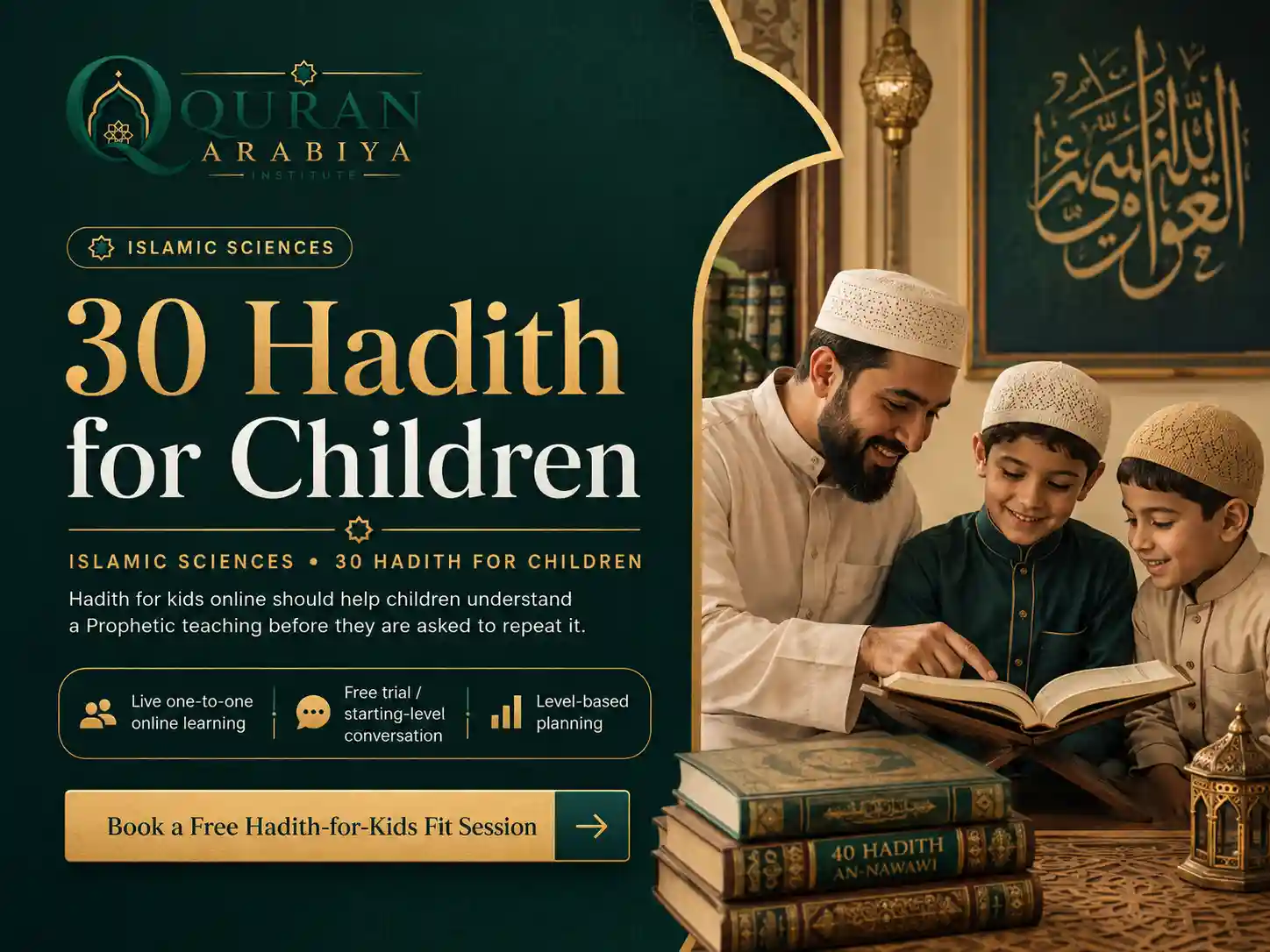
Hadith for kids online should help children understand a Prophetic teaching before they are asked to repeat it. A short narration can become a powerful lesson when the child knows what it means, sees a familiar situation where it applies and can name one action to try at home, school or with friends.
Your child will study a source-checked set of age-appropriate Prophetic teachings, with the exact narrations chosen and verified before the curriculum is presented. The explanation, vocabulary and activities are then adapted to your child’s age and level.
Islamic Hadith lessons for kids should begin with comprehension. The teacher can explain the main words, give the meaning in child-friendly English and ask the learner to say the teaching back in their own words.
Only then does memorization become meaningful. A child who can recite a sentence but cannot explain its lesson has not yet received the full value of the Hadith.
The teacher can explain the main words, give the meaning in child-friendly English and ask the learner to say the teaching back in. A child who can recite a sentence but cannot explain its lesson has not yet received the full value of the Hadith. The aim is to understand the principle clearly enough to recognize where it applies.
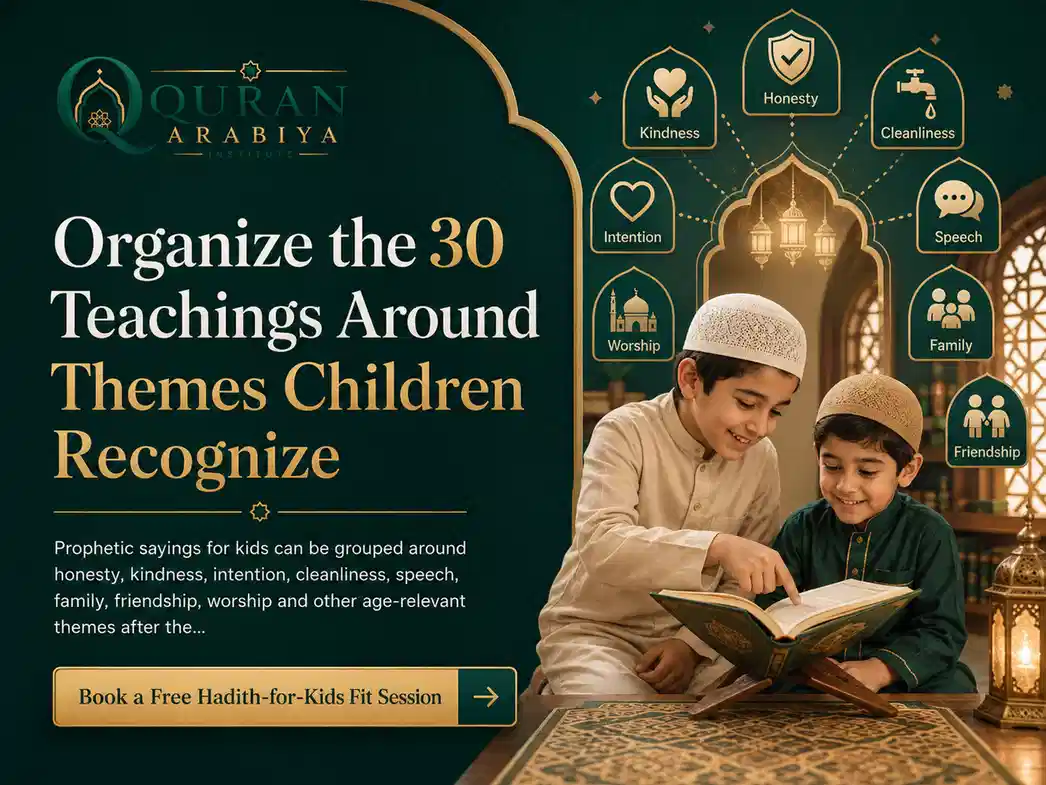
Prophetic sayings for kids can be grouped around honesty, kindness, intention, cleanliness, speech, family, friendship, worship and other age-relevant themes after the exact narration set is verified.
Thematic grouping helps the child connect one Hadith to another and gives parents a clearer sense of what the course is building.
A practical checkpoint is to explain one idea in simple words and connect it to one realistic situation before adding another concept.
A short scenario can turn an abstract teaching into a choice. What should you do when a friend tells you a secret? What does kindness look like when a sibling annoys you? How does intention change helping at home?
This style makes Sunnah lessons for children interactive without changing the wording or meaning of the source narration.
A short scenario can turn an abstract teaching into a choice. What should you do when a friend tells you a secret? The aim is to understand the principle clearly enough to recognize where it applies, with guided discussion checking understanding before the learner moves deeper.
Every lesson can end with one realistic action: greet first, control one unkind phrase, help a parent, remember a Dua, or practice one Sunnah behavior relevant to the verified Hadith.
The course should not promise instant character change. Small repeated actions simply give the child a way to connect knowledge with practice.
Hadith classes for children should not sound like an adult lecture delivered more slowly. A younger child may need one concept and one example; an older learner may discuss vocabulary, context and multiple applications.
Private teaching makes it easier to shorten the task, ask more questions or revisit a narration without holding an entire group to the same pace.
A useful checkpoint is to explain the idea in the learner’s own words, identify one example, and know when a deeper specialist course is the better next step.
Every lesson can end with one realistic action: greet first.
A useful progress note can answer three questions: Can the child explain the Hadith? Can they recall the key wording or meaning expected for their level? Can they identify a real-life example?
That is more informative than “Hadith 1-8 completed” and gives parents a simple way to reinforce learning at home.
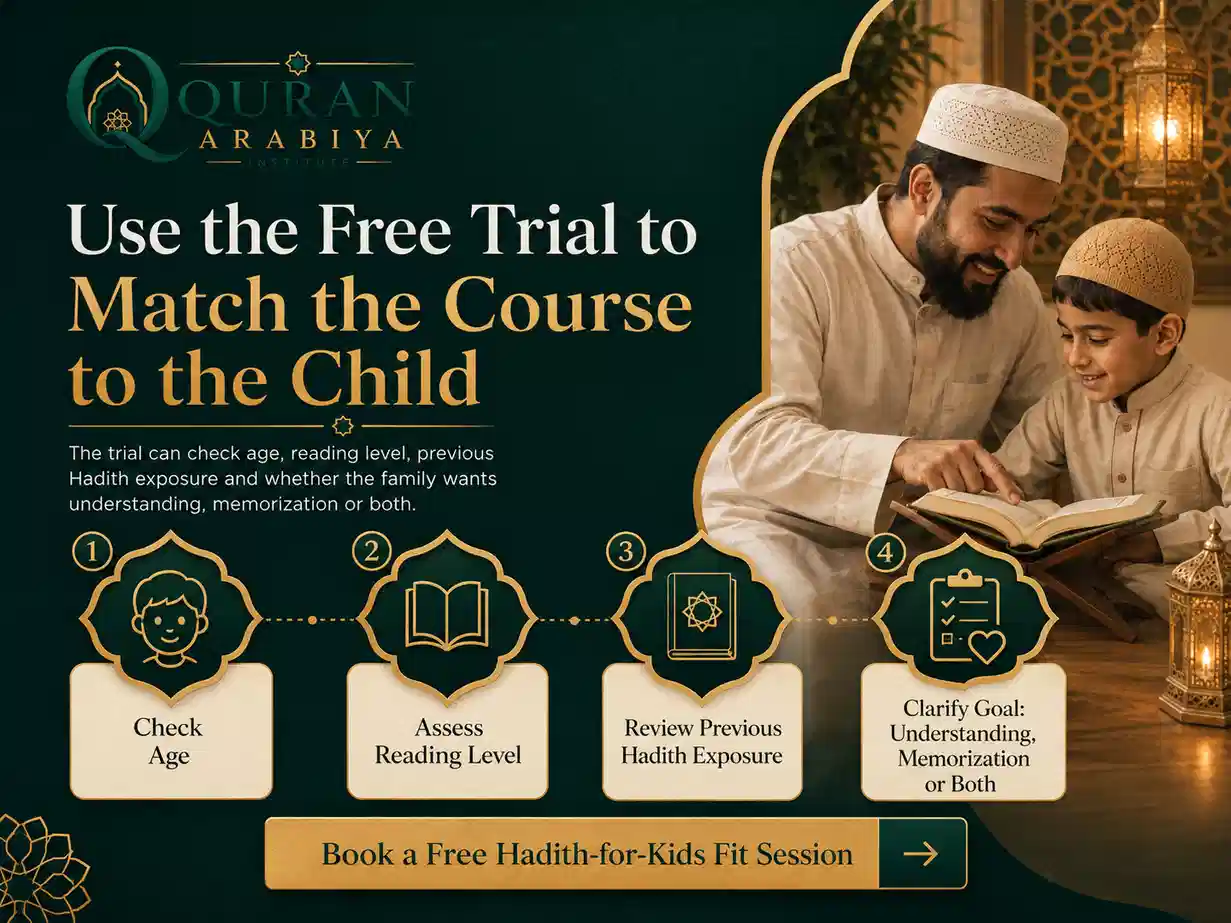
The trial can check age, reading level, previous Hadith exposure and whether the family wants understanding, memorization or both. It can also confirm whether the broad Islamic Studies course would be a better starting point for a child with wider foundational gaps.
The result is a clearer path and less duplication between sibling course pages. Children who want to learn Five Pillars for kids in a focused way stay on this URL, while broader needs move to the full Islamic Studies track.
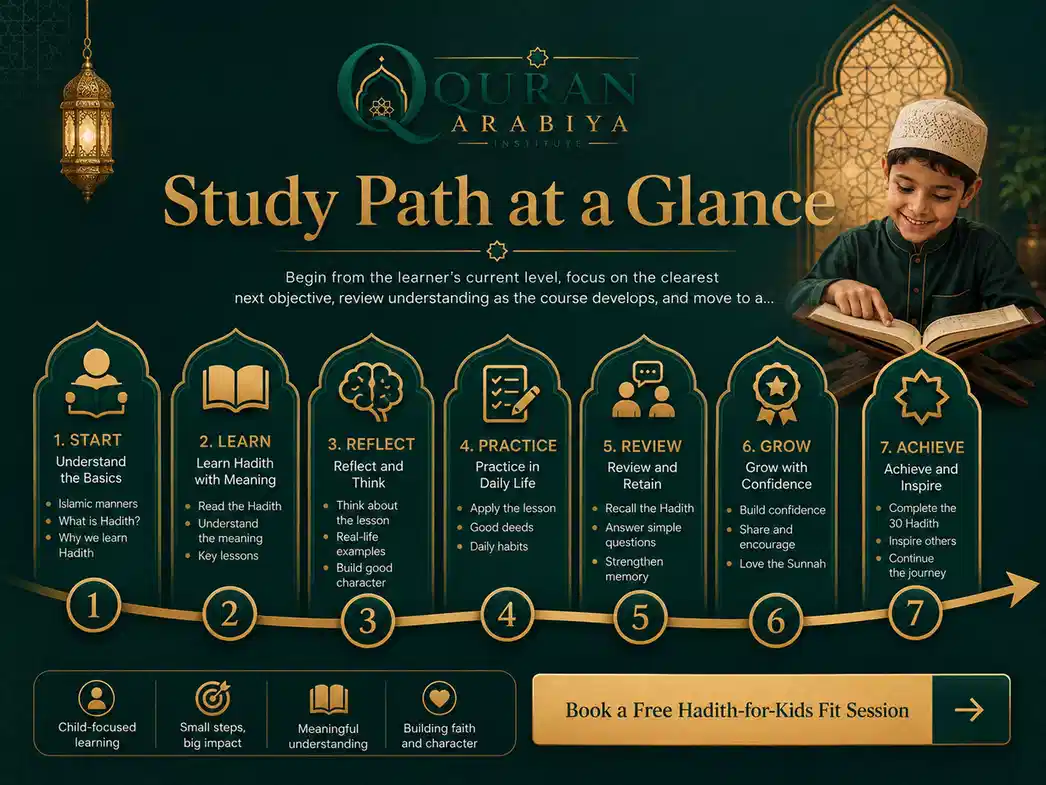
Understands selected Prophetic teachings in age-appropriate language.
Can connect a Hadith to a familiar real-life situation.
Builds recall/memorization only after meaning is clear.
Practises small, realistic actions connected to the lesson.
Parents can see progress through understanding, recall and application.
Book a free trial to check your child’s age, understanding and memorization goal, then decide whether the focused 30 Hadith route or the broader Islamic Studies track is the better start.
The exact list must be confirmed and source-checked by Quran Arabiya Institute before publication. This page should not copy an external list automatically.
Not necessarily. Memorization can be adjusted to age and goals; understanding and responsible application remain important.
No. The full track covers several Islamic subjects. This page is a focused Hadith/Sunnah route.
Yes if the selected narrations and teaching style are adapted to their age and attention span.
The academy should use a verified teaching source and check references before publishing or teaching the exact narration set. The course should not rely on unsourced social-media quote graphics.
Parents of children/teens who want selected Hadith taught with simple meaning, recall, character application and age-appropriate discussion.
The learner does not need to repeat every introductory point automatically. The starting conversation can identify what is already stable, what is only familiar by name and which concept needs the first focused explanation or practice.
Private teaching lets the teacher adjust vocabulary, pace, examples and questioning without changing the academic goal. It also creates space to stop on a misunderstood concept, check it from another angle and continue only when the learner can explain it more independently.
The course can explain relevant evidence and terminology at the level required by the subject, while avoiding claims beyond the confirmed text, teacher or syllabus. High-trust topics remain guided study rather than independent fatwa, hadith grading or personal interpretation.
No. The course is educational and should keep its scholarly scope clear. Personal rulings, estate cases, legal/tax questions or independent authentication require the appropriately qualified person and the full facts of the real case.
The trial can identify current knowledge, goals, preferred depth and the most suitable route before regular enrollment. It is used as a placement and fit step, not as guaranteed certification, a fatwa session or a promise of fixed completion time.
Progress should be visible in understanding and application rather than chapters finished. A useful checkpoint is whether the learner can understands selected prophetic teachings in age-appropriate language. can connect a hadith to a familiar real-life situation.
The next step should follow the skill or science that becomes dominant. Own Hadith for kids online, 30 Hadith for children course and child-Sunnah intent. The broad kids Islamic Studies page mentions Hadith only as one component; adult Nawawi remains separate. Once that role has been fulfilled, the teacher can recommend the most relevant specialist route instead of expanding the course beyond its intended scope.
If you are considering Hadith for kids online, begin with the concept or study gap that matters most now. The free trial can clarify your current level, intended depth and best-fit route without inventing a certificate, fixed duration or specialist ruling that has not been verified.