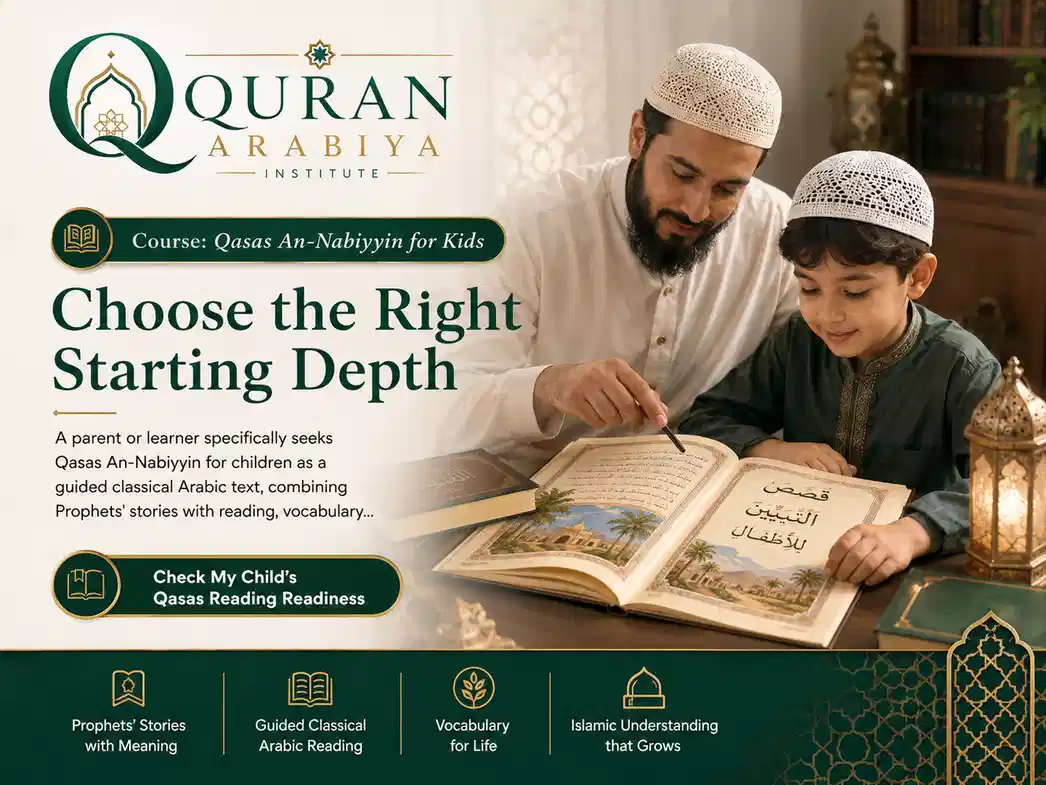
The Qasas An Nabiyyin course for kids uses meaningful prophetic narratives as a bridge into stronger Arabic reading. Instead of separating language practice from Islamic content, the learner reads an age-appropriate portion of the classical text, prepares key vocabulary, works through sentence meaning and then retells the story in increasingly independent Arabic.
This is not simply another Prophets-stories page. Qasas An Nabiyyin lessons are text-led and language-aware, so the free trial should check reading readiness before deciding how much vowel support, vocabulary preview and teacher scaffolding the child needs.
A Qasas An Nabiyyin course for kids works best when Arabic is not treated as a list of isolated words. The child reads a short piece of a Prophets' story, identifies the people and action, then explains what happened. Language has a reason to be remembered because it belongs to a story the learner cares about.
This is why Qasas An Nabiyyin lessons can bridge Arabic and Islamic Studies. The teacher can keep the religious meaning clear while using the text to build reading confidence, vocabulary and sentence comprehension.
Parents looking for a Prophets stories textbook for kids should expect the text to do two jobs together: carry meaningful Islamic narrative and create repeated opportunities for vocabulary, reading comprehension and supported Arabic expression.
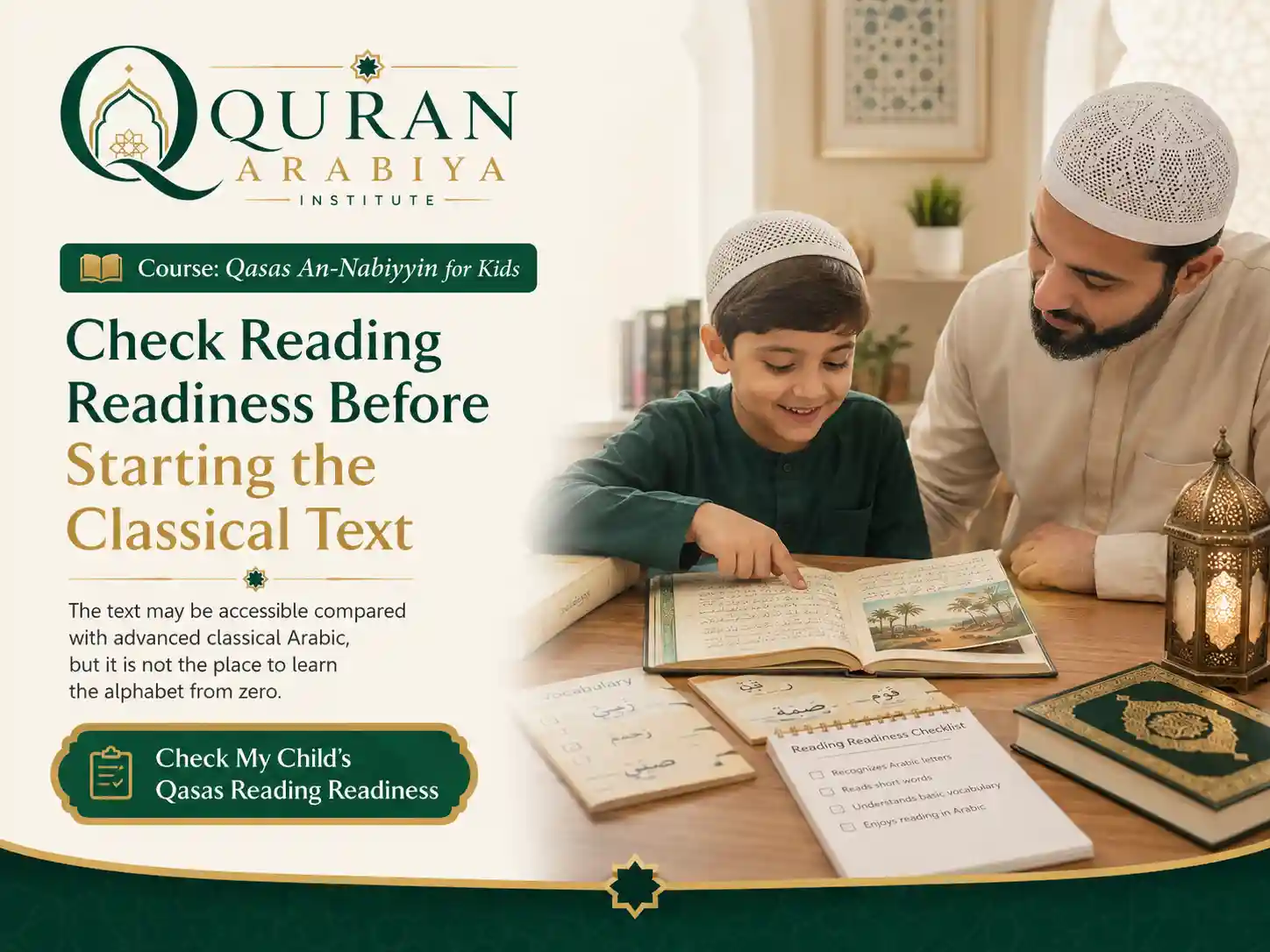
A Qasas An Nabiyyin course for kids works best when Arabic is not treated as a list of isolated words. The child reads a short piece of a Prophets' story, identifies the people and action, then explains what happened. The aim is to connect the detail to its wider chronology and historical context.
The text may be accessible compared with advanced classical Arabic, but it is not the place to learn the alphabet from zero. A child who still struggles to identify letters, vowels or basic word blending may need Arabic reading foundations first.
The free trial can check whether the learner can read a short vocalized sentence, follow simple meaning and sustain attention. If not, the academy can recommend a reading-first route and return to Qasas An Nabiyyin for children when the text becomes productive rather than frustrating.
The section should finish with one short recap in the learner’s own words so the new detail stays connected to the wider historical framework.
A short vocabulary preview reduces the temptation to stop at every word. The teacher can choose a few names, verbs and recurring expressions that unlock the passage, then allow the child to meet them again in context.
Over time, this repeated exposure supports Arabic Islamic stories for young learners more naturally than memorizing a long word list disconnected from a sentence.
A short vocabulary preview reduces the temptation to stop at every word. The teacher can choose a few names, verbs and recurring expressions that unlock the passage, then allow the child to meet them. The aim is to connect the detail to its wider chronology and historical context.
The lesson can follow a simple cycle: read a manageable section aloud, correct major reading issues, clarify the meaning, then ask the learner to retell the event in simple English or Arabic according to level. Retelling reveals whether the child understood the sentence rather than only pronounced it.
For stronger learners, the teacher can ask the child to reuse a phrase, identify a familiar grammar pattern or write a short summary. The page should not promise a full grammar course; grammar appears only where it helps comprehension.
The Islamic lesson should emerge from the story being read. The teacher can ask what the prophet called people to, what challenge appeared, how the prophet responded, and what the child can learn from that response.
That prevents Qasas An Nabiyyin classes online from splitting into two unrelated halves – Arabic first and a random moral talk afterward. The language and the Islamic meaning reinforce each other.
The section should finish with one short recap in the learner’s own words so the new detail stays connected to the wider historical framework.
The lesson can follow a simple cycle: read a manageable section aloud.
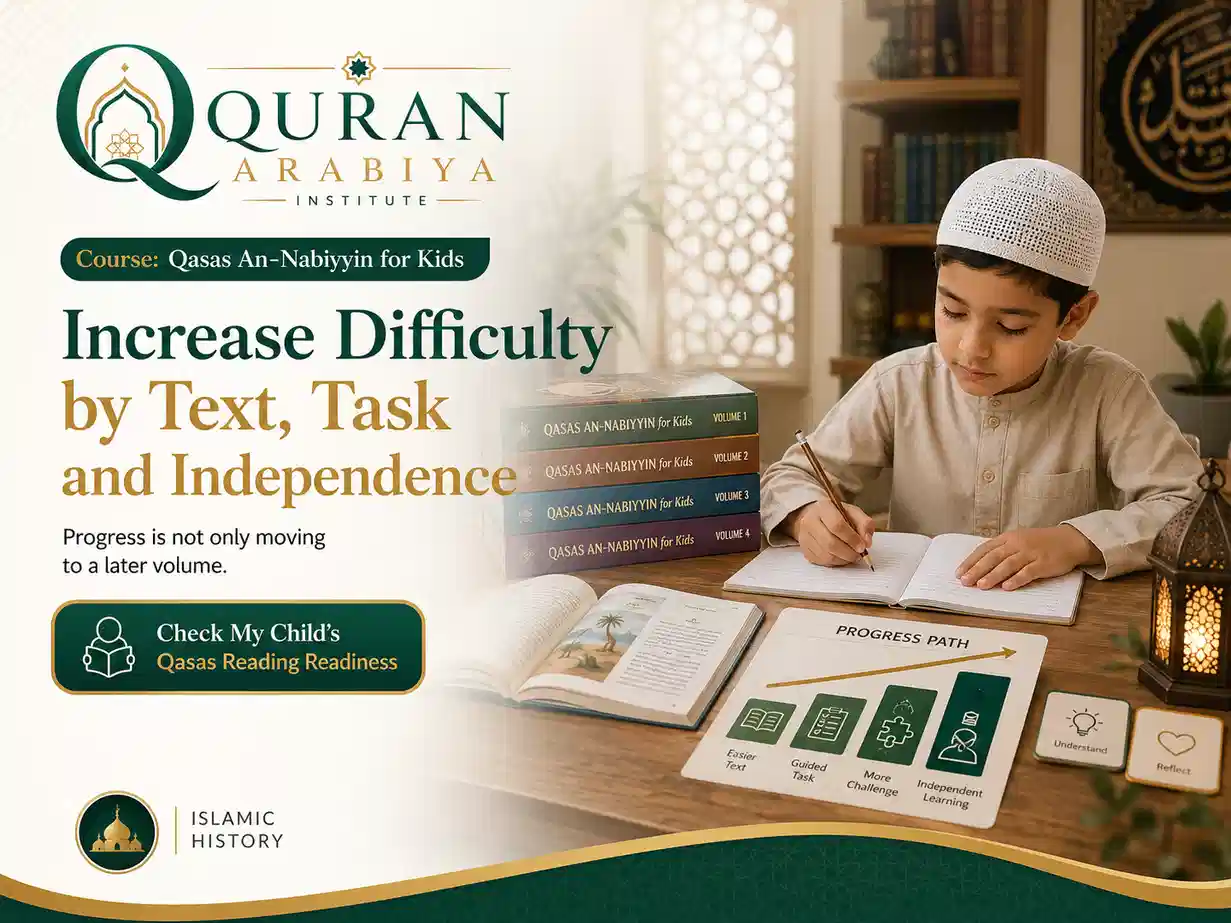
Progress is not only moving to a later volume. A learner can advance by reading longer passages, needing fewer vocabulary prompts, answering more in Arabic, noticing sentence patterns and summarizing with less teacher support.
Because published editions and multi-part sets can differ, the academy should confirm the exact book sequence rather than promise a universal volume schedule on the website.
If the learner wants broad Prophets' stories without Arabic-text study, the Stories of the Prophets course is a better fit. If the main goal becomes general Arabic reading and writing, the Arabic literacy course should own that intent. If the learner becomes ready for more advanced classical texts, Advanced Arabic can provide the next language step.
Clear routing protects both learning quality and SEO clarity.
Read selected Qasas An-Nabiyyin passages with increasing fluency and less prompting.
Understand key vocabulary and sentence meaning in context.
Retell studied prophetic stories at an age-appropriate level.
Notice selected recurring Arabic patterns without turning the course into a full grammar curriculum.
Connect the story's Islamic lesson to the actual passage being studied.
Book a free trial so the teacher can check Arabic reading readiness, vocabulary level and the child's interest in text-based learning. The academy can then confirm whether Qasas An-Nabiyyin is the right starting point or whether a reading foundation should come first.
It can serve both purposes: guided Arabic reading through Prophets’ stories and age-appropriate Islamic understanding. The balance depends on the child’s level and goal.
A child who does not yet read Arabic letters and basic vocalized words may need a foundation course first. The trial should check readiness.
The exact edition and sequence should be confirmed by the academy before enrollment. The public page should not assume that every family has the same printing.
Selected grammar can be explained when it unlocks the text, but Qasas An-Nabiyyin is not the owner for a complete grammar curriculum.
The generic Prophets course focuses on Quranic narratives and lessons. This course is organized around a named Arabic text and includes reading/vocabulary development.
Children and young teens who have enough Arabic reading foundation to benefit from a graded story text, plus families who want a text-based bridge between Arabic and Islamic Studies.
The starting point does not have to be lesson one. In a live one-to-one setting, the teacher can identify what is already clear, locate the first real gap and adjust the depth without changing the course’s central historical focus.
Chronology is used as an organizing spine rather than a memorization target. Timelines, cause-and-consequence notes and short recaps help the learner explain how one event prepares the next and why a turning point matters.
The course should distinguish well-established chronology from interpretive or disputed details and avoid turning a debated reading into a marketing promise. Where the source document flags caution, the teacher can explain that difference rather than flatten it into certainty.
Arabic is not assumed as a universal prerequisite for this category. If a selected text, edition or reading route requires a particular language level, that should be confirmed during the course-fit conversation before regular study begins.
The academic focus stays intact while explanation, pacing and depth can change. One-to-one teaching allows the teacher to spend more time on names, relationships, maps, source questions or analytical discussion according to the learner’s age and prior study.
The conversation can clarify age, prior knowledge, preferred depth, learning goal and suitable scheduling before the route is chosen. It is a starting-level discussion, not a promise of a fixed syllabus length or certificate.
Progress should become visible in explanation, sequence and context rather than page count alone. A useful checkpoint is whether the learner can read selected qasas an-nabiyyin passages with increasing fluency and less prompting. understand key vocabulary and sentence meaning in context.
The next step depends on the intent this page deliberately does not absorb. Do not promise the child will learn Arabic from scratch here. Route script/decoding needs to Arabic Reading & Writing or a beginner Arabic path. Do not duplicate the generic Prophets page’s broad thematic curriculum. The teacher can use the final lessons to identify the most logical sibling course instead of stretching this page beyond its purpose.
If you are considering Qasas An Nabiyyin course for kids, begin with the historical question you actually want answered and the depth you can sustain. The free trial can clarify your starting knowledge and route you into this course or a more specific sibling topic without turning disputed interpretation into a fixed promise.