QURAN & TAJWEED • MURAJA’AH & RETENTION

Quran Revision Program Online to Strengthen Hifz, Fix Weak Portions & Build Consistent Muraja'ah

Forgetting does not always mean you need to memorize again from the beginning. Often the real problem is that review has no structure: strong portions are repeated too often, weak portions are avoided, similar verses are mixed, and new Hifz continues while older memorization becomes unstable. This Quran revision program online treats Muraja’ah as a separate skill: diagnose the condition of existing Hifz, then rebuild recall through a review cycle that can be maintained.

Muraja’ah Is a Separate Skill, Not Just “Read More”

Reading the same familiar Surah from the beginning can create a false sense of strength. Real revision tests retrieval. Online Murajaah classes can use starts from selected ayat, transitions across page boundaries and recitation after different delays. The objective is to make the memorized Quran accessible, not merely recognizable.

Recognition

The passage feels familiar when seen or heard.

Retrieval

The words can be produced from memory without rebuilding from the first line.

Transition

The next section remains accessible across page or Surah boundaries.

Delayed Recall

The memory survives after enough time has passed to expose weakness.

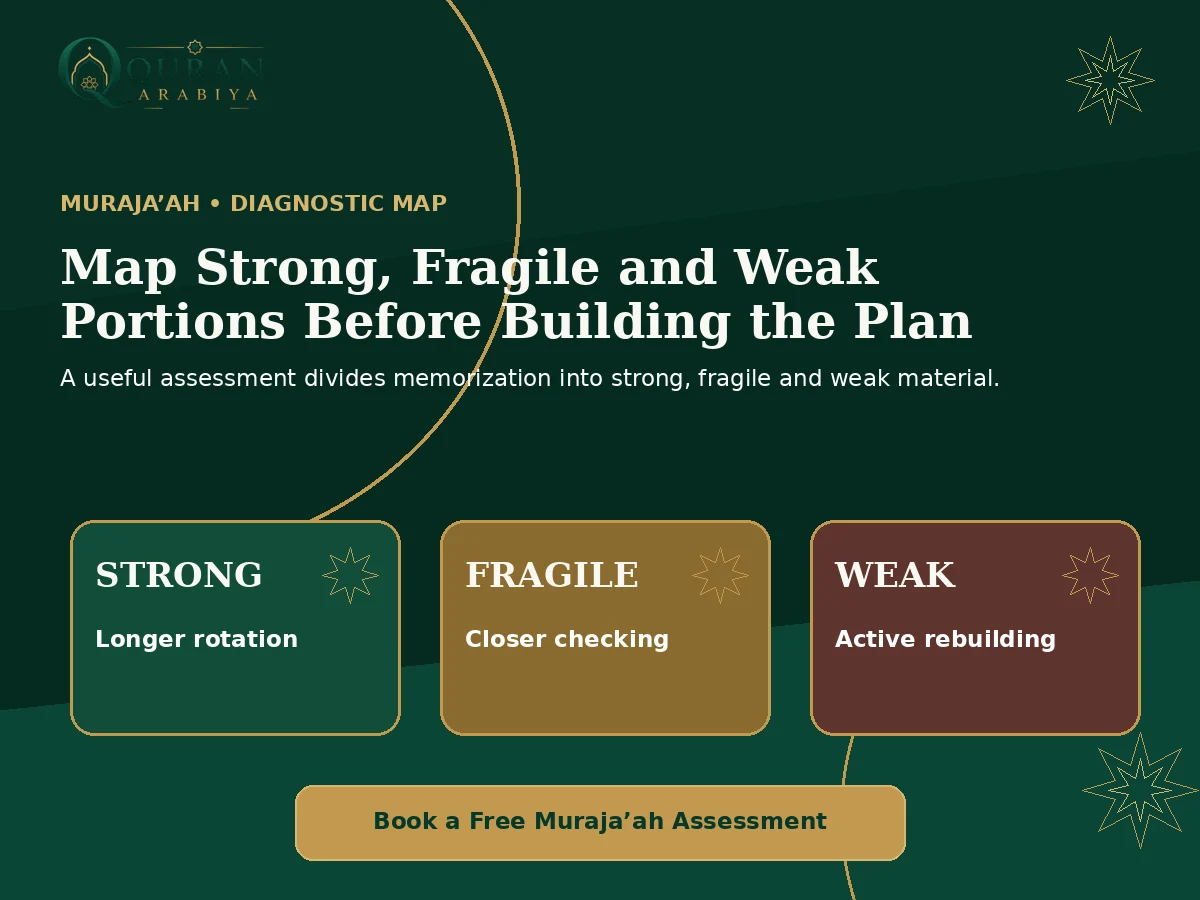
Map Strong, Fragile and Weak Portions Before Building the Plan

A useful assessment divides memorization into strong, fragile and weak material. Strong portions can sit on a longer rotation; fragile sections need closer checking; weak sections need active rebuilding. Quran revision classes for Hifz should spend time according to that map rather than treating every Juz equally.

Build the plan from the map

The first useful question is not “How many Juz?” but “Which parts are strong, fragile or weak?”

Use Layered Review for Recent, Medium-Term and Older Hifz

Review frequency should reflect memory age and stability. Recent material usually needs closer repetition, medium-term Hifz needs spaced testing and older material needs a sustainable rotation. A Hifz revision program online should scale that cycle to the learner’s total Hifz and available time.

Recent

Closer contact while the memory is still settling.

Medium-Term

Spaced testing that checks whether the section can survive longer intervals.

Older Hifz

A sustainable rotation that keeps established material retrievable.

Test Random Starts, Page Transitions and Surah Boundaries

Weakness often hides between familiar starting points. The teacher can begin in the middle of a page, ask for the continuation, or test the transition between sections. This reveals chain-dependent memory and shows exactly where retrieval needs strengthening.

Middle-of-Page Start

Remove the familiar opening and test direct retrieval.

Continue from a Cue

Check whether the next words are genuinely accessible.

Cross the Boundary

Test page and Surah transitions where linking often weakens.

Return Later

Re-test after a delay to see whether the repair held.

Let weak transitions reveal themselves

A targeted test is more useful than repeating a strong Surah from the beginning again.

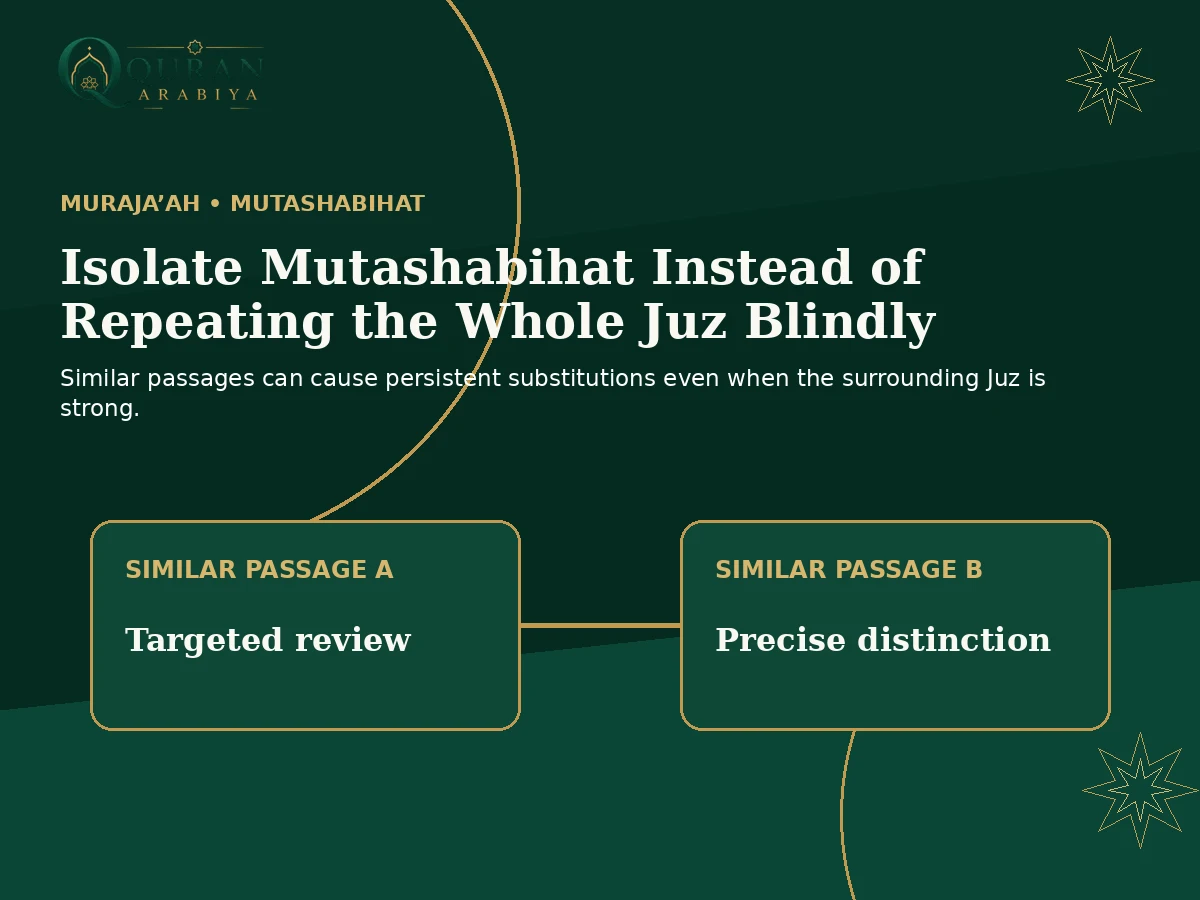
Isolate Mutashabihat Instead of Repeating the Whole Juz Blindly

Similar passages can cause persistent substitutions even when the surrounding Juz is strong. The learner can collect confusing locations, compare their distinguishing words and practice the transitions around each one. A Murajaah program for Huffaz should make these high-risk points visible.

Collect the Pair

Put the confusing locations side by side.

Mark the Difference

Identify the distinguishing word, phrase or transition.

Separate Memory Errors from Tajweed and Recitation Errors

Not every stumble is forgetting. A learner may know the words but lose a Makharij correction, shorten Madd or rush a stop. Tracking memory and recitation errors separately prevents one problem from being hidden inside the other and helps decide whether a Tajweed specialist route is also needed.

Memory Error

Omission, substitution, sequence break, missing transition or prompt dependence.

Recitation Error

Makharij, Sifaat, Madd, Ghunnah, stopping or another performance issue while the words are known.

Diagnose before you prescribe more repetition

If the words are known, repeating them may not solve a Tajweed problem.

Know When to Pause New Memorization

Sometimes the fastest route to stronger Hifz is a temporary pause in new material. If older sections are collapsing, adding more increases the rescue burden. A Quran memorization revision program can create a stabilization phase before new Hifz resumes.

Older Hifz Is Collapsing

Weakness is spreading faster than review can repair it.

Prompting Is Increasing

Retrieval depends more and more on external cues.

New Material Adds Rescue Work

Every new portion makes older instability harder to manage.

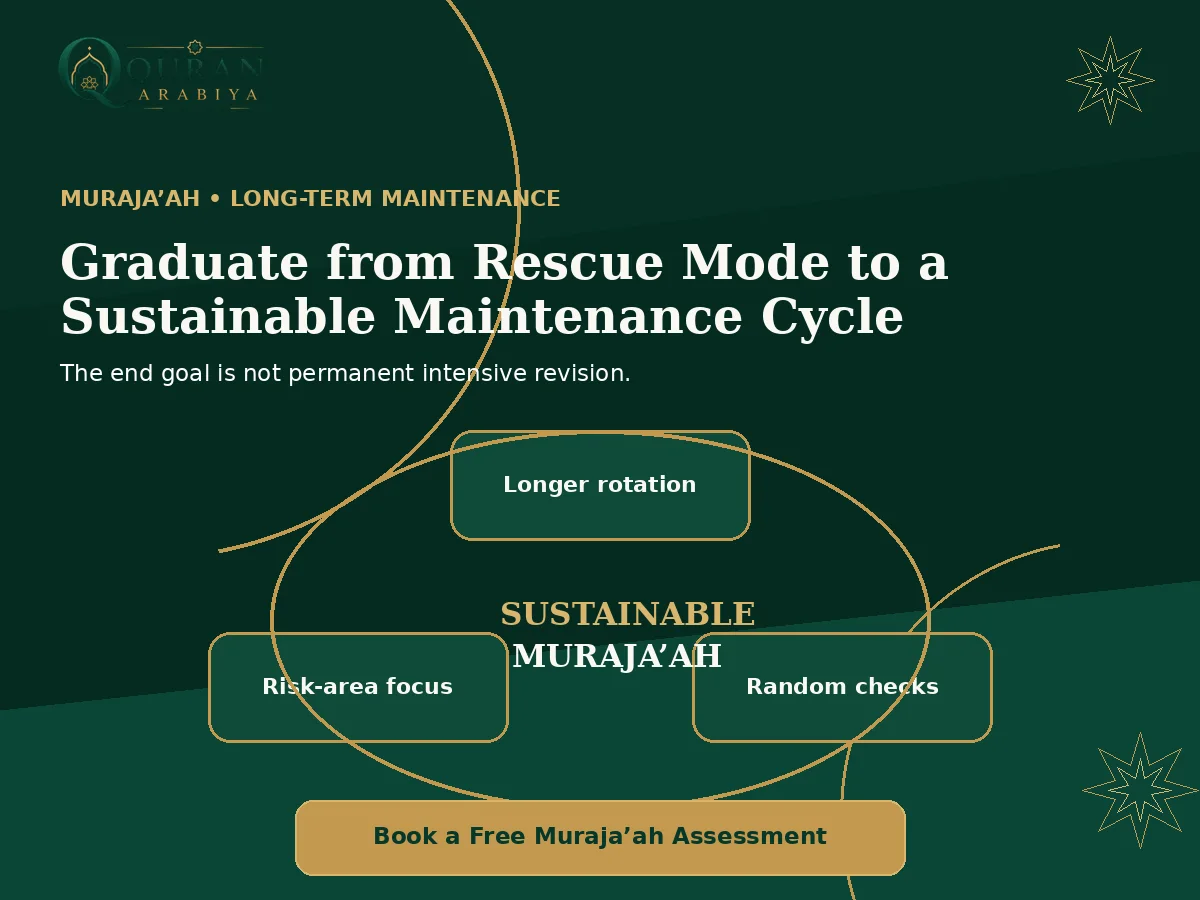
Graduate from Rescue Mode to a Sustainable Maintenance Cycle

The end goal is not permanent intensive revision. Once weak areas become stable, the plan can transition to maintenance: a realistic rotation, periodic random checks and targeted attention to known risk areas. That maintenance system is the long-term value of good Muraja’ah.

The goal is a maintainable system

Repair should eventually make intensive rescue unnecessary.

What Progress Should Look Like

Progress should be visible in the skill this course owns—not merely in pages, lessons or topics touched.

Strength Map

A clear picture of strong, fragile and weak memorization.

Layered Review

Different frequencies for recent, medium-term and older Hifz.

Targeted Retrieval

Random starts, transitions and Mutashabihat work.

Separate Error Tracking

Memory errors are not confused with recitation errors.

Maintenance Cycle

A sustainable system after rescue work is complete.

Check progress against the right standard

Use the free assessment to establish the starting point and the next meaningful target.

Start with a Free Trial & Readiness Assessment

Use the free assessment to confirm current level, identify the real bottleneck and make sure this course owns the learner’s next goal before a longer plan is confirmed.

1. Show the Real Level

Use an unprepared sample or realistic task.

2. Identify the Bottleneck

Separate reading, Tajweed, memory, revision or advanced-route needs.

3. Confirm the Course

Check that this page—not a sibling route—owns the next goal.

4. Set the First Target

Leave with a practical starting priority rather than a generic promise.

Related Quran & Tajweed Courses

Move to a sibling course only when the learner’s primary intent changes. Each page keeps ownership of a different goal.

Kids Hifz

For children whose main goal is building new memorization.

Adult Hifz

For adults whose main goal is building new memorization.

Hifz Ijazah

For advanced Huffaz preparing for formal presentation from memory.

Advanced Tajweed

For learners whose main problem is recitation accuracy rather than recall.

Frequently Asked Questions

Answers to the questions learners and families are most likely to ask before choosing this course, its readiness level and the free assessment.
It can support them, but the primary intent is revision of existing Hifz. If new memorization is the main goal, use a Hifz course.
No. Strong, fragile and weak sections often need different frequencies.
Mutashabihat can be isolated and compared directly so distinguishing words and transitions become clearer.
Yes when continuing to add would worsen instability in older Hifz.
No. Partial memorizers can also need a structured revision system.
Recite from both a strong and weak area so the teacher can map stability, retrieval and recurring error patterns before recommending the review load.
Equal repetition can waste time on strong material while weak locations remain hidden. A strength map lets review intensity follow actual need.
It is material that can still be recalled but shows hesitation, prompting dependence, transition weakness or inconsistent accuracy.
They reveal whether memory is retrievable from multiple entry points or depends on a fixed chain from the beginning.
Transitions between sections often expose weak linking that is hidden when recitation begins from a comfortable opening.
They are similar passages that can cause substitution or sequence confusion. The course isolates them instead of blindly repeating the whole Juz.
The teacher can track forgetting, substitutions and prompts separately from Makharij, Madd, Ghunnah or stopping errors.
When older sections are collapsing or review capacity cannot protect what is already memorized, a stabilization phase can be more useful.
It is an intensive period where weak material gets more attention than normal maintenance until recall becomes dependable again.
The plan should graduate into a sustainable maintenance rotation with periodic random checks and targeted attention to known risk areas.
Yes if the primary need is structured revision of existing Hifz; the plan should be adapted to age and available review capacity.
Yes. The review cycle can be built around the memorized amount, work/family schedule and current stability map.
No. This page owns revision-only intent. New memorization belongs primarily to the Kids or Adult Hifz routes.
It can stabilize existing memorization before an advanced Hifz Ijazah readiness route, but it does not itself promise authorization.
A stronger map has fewer weak zones, more reliable random starts, cleaner transitions, clearer separation of error types and a sustainable maintenance cycle.

Turn Existing Hifz into Accessible Hifz

Map what is strong, expose what is fragile, repair what is weak and graduate into a revision cycle you can actually maintain.