

Ramadan 2027 lands in the middle of the American school year, in the short days of late winter. For families, that changes everything from suhoor alarms to homework time. This Ramadan 2027 USA guide pulls together what parents and working adults actually need to plan: the expected first fast and Eid al-Fitr, why some masajid start on different days, how long the fasts will be in eight US cities, which schools close for Eid, and a realistic Quran plan for every age in the house.
The short answer: Ramadan 2027 is expected to begin in the United States on Monday, February 8, 2027, with taraweeh starting the evening before. If the month runs 29 days, Eid al-Fitr falls on Tuesday, March 9, 2027. Fasts will last about 11 hours 20 minutes to 12 hours 15 minutes at the start, depending on the city, and close to 12 hours 50 minutes by the end.
If you want this to be the Ramadan your child finally reads with confidence, the best time to start is before the month begins. You can book a free trial lesson and get a starting point before February.
When Does Ramadan 2027 Start in the United States?
So when is Ramadan 2027 in America? It is expected to start on Monday, February 8, 2027, which corresponds to Ramadan 1448 AH. Most American communities that follow the Fiqh Council of North America calendar have already planned around that date. Communities that wait for a local or regional moon sighting will confirm their start on the evening of Sunday, February 7.
That means the first taraweeh prayer is expected on Sunday night, February 7, and the first suhoor is before dawn on Monday. Because the date follows the lunar calendar, it moves about 11 days earlier each year. Ramadan 2026 began in mid-February; Ramadan 2028 will begin in late January.
The Quran itself ties the month to the revelation of the Quran:
شَهْرُ رَمَضَانَ ٱلَّذِىٓ أُنزِلَ فِيهِ ٱلْقُرْءَانُ هُدًى لِّلنَّاسِ وَبَيِّنَـٰتٍ مِّنَ ٱلْهُدَىٰ وَٱلْفُرْقَانِ
“The month of Ramadan [is that] in which was revealed the Quran, a guidance for the people and clear proofs of guidance and criterion.” (Quran 2:185)
That is one reason so many American families treat Ramadan as the month to restart Quran reading, not just the month of fasting.
How American Communities Decide the Start Date (Moon Sighting vs Calculation)
There are two main approaches in North America, and knowing which one your masjid follows explains almost every “Why did they start a day earlier?” conversation.
In 2006, the Fiqh Council of North America adopted a calendar based on astronomical calculation, and the Islamic Society of North America (ISNA) followed its position (NPR). Communities using this method publish their Ramadan and Eid dates months in advance, which helps families request days off and plan school absences early.
Other communities wait for an actual sighting of the new crescent, either locally or from a wider region. They announce the start the night before. Both approaches come from sincere scholarly reasoning, and neighbors in the same city can end up a day apart.
| Approach | How the date is set | When you know | What to do as a family |
|---|---|---|---|
| Astronomical calculation (FCNA/ISNA) | Pre-calculated new moon criteria | Months ahead | Plan school and work requests early |
| Local or regional moon sighting | A confirmed sighting of the crescent | The evening before | Keep both possible dates open |
| Following another country’s announcement | Announcement from abroad | The evening before | Ask your local imam which one your masjid follows |
Practical tip: If you need a day off for Eid, ask your employer or school for the expected date and the following day. It costs nothing to mention both.
Expected Fasting Hours in New York, Chicago, Houston, Los Angeles and Other US Cities
Fasting runs from Fajr (true dawn) to Maghrib (sunset). Ramadan 2027 is a winter-to-early-spring Ramadan, so the fasts are shorter than the summer Ramadans many older American Muslims remember. The days lengthen through the month, adding a little over an hour by the last fast.
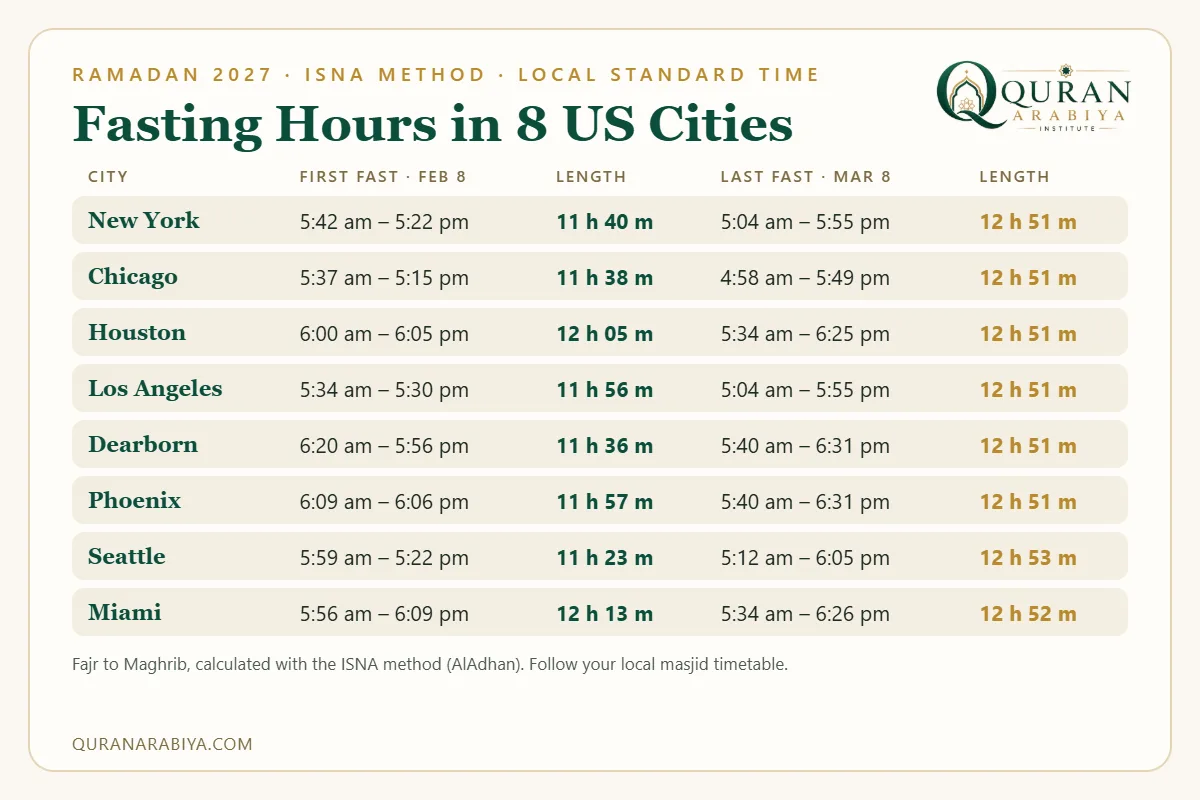
We calculated the expected times below for the first fast (February 8) and the expected last fast (March 8) using the ISNA prayer-time method through the AlAdhan prayer times service. Times are in each city’s local standard time.
| City | First fast: Feb 8, 2027 | Fast length | Last fast: Mar 8, 2027 | Fast length |
|---|---|---|---|---|
| New York, NY | 5:42 am – 5:22 pm | 11 h 40 m | 5:04 am – 5:55 pm | 12 h 51 m |
| Chicago, IL | 5:37 am – 5:15 pm | 11 h 38 m | 4:58 am – 5:49 pm | 12 h 51 m |
| Houston, TX | 6:00 am – 6:05 pm | 12 h 05 m | 5:34 am – 6:25 pm | 12 h 51 m |
| Los Angeles, CA | 5:34 am – 5:30 pm | 11 h 56 m | 5:04 am – 5:55 pm | 12 h 51 m |
| Dearborn, MI | 6:20 am – 5:56 pm | 11 h 36 m | 5:40 am – 6:31 pm | 12 h 51 m |
| Phoenix, AZ | 6:09 am – 6:06 pm | 11 h 57 m | 5:40 am – 6:31 pm | 12 h 51 m |
| Seattle, WA | 5:59 am – 5:22 pm | 11 h 23 m | 5:12 am – 6:05 pm | 12 h 53 m |
| Miami, FL | 5:56 am – 6:09 pm | 12 h 13 m | 5:34 am – 6:26 pm | 12 h 52 m |
Two things stand out. First, at the start of the month, fasts in the South are longer than in the North: Miami fasts about 50 minutes longer than Seattle on day one. Second, by the end of Ramadan almost every US city fasts for about 12 hours 51 minutes. That happens because the month ends close to the spring equinox, when day length is nearly the same everywhere.
Your masjid’s timetable may differ by a few minutes, because communities use different dawn angles and some add a safety margin before Fajr. Always follow your local timetable for suhoor and iftar.
One more detail: daylight saving time begins on the second Sunday in March (NIST), which in 2027 is March 14. That is after Eid, so the entire month of Ramadan 2027 stays on standard time. No mid-month clock shock this year.
Ramadan 2027 USA Calendar at a Glance: First Fast, Laylat al-Qadr and Eid al-Fitr
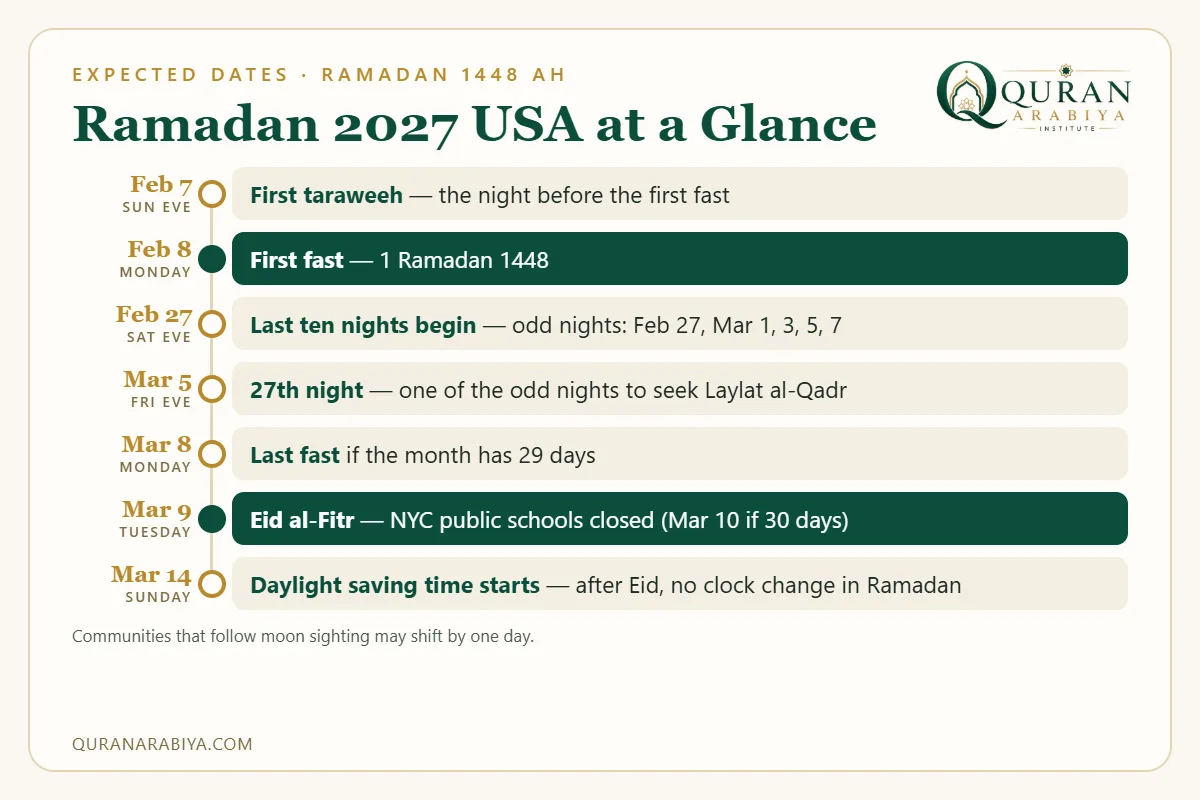
All Ramadan 2027 dates below are expected dates based on a Monday, February 8 start. Communities following moon sighting may shift by one day.
| Moment | Expected date | Day |
|---|---|---|
| First taraweeh | February 7, 2027 (evening) | Sunday |
| First fast (1 Ramadan 1448) | February 8, 2027 | Monday |
| Presidents’ Day (federal holiday) | February 15, 2027 | Monday |
| Last ten nights begin (21st night) | February 27, 2027 (evening) | Saturday |
| 27th night | March 5, 2027 (evening) | Friday |
| Last fast if the month has 29 days | March 8, 2027 | Monday |
| Eid al-Fitr (29-day month) | March 9, 2027 | Tuesday |
| Eid al-Fitr (30-day month) | March 10, 2027 | Wednesday |
The Prophet ﷺ told believers to “search for the Night of Qadr in the odd nights of the last ten days of Ramadan” (Sahih al-Bukhari 2017). For 2027, the odd nights are expected on the evenings of February 27, March 1, March 3, March 5 and March 7. Many families plan one longer Quran session on each of those nights rather than trying to stay up every night.
Fasting on a School and Work Day: A Practical Daily Rhythm for US Families
A February Ramadan means school buses, early meetings and dark mornings. The trick is not to squeeze more into the day. It is to move a few things to the right time slot.
Here is what a realistic weekday can look like for a family in New York during the first week, when Fajr is around 5:42 am and Maghrib around 5:22 pm:
| Time (New York, early Ramadan) | What happens | Why it works |
|---|---|---|
| 4:50 – 5:30 am | Suhoor: water, protein, slow carbs | Finish before Fajr with a few minutes to spare |
| 5:45 am | Fajr, then 10 minutes of Quran | The quietest Quran time of the whole day |
| 7:00 am – 3:00 pm | School and work | Keep lunch-hour plans simple; rest if possible |
| 4:00 – 4:30 pm | One short Quran lesson or practice | Energy is low, so keep it to 20–30 minutes |
| 5:22 pm | Iftar with dates and water, then Maghrib | Light first, full meal after prayer |
| Evening | Homework, Isha and taraweeh | Older kids can join taraweeh on weekends |
If you live in Chicago, Houston or Los Angeles, shift the times using the table above. The rhythm stays the same.
Talking to your child’s school
Children are not required to fast before puberty. A well-known hadith says that deeds are not recorded for “a boy till he reaches puberty” (Sunan Abi Dawud 4403). Many American families still let younger children practice half-days or weekend fasts.
If your child is fasting at school, a short note to the teacher helps. Mention that your child is fasting and may prefer a quiet space at lunch, and that PE might feel harder in the afternoon. Ask the school nurse to call you if your child feels unwell. Any child with a medical condition should follow medical advice. The Quran itself makes room for people who are ill: “whoever is ill or on a journey – then an equal number of other days” (Quran 2:185).
For working adults
Many adults find the hardest part is not hunger but the 3 pm energy dip. Front-load demanding tasks to the morning, take a short walk instead of a coffee break, and keep evening screen time low so you can wake for suhoor. If your employer offers flexible hours, ask early. With the FCNA calendar, you can give exact expected dates.
Eid al-Fitr 2027 and School Closures (Including NYC Public Schools)
Eid al-Fitr 2027 is expected on Tuesday, March 9, 2027 for communities following the FCNA calendar, or Wednesday, March 10 if the month completes 30 days by sighting.
New York City Public Schools list Tuesday, March 9, 2027 – Eid al-Fitr as a day when schools are closed in the official 2026–2027 school year calendar. NYC students will also have Midwinter Recess from February 15 to 19, during the second week of Ramadan. That is a good week to plan longer daytime Quran sessions and family iftars.
Outside New York, closures vary by district. Some districts close for Eid, while others treat it as an excused religious absence. Check your district’s published calendar now, and send any absence request as early as the district allows.
| Your situation | What to do in January |
|---|---|
| District closes for Eid | Confirm the date matches your masjid’s Eid |
| District excuses religious absences | Submit the request for March 9, and note March 10 as possible |
| No clear policy | Email the principal with the expected dates and ask how to record the absence |
| You work shifts | Request both March 9 and March 10 if possible |
A 30-Day Quran Plan for Kids, Teens and Adults
The most common Ramadan Quran mistake is choosing a goal that collapses by day five. A goal should fit the reader’s real level, not the level you hope they have.
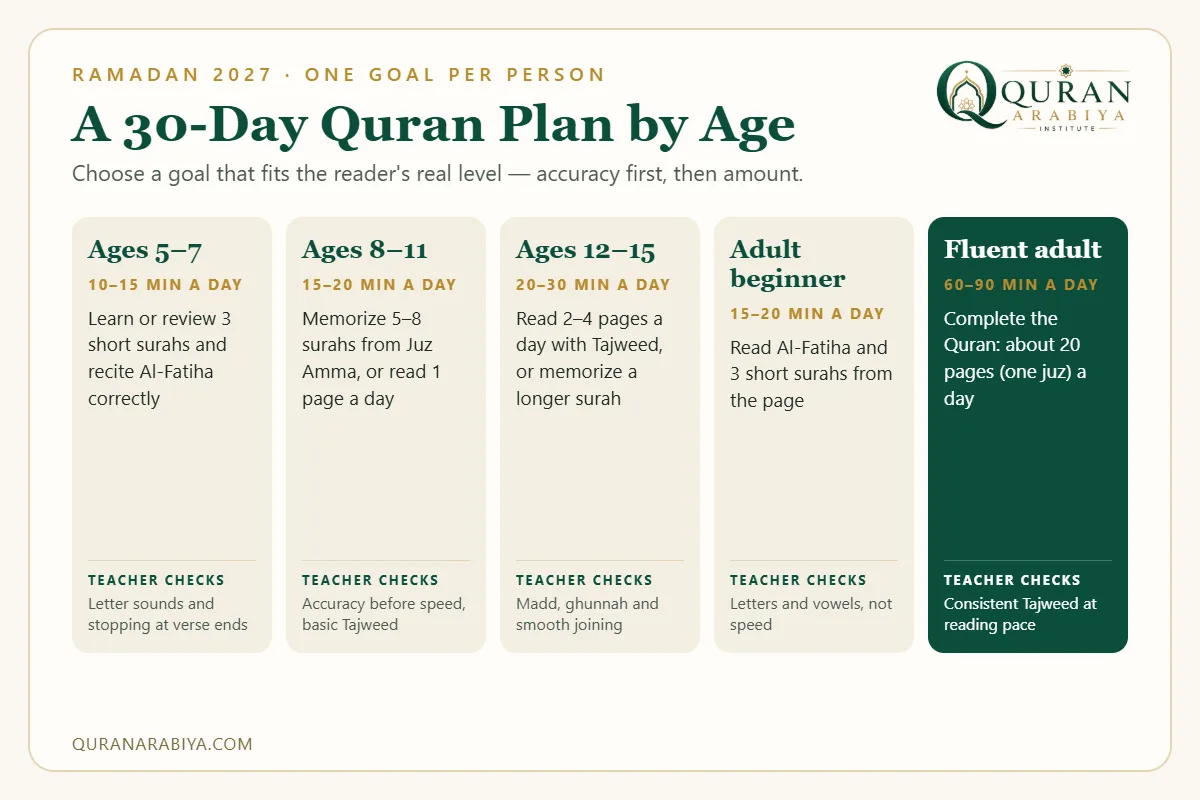
A standard Madinah mushaf has 604 pages, so finishing the whole Quran in 30 days means about 20 pages a day, or one juz. That is a beautiful goal for a fluent reader with a flexible schedule. It is not the right goal for a child still joining letters, or an adult who reads slowly and wants to read correctly.
| Learner | Realistic Ramadan goal | Daily time | What a teacher checks |
|---|---|---|---|
| Ages 5–7 | Learn or review 3 short surahs; recite Al-Fatiha correctly | 10–15 min | Letter sounds, stopping at verse ends |
| Ages 8–11 | Memorize 5–8 surahs from Juz Amma, or read 1 page a day | 15–20 min | Accuracy before speed, basic Tajweed |
| Ages 12–15 | Read 2–4 pages a day with Tajweed, or memorize a longer surah | 20–30 min | Madd, ghunnah, smooth joining |
| Adult beginner | Read Al-Fatiha and 3 short surahs from the page | 15–20 min | Letters and vowels, not speed |
| Fluent adult | Complete the Quran (about 20 pages a day) | 60–90 min | Consistent Tajweed at reading pace |
For younger children, the Online Quran Classes for Kids path focuses on reading and recitation step by step. If a child already reads and wants a memorization goal for Ramadan, the Juz Amma Memorization Course gives a structured way to memorize and review short surahs. Adults who read but want to fix their recitation can use the month to start Online Tajweed Classes for Adults.
Make the goal visible
Print a simple 30-day chart and put it on the fridge. Children respond to seeing progress. For teens, a shared family chart works better than a private one. Nobody wants to be the one with three empty boxes in a row.
Use correction, not just repetition
Reading a lot is good. Reading correctly is better. A child who repeats a mistake 30 times in Ramadan has practiced the mistake. A short weekly lesson with someone who listens and corrects keeps the extra reading on track.
Preparing Before Ramadan: What to Practice in December and January
The families who have the smoothest Ramadan rarely start on February 8. They start in December, with small habits:
- Pick one daily Quran slot now. Ten minutes after Fajr or before bed. Ramadan will make it longer; it should not have to create it.
- Fix Al-Fatiha first. It is recited in every unit of prayer. Ask a teacher or a fluent family member to listen to it once.
- Choose the taraweeh surahs your child might hear. Short surahs from Juz Amma are a good start.
- Test suhoor wake-up times on weekends. A few early Saturday breakfasts in January make the first week easier.
- Agree on screen rules before the month, not during it.
- Set the Ramadan goal by mid-January, using the table above, so the first week starts with a plan.
If your child knows the letters but still struggles to read words, our guide on learning to read the Quran without knowing Arabic explains the order that works best.
Quran Arabiya is a New York–based online institute. Lessons are live and one-to-one, and families book them in their own time zone, from Eastern to Pacific time. See how lessons work in the US on our online Quran classes in the USA page. Prices are shown in US dollars.
Taraweeh, Iftar Programs and Community Life Across the US
Ramadan in America is very local. In large metro areas, many masajid host nightly taraweeh, weekend community iftars and youth programs. In smaller towns, a single masjid may carry the whole community, and families often host iftars at home.
A few ideas that work for American families:
- Weekend taraweeh with kids. School nights are short; Friday and Saturday nights are easier for children to attend.
- Invite a neighbor or coworker to iftar. Sharing a meal is often the easiest way to explain Ramadan to friends.
- Plan one service project. Many masajid run food drives or meal packing in Ramadan, and kids remember taking part.
- Keep the last ten nights special. Even if you can’t attend every night, choose the odd nights and make them family Quran nights.
The Prophet ﷺ said, “Whoever observes fasts during the month of Ramadan out of sincere faith, and hoping to attain Allah’s rewards, then all his past sins will be forgiven” (Sahih al-Bukhari 38). Community life helps, but the heart of the month is that sincere intention, at home as much as at the masjid.
Conclusion
Ramadan 2027 in the USA is expected to run from Monday, February 8 to Eid al-Fitr on Tuesday, March 9, with fasts of roughly 11 to 13 hours, entirely on standard time. That is a manageable Ramadan for school-age children and working adults if the plan is set early.
The single most useful step you can take in December is choosing a realistic Quran goal for each person at home, then protecting one daily time slot for it. If you’d like a teacher to assess where your child or you should start, book a free trial lesson before Ramadan begins.
Frequently Asked Questions
When does Ramadan 2027 start in the USA?
Most Ramadan 2027 USA calendars expect the first fast on Monday, February 8, 2027, with the first taraweeh on the evening of Sunday, February 7. Communities that follow moon sighting confirm the date the night before, so some may begin on Tuesday, February 9.
When is Eid al-Fitr 2027 in the United States?
Eid al-Fitr 2027 is expected on Tuesday, March 9, 2027 if Ramadan lasts 29 days, which matches the Fiqh Council of North America calendar. If the month completes 30 days, Eid falls on Wednesday, March 10.
How long will the fasts be in Ramadan 2027?
Using the ISNA method, the first fast lasts about 11 hours 23 minutes in Seattle to 12 hours 13 minutes in Miami. By the last fast, most US cities fast about 12 hours 51 minutes, because the month ends close to the spring equinox.
Why do some American mosques start Ramadan on a different day?
Some communities follow the astronomical calendar of the Fiqh Council of North America, while others wait for a confirmed moon sighting locally or regionally. Both are scholarly positions, and they can produce a one-day difference.
Are NYC public schools closed for Eid al-Fitr 2027?
Yes. The official NYC Public Schools 2026–2027 calendar lists Tuesday, March 9, 2027 as Eid al-Fitr, with schools closed. Other districts set their own policies, so check your district’s calendar.
Does daylight saving time affect Ramadan 2027?
No. Daylight saving time begins on Sunday, March 14, 2027, after Eid al-Fitr. The whole month stays on standard time, so suhoor and iftar times shift gradually without a sudden one-hour jump.
Should my child fast during Ramadan 2027?
Fasting is not required before puberty, but many families let children practice partial fasts or weekend fasts. Start small, watch for fatigue at school, and follow medical advice for any child with a health condition.
How many pages a day do I need to read to finish the Quran in Ramadan?
A standard Madinah mushaf has 604 pages, so finishing in 30 days takes about 20 pages, or one juz, a day. If that is too much, choose a smaller goal and read it correctly.
Can my child take online Quran classes during Ramadan?
Yes. At Quran Arabiya, lessons are live and one-to-one, and families book them in their own US time zone, so a short lesson can fit between school and iftar. A free trial helps set the right Ramadan goal.
When is Laylat al-Qadr in 2027?
Laylat al-Qadr is sought in the odd nights of the last ten nights. For Ramadan 2027 in the USA, those are expected on the evenings of February 27, March 1, March 3, March 5 and March 7.
References
- Quran 2:185 – Quran.com
- Sahih al-Bukhari 38 – Sunnah.com
- Sahih al-Bukhari 2017 – Sunnah.com
- Sunan Abi Dawud 4403 – Sunnah.com
- 2026–2027 School Year Calendar – NYC Public Schools
- Mosques Update Approach to Ramadan Planning – NPR
- Daylight Saving Time Rules – NIST
- Prayer Times API (ISNA method) – AlAdhan