A 40 Hadith Nawawi course online gives the learner a defined collection to study deeply rather than browsing unrelated narrations. Imam Nawawi’s famous Arbaeen brings together foundational Prophetic teachings on intention, Islam and Iman, lawful and unlawful matters, character, responsibility and other core principles.
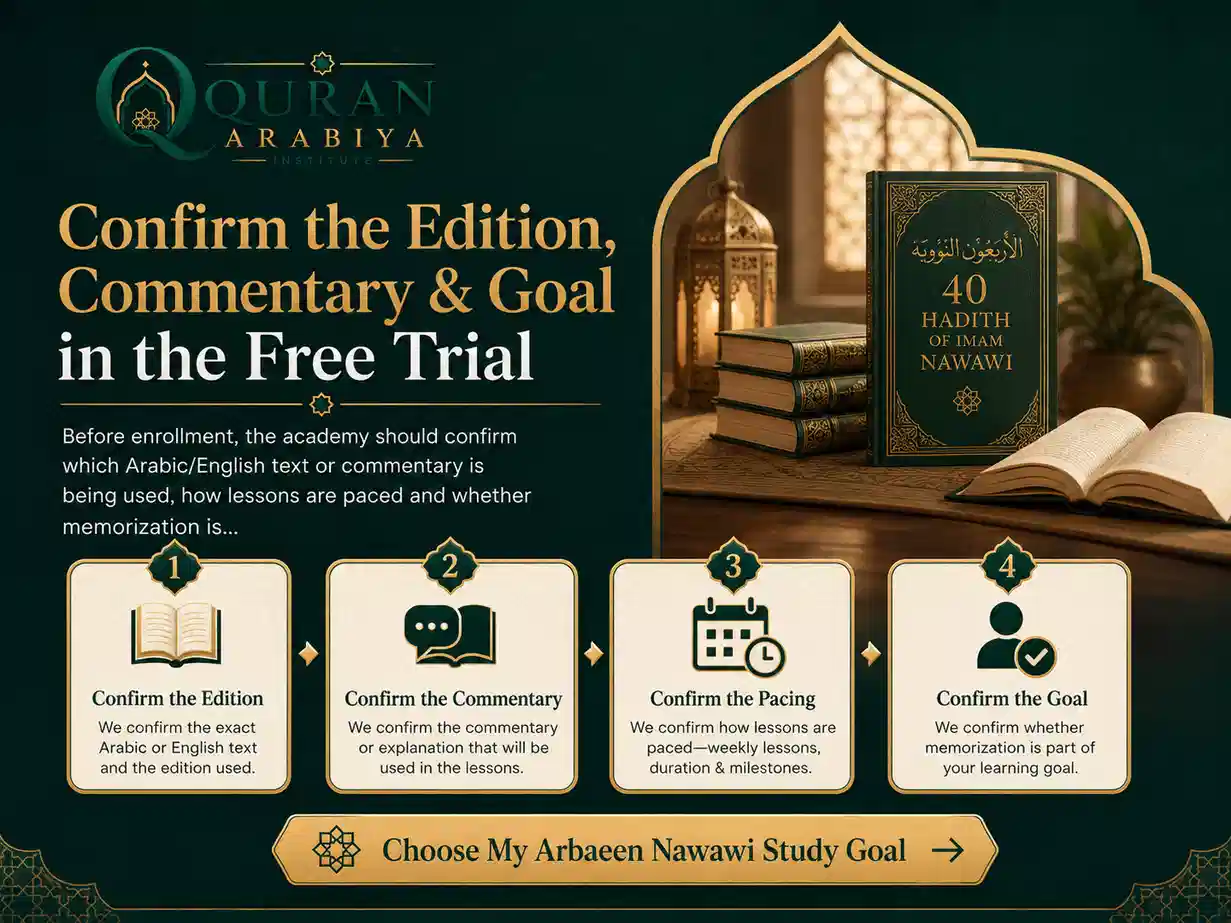
Before regular study begins, we confirm the teaching edition and commentary so you know which version of Imam Nawawi’s collection you will follow and how the lessons will be organized.
The collection is valued because individual narrations address major principles that connect to many areas of Muslim life. Studying them together gives the learner a compact reference set that can be revisited across Aqeedah, Fiqh, character and spiritual development.
This named-collection structure is what separates 40 Hadith explanation course intent from a broad Hadith Studies page.

The collection is valued because individual narrations address major principles that connect to many areas of Muslim life. Studying them together gives the learner a compact reference set that can be revisited across Aqeedah, Fiqh, character and spiritual development. The aim is to understand the principle clearly enough to recognize where it applies.
Each lesson can follow the same sequence: read the narration from the verified text, clarify translation and key Arabic terms, identify the central principle, add necessary context, then discuss a limited practical application.
A repeatable method reduces cognitive load and gives students a consistent notebook structure for review.
The learner should distinguish the course explanation from independent source authentication or personal interpretation. Guided study keeps evidence connected to scholarly scope.
Across the collection, learners encounter intention, Islam/Iman/Ihsan, lawful and unlawful matters, sincere advice, responsibility, character and other foundational themes. The teacher can show relationships between narrations instead of treating each as an isolated quote.
That thematic linking is one of the clearest ways to create value beyond a free translation of the text.

Across the collection, learners encounter intention, Islam/Iman/Ihsan, lawful and unlawful matters, sincere advice, responsibility, character and other foundational themes. The teacher can show relationships between narrations instead of treating each as an isolated quote. The aim is to understand the principle clearly enough to recognize where it applies.
A forty Hadith commentary course can become too dense if every narration becomes a long survey of scholarly literature. The teacher should choose explanation depth that serves the learner’s level while keeping the narration and its main principle visible.
Advanced commentary sources can be introduced when appropriate, but the commercial page should not pretend a beginner course covers every juristic or theological discussion attached to each Hadith.
Some students want to memorize the collection; others want understanding and review. The course can support memorization through short portions and recitation checks if the academy offers it, but memorization should not be silently assumed as the only definition of progress.
The trial can clarify whether the student wants commentary, memorization or both.
A useful checkpoint is to explain the idea in the learner’s own words, identify one example, and know when a deeper specialist course is the better next step.
A forty Hadith commentary course can become too dense if every narration becomes a long.
Sharh Arbaeen Nawawi online is named-text study. It does not need to become a full introduction to narrator criticism, terminology and Hadith classification methodology. Those concepts belong on the broader Hadith Studies course.
This content boundary protects both pages from cannibalization and gives learners a cleaner choice.
Before enrollment, the academy should confirm which Arabic/English text or commentary is being used, how lessons are paced and whether memorization is part of the learner’s personal plan.
This is also the moment to explain that the course teaches the collection and its meanings; any Ijazah or formal transmission route would require separate verified arrangements.
Understands major foundational principles represented in Imam Nawawi’s collection.
Can explain each studied Hadith beyond a one-line translation.
Builds a consistent commentary/review notebook.
Connects themes across narrations and to daily Muslim life responsibly.
Can choose whether to add memorization without confusing it with Hadith-science qualification.
Book a free trial to confirm the Arbaeen Nawawi edition, your desired commentary depth and whether you want understanding only or an added memorization plan.
The famous title is “Forty Hadith of Imam Nawawi,” but standard course/book presentations can include additional narrations. Quran Arabiya Institute should confirm the exact teaching edition before publishing a precise count.
No. It is a named-collection explanation/application course. General Hadith Studies owns introductory Hadith sciences.
Not necessarily. Memorization can be an optional learner goal if the academy supports it; understanding remains central.
That must be confirmed by the academy. The page should not copy a competitor’s commentary choice.
Do not assume so. Any Ijazah/transmission authorization must be separately verified with the specific teacher and route.
Teens/adults who want a compact, foundational Prophetic-teachings collection studied narration by narration with meaning and application.
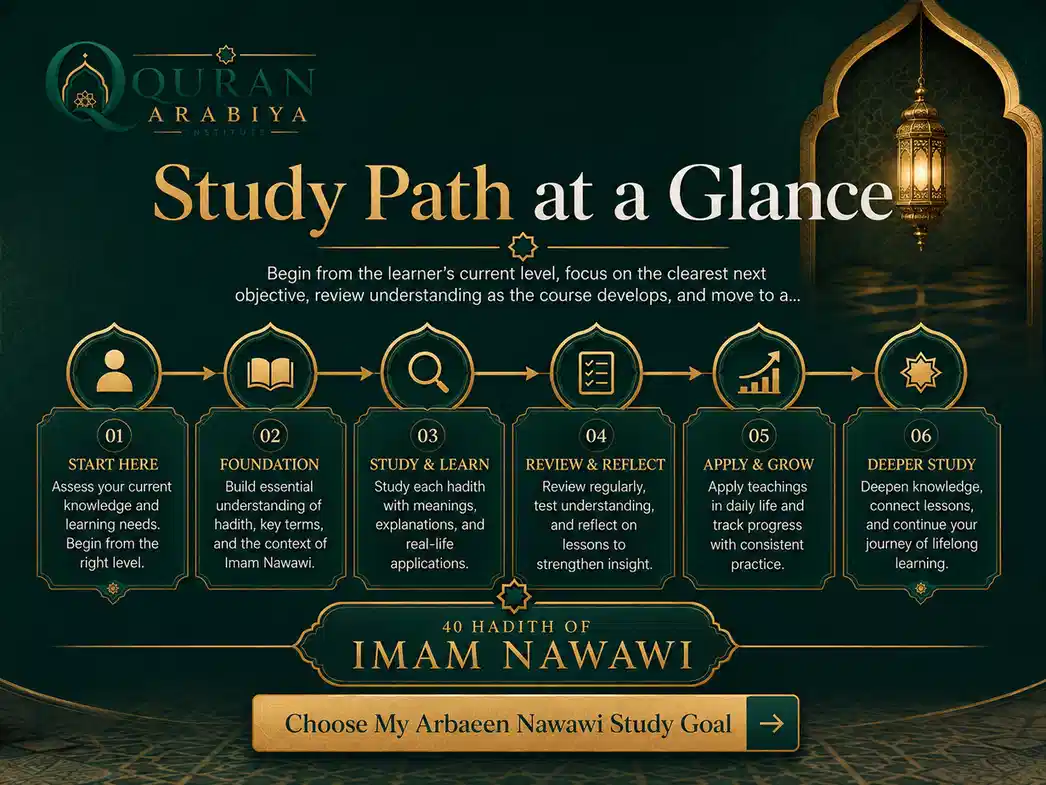
The learner does not need to repeat every introductory point automatically. The starting conversation can identify what is already stable, what is only familiar by name and which concept needs the first focused explanation or practice.
Private teaching lets the teacher adjust vocabulary, pace, examples and questioning without changing the academic goal. It also creates space to stop on a misunderstood concept, check it from another angle and continue only when the learner can explain it more independently.
The course can explain relevant evidence and terminology at the level required by the subject, while avoiding claims beyond the confirmed text, teacher or syllabus. High-trust topics remain guided study rather than independent fatwa, hadith grading or personal interpretation.
No. The course is educational and should keep its scholarly scope clear. Personal rulings, estate cases, legal/tax questions or independent authentication require the appropriately qualified person and the full facts of the real case.
The trial can identify current knowledge, goals, preferred depth and the most suitable route before regular enrollment. It is used as a placement and fit step, not as guaranteed certification, a fatwa session or a promise of fixed completion time.
Progress should be visible in understanding and application rather than chapters finished. A useful checkpoint is whether the learner can understands major foundational principles represented in imam nawawi’s collection. can explain each studied hadith beyond a one-line translation.
The next step should follow the skill or science that becomes dominant. Own 40 Hadith Nawawi, Arbaeen Nawawi course and commentary intent. General Hadith Studies remains the page for source terminology and broader Hadith-science foundations. Once that role has been fulfilled, the teacher can recommend the most relevant specialist route instead of expanding the course beyond its intended scope.
If you are considering 40 Hadith Nawawi course online, begin with the concept or study gap that matters most now. The free trial can clarify your current level, intended depth and best-fit route without inventing a certificate, fixed duration or specialist ruling that has not been verified.