A Stories of the Prophets course online should do more than retell memorable narratives. It should help the learner see how the Quran presents prophetic missions, recurring calls to Tawhid, different forms of trial, the response of communities and the lessons emphasized by revelation itself.
This course therefore treats Qasas Al Anbiya as guided Quranic study with source awareness. This course gives you a broad, story-based study of the Prophets while remaining separate from the Qasas An-Nabiyyin textbook pathway and the detailed Seerah route.
The Quran does not tell every story with the same amount of detail or for the same purpose. A Stories of the Prophets course online should therefore ask what the passage is teaching, which part of the story is emphasized, and how the same prophet may appear in more than one Surah with a different focus.
That approach makes Quran Prophets stories course content more meaningful. Students learn that the goal is not to reconstruct every missing detail, but to understand the faith, warning, mercy, perseverance, repentance or community response that the revelation itself highlights.
The Quran does not tell every story with the same amount of detail or for the same purpose. That approach makes Quran Prophets stories course content more meaningful. The aim is to connect the detail to its wider chronology and historical context.
Prophetic stories differ in setting, challenge and community, yet the call to worship Allah alone remains central. Comparing the stories helps a learner see unity of message without flattening each prophet into the same biography.
This gives a Qasas Al Anbiya course a strong spine: Who was addressed? What form did rejection take? How did the prophet respond? What did rescue, judgment, patience or repentance look like in that account?
The section should finish with one short recap in the learner’s own words so the new detail stays connected to the wider historical framework.
Nuh, Ibrahim, Yusuf, Musa, Yunus, Ayyub and other prophets face very different trials. A useful lesson does not end with 'be patient.' It asks what kind of patience was required, what action accompanied reliance on Allah, what mistakes a community made, and what changed after repentance or steadfastness.
This allows lives of Prophets in Islam course material to build moral reasoning rather than just memory. Older learners can compare themes across Surahs; younger learners can work with one clear decision and one practical takeaway at a time.
Nuh, Ibrahim, Yusuf, Musa, Yunus, Ayyub and other prophets face very different trials. This allows lives of Prophets in Islam course material to build moral reasoning rather than just memory. The aim is to connect the detail to its wider chronology and historical context.
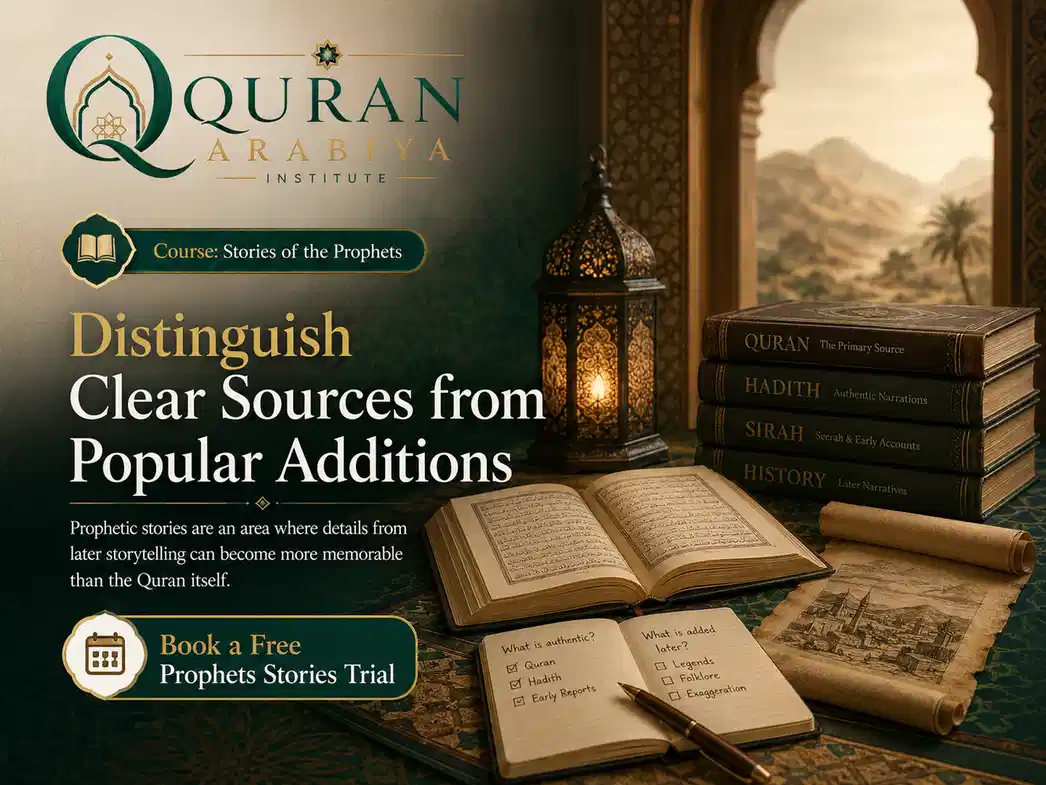
Prophetic stories are an area where details from later storytelling can become more memorable than the Quran itself. The teacher should identify what is directly established in the Quran, what is supported by authentic Hadith where relevant, and what should be left unasserted or labeled cautiously.
That source habit protects Islamic Prophets stories classes from becoming entertainment-first storytelling. It also prepares students for later Tafsir study, where the difference between text, explanation and unsupported detail matters.
Some learners benefit from a simple map, family relationship or sequence of prophets, but these tools should support the Quranic message rather than create false precision. Not every prophet's exact date or geographic route can be established with the same confidence.
A good course uses visual structure where it is helpful and honest: recurring peoples, regions that are well established, major relationships and the broad sequence needed to prevent confusion.
A useful study habit is to keep a short cause → event → consequence note. That makes chronology easier to remember without reducing history to dates.
Prophetic stories are an area where details from later storytelling can become more memorable than.

A child may need short narration, repeated names and a concrete question. A teen can discuss pressure, identity, truthfulness and peer response. An adult may compare interpretations, source details and thematic connections. The underlying story does not need to be rewritten into a different religion for each age.
One-to-one lessons can change vocabulary, pace and discussion depth while keeping the same source discipline. That makes it possible to learn stories of Prophets online as a family while still giving each learner an appropriate challenge.
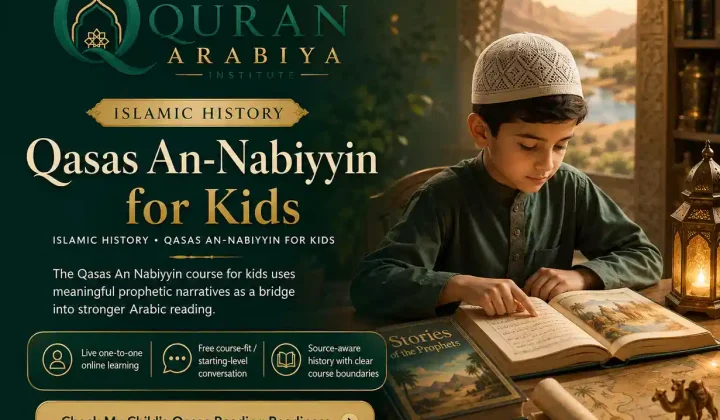
When the student's main interest becomes the detailed life of Prophet Muhammad ﷺ, the Seerah course is the better next page. When the goal becomes verse-by-verse meaning, Tafsir is more suitable. When a child wants to use a classical Arabic text to learn prophetic stories and build reading, Qasas An-Nabiyyin is the specialist route.
This routing keeps the broad Prophets page valuable without making it absorb every neighboring course.
Explain the central message and selected major events from studied prophetic stories.
Compare recurring themes such as Tawhid, patience, repentance, trust and response to revelation.
Distinguish Quranic content from later or weakly supported narrative additions at an appropriate level.
Retell studied stories in sequence without losing the main lesson in minor detail.
Recognize when Seerah, Tafsir or Qasas An-Nabiyyin is the better next specialist path.
Book a free trial and share the learner's age, previous knowledge and whether the goal is faith-building, family study, Quranic story comprehension or preparation for deeper Tafsir/Seerah study. The academy can then recommend the right depth and sequence.
No. This is a broad Stories of the Prophets route. Qasas An-Nabiyyin is a named classical text that can also support Arabic reading and vocabulary.
No. The language and discussion can be adapted for children, teens or adults. Older learners can study source questions, themes and cross-Surah connections in greater depth.
The exact syllabus should be confirmed with the academy. The page should not promise a fixed list unless it is approved; the course can select prophets and themes according to level and study goals.
The course should prioritize the Quran and reliable Prophetic reports, then clearly label or omit details that do not have a dependable basis.
Yes. It helps students recognize recurring Quranic narratives and themes, but detailed verse explanation belongs to a Tafsir course.
Children from a suitable comprehension level, teens, adults, families and new/returning learners who want a coherent overview of multiple prophets mentioned in Islamic sources.
The starting point does not have to be lesson one. In a live one-to-one setting, the teacher can identify what is already clear, locate the first real gap and adjust the depth without changing the course’s central historical focus.
Chronology is used as an organizing spine rather than a memorization target. Timelines, cause-and-consequence notes and short recaps help the learner explain how one event prepares the next and why a turning point matters.
The course should distinguish well-established chronology from interpretive or disputed details and avoid turning a debated reading into a marketing promise. Where the source document flags caution, the teacher can explain that difference rather than flatten it into certainty.
Arabic is not assumed as a universal prerequisite for this category. If a selected text, edition or reading route requires a particular language level, that should be confirmed during the course-fit conversation before regular study begins.
The academic focus stays intact while explanation, pacing and depth can change. One-to-one teaching allows the teacher to spend more time on names, relationships, maps, source questions or analytical discussion according to the learner’s age and prior study.
The conversation can clarify age, prior knowledge, preferred depth, learning goal and suitable scheduling before the route is chosen. It is a starting-level discussion, not a promise of a fixed syllabus length or certificate.
Progress should become visible in explanation, sequence and context rather than page count alone. A useful checkpoint is whether the learner can explain the central message and selected major events from studied prophetic stories. compare recurring themes such as tawhid, patience, repentance, trust and response to revelation.
If you are considering Stories of the Prophets course online, begin with the historical question you actually want answered and the depth you can sustain. The free trial can clarify your starting knowledge and route you into this course or a more specific sibling topic without turning disputed interpretation into a fixed promise.