

Knowing the alphabet is an important beginning, but it is not the same as reading. Many learners can name individual letters and still freeze when those letters change shape, connect, carry vowel marks, or appear inside a Quranic word. If you know Arabic letters but can’t read Quran text smoothly, the problem is usually a missing decoding skill rather than a lack of effort. This guide shows how to identify that gap, practise it directly, and know when you are ready to move from letter knowledge into independent Mushaf reading.
Why You Know Arabic Letters but Can’t Read Quran Words Yet
The main reason is that reading requires several skills to work together at once. You must recognize a letter in different positions, connect its visual form to the correct sound, notice Harakat and other signs, blend sounds without losing their order, and keep doing this across a full word. Knowing isolated letters proves only the first part of that process.
Arabic script adds a visual challenge because many letters change form by position and connection. Research on Arabic literacy also identifies letter knowledge, phonological processing, and orthographic processing as important contributors to word reading.
If you are still building these foundations, Learn to Read Quran Online targets letters, signs, joining, blending, and guided Quran reading. Quran Arabiya uses skill-based placement rather than assuming every learner should restart from page one.
If you can decode unfamiliar Quranic words but remain hesitant, the Quran Reading Fluency Course focuses on smoother Mushaf reading after basic decoding is already available.
For the broader beginner pathway, see how to start reading the Quran without knowing Arabic.
The Five Gaps That Usually Block Reading
A learner who “knows the letters” may have several different problems. Repeating the alphabet will not fix weak blending, and fluency drills will not fix unstable recognition.
| What happens when you read? | Likely gap | Best practice target |
|---|---|---|
| You know letters alone but miss them inside words | Connected-form recognition | Initial, medial, and final shapes |
| You read the letter but choose the wrong sound | Harakat recognition | Fatha, Kasra, Damma, Sukoon |
| You identify every part but cannot combine them | Blending | Two- and three-part decoding |
| You read familiar examples only | Memorized pattern dependence | New, mixed examples |
| You can decode but pause constantly | Fluency | Short phrases and unfamiliar passages |
1. Connected Letters Look Too Different

Arabic is cursive, and many letters change shape by position. A learner may identify ب alone yet hesitate when it appears inside a word. Some letters also break connection with what follows.
Practise isolated, initial, medial, and final forms, then mix similar-looking letters. The goal is quick recognition inside changing words. See how to join Arabic letters for Quran reading for this specific gap.
2. Harakat Are Not Automatic Yet
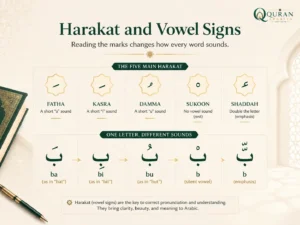
Quranic text uses vowel and reading signs extensively. Fatha, Kasra, Damma, Sukoon, Shaddah, and Tanween change what the reader produces, so recognizing the base letter alone is incomplete decoding.
Arabic-reading studies show that vowel marks can support accuracy, especially for less-skilled readers.
Practise signs in mixed combinations rather than a memorized order, so your eyes must identify each mark.
3. You Are Naming Letters Instead of Blending Sounds
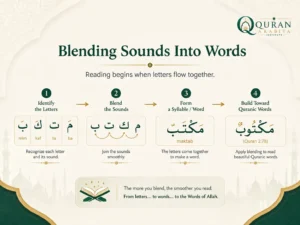
Another problem is reading a word as separate letter names. Quran reading requires blending the written sounds without restarting.
Start with short combinations and read slowly but continuously. If you lose the first sound before reaching the last, shorten the example. Add longer combinations only when accuracy stays stable.
4. Familiar Pages Are Hiding the Real Problem
Repetition helps, but it can become memorization. A learner may read one Qaida page or short surah smoothly yet struggle with a new line.
After practising a pattern, change the letters while keeping the rule. After a familiar passage, try an unfamiliar one. Real reading should transfer to new material.
5. Your Foundation Is Good, but Recognition Is Still Slow
Some learners decode correctly but recognize each unit slowly. The problem is then reading efficiency, not basic alphabet knowledge.
Research finds that orthographic, phonological, and morphological processing contribute to Arabic word-reading accuracy and fluency.
If decoding is accurate but every line feels heavy, read why Quran reading can remain slow and work on controlled fluency.
A Practical Fix: Rebuild the Skill in the Right Order
Use this sequence instead of jumping randomly between alphabet videos, Qaida pages, and full surahs.
- Test letter recognition in random order, not alphabetic order.
- Test connected forms inside short words.
- Add Fatha, Kasra, and Damma until recognition is immediate.
- Add Sukoon, Shaddah, Tanween, and long-vowel patterns gradually.
- Blend two-part combinations before longer words.
- Read unfamiliar examples to prove transfer.
- Move into short Quranic phrases.
- Increase continuity only after accuracy remains stable.
A teacher can identify where the chain first breaks. If isolated letters are secure but connected forms cause pauses, practise connected forms instead of repeating the whole alphabet.
How to Practise for 15 Minutes a Day
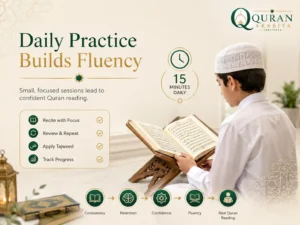
Give each minute a clear target: three minutes each for mixed letters, connected forms, one sign pattern, blending, and a fresh Quranic line.
Keep a short error list of recurring problems, such as confusing ث and ت or missing Shaddah, and review them first next time.
Parents should allow a brief self-correction attempt. If the mistake repeats, model it once, then test the same skill in a new example.
Use a New-Example Check
End every practice session with material the learner has not rehearsed. Keep the rule familiar but change the letters, word, or line. If the learner succeeds only on the original exercise, the skill is not yet independent. A fresh example separates real decoding from memory and shows whether tomorrow’s practice should repeat the same target or move forward.
What a Teacher Should Listen For
The most useful correction is specific. A teacher can notice whether hesitation starts before identifying the letter, after seeing the vowel sign, while joining sounds, or only when the line becomes longer. Correct that earliest failure first, then ask the learner to apply the correction in another example. This makes feedback measurable instead of turning the lesson into repeated prompting. Accuracy should remain the priority.
How to Know You Are Ready for the Quran
You do not need perfect speed before opening the Mushaf. You need stable basic letters, common connected forms, essential vowel signs, and simple blending.
Test unfamiliar material. If you can attempt a new word by decoding rather than guessing, you are moving beyond memorization. If prompts are still essential, continue foundation work and review when to move from Qaida to Quran.
Conclusion
Knowing letters without reading words means one decoding skill is still unstable, not that the alphabet study was useless. Find the first weak point—connected forms, vowel recognition, blending, transfer, or fluency—and practise it directly. Measure progress by what you can read independently in a new example, not by pages completed.
Frequently Asked Questions
Why do I know Arabic letters but still cannot read Quran?
Because alphabet recognition does not include connected forms, Harakat, blending, or automatic decoding. Test each skill separately to locate the break.
Is it normal to know Arabic letters but can’t read Quran words?
Yes. Beginners often learn isolated letters before connected forms and vowel signs. The next stage is decoding practice, not memorizing the alphabet again.
Should I restart Noorani Qaida from the beginning?
Not automatically. If letters are secure, begin at the first weak skill, such as connected forms, Harakat, Sukoon, Shaddah, or blending.
How can I practise joining Arabic letters?
Read one letter in several positions, then use short connected words. Mix examples so you learn the pattern rather than one page.
Why can I read familiar surahs but not new Quran pages?
You may be relying on memory. Test unfamiliar words and passages. If reading collapses, continue decoding and transfer practice.
Should I focus on Tajweed before I can read words?
Build reliable decoding while correcting essential pronunciation. Detailed Tajweed becomes more useful once you can read Quranic words without constant guessing.
How long should daily Quran reading practice be?
Fifteen focused minutes can be useful when practice targets specific weaknesses. Consistent short sessions are easier to sustain than unfocused long sessions.
What should a teacher correct first?
Correct the earliest recurring error. If a connected letter is misidentified, later fluency or Tajweed correction will not solve that foundation gap.
When should I work on Quran reading fluency?
Work on fluency after you can decode unfamiliar words accurately enough. If letters, Harakat, or blending remain unstable, foundation work comes first.
How do I know whether my problem is reading or pronunciation?
Decode very slowly. If you cannot identify the written sequence, the problem is reading. If you identify it but produce it inaccurately, focus on pronunciation.
References
- The Influence of Visual Attention on Letter Recognition and Reading Acquisition in Arabic
- Reading in Arabic Orthography: The Effect of Vowels and Context on Reading Accuracy
- MAWRID: A Model of Arabic Word Reading in Development
- What Predicts Word Reading in Arabic?
- Learning to Spell in Arabic: The Impact of Script-Specific Visual-Orthographic Features