Finishing the last page of a Qaida feels like a milestone, yet many learners open the Mushaf and suddenly read slower than they did a week earlier. Knowing when to move from Qaida to Quran is less about the page number you reached and more about which skills hold up on text you have never practiced. This guide gives you a five-minute readiness test, the seven signs teachers look for, a warning about script differences that catch many families off guard, and a simple seven-day plan for the first week in the Mushaf.
When to Move From Qaida to Quran: The Short Answer
Move when you can read an unfamiliar line of Quranic text slowly but accurately, without spelling every letter aloud and without a teacher correcting most words. Finishing the book is not enough. What matters is whether harakat, sukoon, shaddah, tanween and long vowels stay correct when the words are new.
A useful rule: if a short, unseen passage needs only one or two corrections, you are ready. If nearly every line needs help, stay in the Qaida a few more weeks and review the weak lessons. Learners who want structured review can use the Noorani Qaida Course Online, where a teacher checks each lesson before moving on.
Adults who already finished a Qaida but still feel shaky often need guided reading rather than another primer. The Learn to Read Quran Online course is designed for that bridge stage, where the goal is accurate reading from the Mushaf itself.
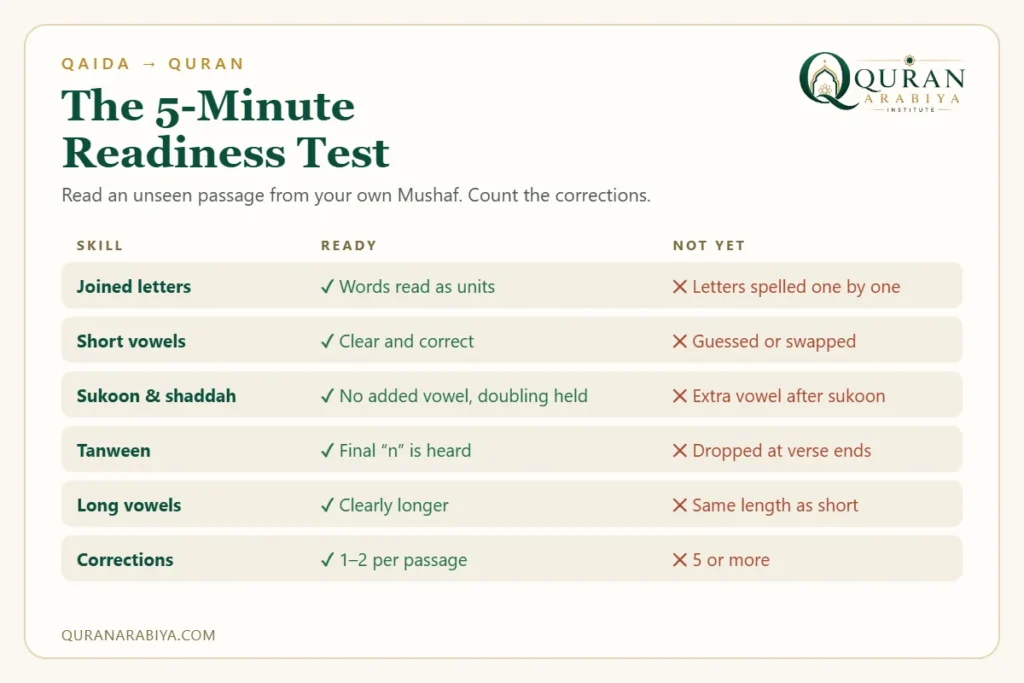
The 5-Minute Qaida-to-Quran Readiness Test
You can run this test at home with a parent, a friend or a teacher listening. Choose a passage the learner has not practiced, such as a few verses from Juz Amma, and read slowly from the same Mushaf you plan to use.
| Skill | How to test it | Ready if | Not yet if |
|---|---|---|---|
| Joined letters | Read 10 words with connected letters | Words are read as units | Each letter is spelled first |
| Short vowels | Read 2 unseen lines | Fatha, kasra and damma are clear | Vowels are guessed or swapped |
| Sukoon and shaddah | Point to 5 words with each mark | No extra vowel, doubled sound held | Vowels added after sukoon |
| Tanween | Read 5 verse endings | The final “n” sound is present | Tanween is dropped or read as a vowel |
| Long vowels | Find 5 madd letters | Clearly longer than short vowels | All vowels sound the same length |
| Stopping | Stop at the end of 3 verses | Final vowel handled calmly | Reader rushes into the next verse |
Count the corrections. One or two per passage is normal. Five or more usually means one specific skill needs review, and the table shows which one.
Seven Signs You Are Ready to Start Reading Quran
- You read joined words without breaking them into separate letters.
- You can see a word with a shaddah and pronounce the doubled consonant without being reminded.
- You do not add a vowel after sukoon.
- Tanween endings are audible instead of silent.
- Long vowels sound longer than short ones.
- You can read for ten minutes without losing focus.
- You notice and fix some of your own mistakes before anyone points them out.
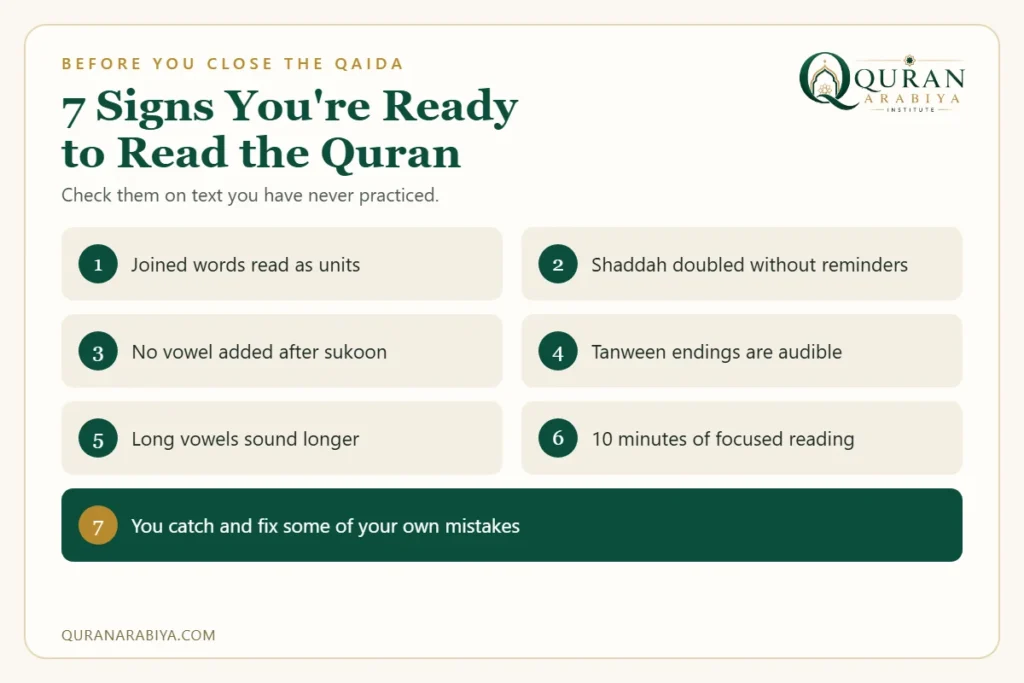
Self-correction is the most underrated sign. A learner who pauses and says “no, that is a kasra” is building the habit that matters most once the Qaida is closed.
Signs to Stay in the Qaida a Little Longer
Some learners can recite memorized surahs smoothly but cannot read new text. That gap is common, and our guide on why people know Arabic letters but can’t read Quran explains it in detail.
| Warning sign | What it usually means | What to review |
|---|---|---|
| Reading only familiar surahs | Memory is doing the work | Unseen practice lines |
| Adding vowels after silent letters | Sukoon is not secure | Sukoon, shaddah and tanween |
| Spelling every letter | Joining is not automatic | How to join Arabic letters |
| Freezing on long words | Decoding is too slow | Short daily drills |
Staying longer is not failure. A few more weeks of review saves months of frustration later.
The Script Surprise: Your Qaida and Your Mushaf May Not Match
Many families in the UK, USA and Canada learn from a Noorani Qaida printed in the South Asian (IndoPak) style, then open a Madinah Mushaf printed in the Uthmani style. The words are the same Quran, but the visual conventions differ, so a capable reader may suddenly hesitate.
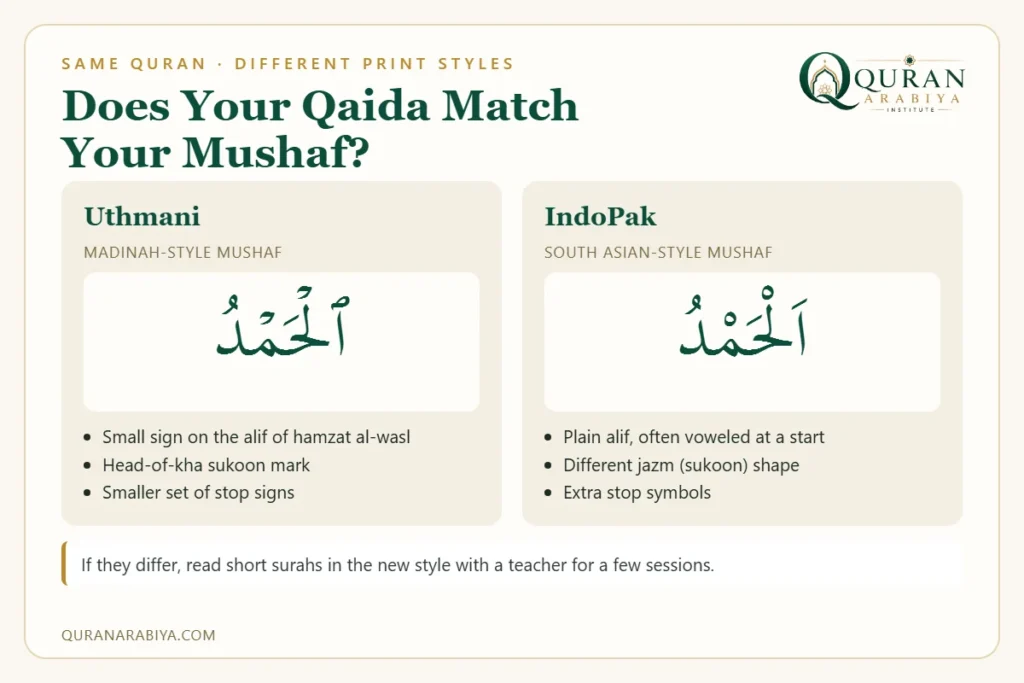
| Feature | Uthmani (Madinah style) | IndoPak style |
|---|---|---|
| Common use | Arab world and many printed editions | South Asia and South Asian communities |
| Hamzat al-wasl | Marked with a small sign on the alif (ٱ) | Usually written as a plain alif |
| Sukoon sign | A small head-of-kha mark; a small circle marks unpronounced letters | A different jazm shape; unpronounced letters are often left unmarked |
| Stop signs | A smaller set of symbols | Additional stop symbols |
| Letter style | Naskh-based lettering | Heavier, more compact lettering |
The fix is simple. Before moving, check which style your Qaida uses and which Mushaf you will read from. If they differ, spend a few sessions reading short surahs in the new script with a teacher, or choose a primer printed in the same style. Learners comparing primers may also look at the Noor Al Bayan Course Online or the Baghdadi Qaida Course Online.
A 7-Day Bridge Plan From Qaida to Mushaf
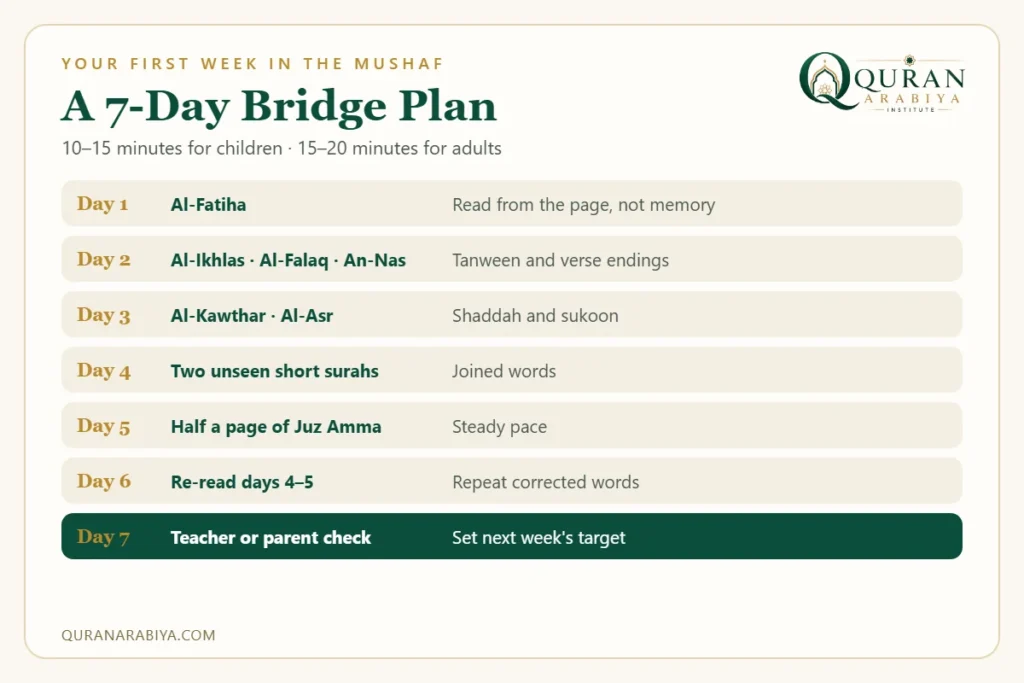
| Day | Read | Focus |
|---|---|---|
| 1 | Al-Fatiha | Reading from the page, not from memory |
| 2 | Al-Ikhlas, Al-Falaq, An-Nas | Tanween and verse endings |
| 3 | Al-Kawthar and Al-Asr | Shaddah and sukoon |
| 4 | Two unseen short surahs | Joined words |
| 5 | Half a page of Juz Amma | Steady pace |
| 6 | Re-read days 4–5 | Repeat corrected words |
| 7 | Teacher or parent check | Choose the next week’s target |
Keep sessions to 10–15 minutes for children and 15–20 minutes for adults. Some teachers continue through Juz Amma, while others begin from Surah Al-Baqarah; either can work if the reading is accurate and supervised.
Slow Reading Is Part of the Path
Many beginners feel embarrassed by slow reading. Allah instructs, “وَرَتِّلِ ٱلْقُرْءَانَ تَرْتِيلًا”, “and recite the Quran in a measured way” (Quran 73:4). Measured recitation is the goal, not speed.
The Prophet ﷺ also said, as narrated by Aisha, “الْمَاهِرُ بِالْقُرْآنِ مَعَ السَّفَرَةِ الْكِرَامِ الْبَرَرَةِ وَالَّذِي يَقْرَأُ الْقُرْآنَ وَيَتَتَعْتَعُ فِيهِ وَهُوَ عَلَيْهِ شَاقٌّ لَهُ أَجْرَانِ”, meaning the skilled reciter is with the noble angels, and the one who struggles will have two rewards (Sahih Muslim 798a). Hesitation in the first months is expected, and it is rewarded.
Children vs Adults: What Changes
Children usually need shorter sessions, more repetition and a parent sitting nearby. Adults tend to decode faster but carry pronunciation habits from English, so they benefit from careful correction of individual sounds. Both groups do better when the first weeks focus on accuracy rather than finishing pages. For the full beginner route, see how to start reading Quran without knowing Arabic.
Moving From Qaida to Quran in the US, Canada, the UK or Australia
Many children in English-speaking countries learn the Qaida in a weekend madrasa or Sunday school class that meets once or twice a week. That rhythm can carry a child through the letters, but the move into the mushaf usually needs more frequent, individual feedback. A short daily reading at home plus regular one-to-one correction tends to keep momentum better than waiting for the next weekly class. If your family mushaf uses a different script from the Qaida, show it to the teacher early so the bridge plan uses the same script. Learners in the USA, Canada, the UK and Australia can book live one-to-one lessons in their own time zone.
See how lessons work where you live:
- Online Quran classes in the USA
- Online Quran classes in Canada
- Online Quran classes in the UK
- Online Quran classes in Australia
Conclusion
The right moment to leave the Qaida is when your skills work on unfamiliar text, not when the last page is turned. Run the readiness test, check that your Qaida and Mushaf use the same script style, and give the first week a clear plan. If corrections stay low, keep going. If one skill keeps breaking, return to that lesson briefly, then try again.
Frequently Asked Questions
When to move from Qaida to Quran for a child?
Move when the child reads an unseen passage with only one or two corrections and can focus for about ten minutes. Age matters less than skill.
Do I need to finish the whole Qaida first?
Usually yes, because later lessons cover sukoon, shaddah and tanween. A teacher may skip review pages for a strong reader.
Should I start with Juz Amma or Surah Al-Baqarah?
Both approaches are used. Juz Amma offers short, familiar surahs, while starting at Al-Baqarah gives longer continuous practice.
What if my Qaida uses a different script from my Mushaf?
Spend a few sessions reading short surahs in the new script with guidance. The words are identical; only the visual conventions change.
How long does the transition usually take?
Most learners settle within a few weeks. Struggling with one specific mark can extend this.
Should I learn Tajweed rules before reading the Quran?
No. Basic decoding comes first. Tajweed rules are easier to learn once you read accurately.
Is it normal to read slower in the Mushaf than in the Qaida?
Yes. Mushaf pages are denser and less predictable. Speed returns with steady practice.
Can adults move faster than children?
Often, yes. Adults decode quickly but may need extra work on sounds that do not exist in English.
Can I make the move without a teacher?
You can practice alone, but a listener catches mistakes you cannot hear yourself, especially in the first weeks.
What should parents listen for during home practice?
Listen for added vowels after sukoon, missing tanween, and long vowels that sound short. Correct one issue at a time.