Many learners feel stuck at the same point: they can name Arabic letters correctly, yet the Mushaf still feels unreadable. If you know Arabic letters but can’t read Quran, the problem usually is not intelligence or effort. It is that letter recognition alone is only one small part of Quran reading. You still need joining, vowel signs, blending, and guided practice. If you need a structured foundation, Learn to Read Quran Online is helpful for rebuilding from the basics. If your main issue is hesitating on words and lines, the Quran Reading Fluency Course can support the move from slow decoding to smoother recitation.
Why You Know Arabic Letters but Can’t Read Quran
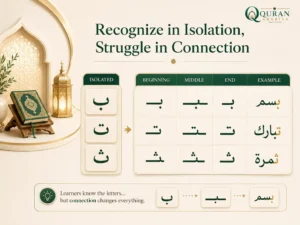
Knowing letters in isolation is not the same as reading them inside real Quranic words. A learner may recognize ب, ت, and ث on a chart, then freeze when those same letters appear connected in a word with harakat, sukoon, or shaddah. That gap is normal. It means you learned names and shapes, but not yet the full reading system.
Another issue is that many beginners practice in alphabet order only. They become comfortable saying letters from memory, but reading requires instant recognition in unfamiliar order. The Quran also adds stopping signs, dense line structure, and visual pressure, so weak decoding becomes obvious very quickly.
Allah says, “وَرَتِّلِ الْقُرْآنَ تَرْتِيلًا” (Quran.com — Al-Muzzammil 73:4). Measured recitation starts with accuracy, not speed.
The Most Common Reasons This Happens
Usually, one of a few missing skills is blocking progress. The table below shows the most common pattern.
| What you notice | Likely missing skill | What to do next |
|---|---|---|
| You know letters alone but not in words | Joined forms | Practice connected letters in short words |
| You can read some words but miss endings | Harakat and sukoon | Review short vowels and silent endings |
| You guess instead of reading | Blending | Decode one letter at a time, then join |
| You read very slowly | Lack of repetition on real text | Practice short Quran lines daily |
| You read from transliteration only | Weak Arabic-script recognition | Stop relying on Latin letters |
In teaching, the biggest misunderstanding is this: “I know the alphabet, so I should already be able to read.” In reality, alphabet recognition is the first step, not the finish line.
Joined Letters Are Often the Real Missing Skill
Arabic letters change shape depending on where they appear in a word. A learner who only studied isolated forms may not immediately recognize beginning, middle, or ending forms. The Open University explains that Arabic uses connected writing, and many letters have different positional forms. That is why word reading feels harder than alphabet drills. (OpenLearn — Joining letters)
If this is your main difficulty, spend time on connected reading before moving deeper into the Mushaf. A practical next step is How to Join Arabic Letters for Quran Reading: A Beginner’s Practical Guide, which focuses directly on joining rather than restarting everything from zero.
Harakat, Sukoon, and Shaddah Change Everything
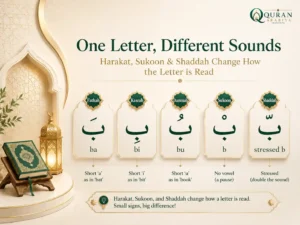
Many learners can spot the letters but do not fully control the reading signs above and below them. In Quranic Arabic, short vowels are written clearly, and they change how a letter sounds. The Quranic Arabic Corpus notes that the Quranic script is fully vowelized, which is one reason Quran reading requires careful attention to diacritics. (Quranic Arabic Corpus — Documentation)
For example, بَ is not the same as بِ, and بْ is different from both. Shaddah also changes timing and emphasis. When a student repeatedly “knows the word” but says it incorrectly, a teacher often discovers that the real issue is not the letter itself but a missed sign.
How a Teacher Diagnoses the Problem
A good teacher does more than listen for mistakes. The teacher identifies where the reading process breaks. Does the learner hesitate before the first letter? Lose track when the letters connect? Ignore the vowel mark? Drop the sukoon? Guess the ending from memory? Each mistake points to a different fix.
This is why random repetition is less effective than targeted correction. If you want the broader pathway, How to Start Reading Quran Without Knowing Arabic: A Beginner’s Step-by-Step Guide explains the overall learning order, while this article focuses on the specific gap between letter knowledge and actual Quran reading.
How to Fix It Step by Step
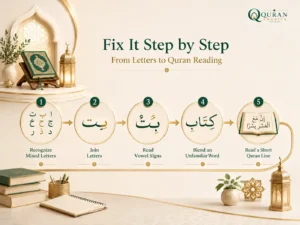
First, test yourself on mixed isolated letters, not alphabet order. Second, read connected pairs and short three-letter combinations. Third, review fatha, kasra, damma, sukoon, and shaddah until they become automatic. Fourth, decode unfamiliar words slowly instead of guessing. Fifth, read very short Quran lines and accept correction immediately.
A simple drill works well: look, sound out, join, repeat. Do that on unfamiliar examples, not only memorized pages. The Prophet ﷺ said that the one who recites the Quran and finds it difficult still receives a double reward (Sahih Muslim 798a). Difficulty is part of the journey, not proof that you cannot learn.
What to Practice at Home

Keep practice short and specific. Spend five minutes on connected forms, five on harakat, and five on one or two unfamiliar Quranic lines. Mark recurring mistakes instead of reading aimlessly. If the same problem keeps returning, isolate it and drill that point only.
Parents helping children at home should keep correction simple. Ask the child to point to each letter, read the sign, then blend the word aloud during practice. Correct one mistake at a time. Too many interruptions can confuse beginners and make them rely on guessing again.
It also helps to stop reading through transliteration. Transliteration may feel comforting, but it often delays direct recognition of Arabic script. If you are unsure whether you are ready to leave the primer stage, read when to move from Qaida to Quran for clear signs. And if you already read but feel unreasonably slow, this guide on why your Quran reading is slow can help you identify the next bottleneck.
Conclusion
If you know Arabic letters but can’t read Quran, you are probably missing one or more connecting skills, not starting from nothing. Most learners need stronger joined-form recognition, better control of harakat and reading signs, and more guided blending on unfamiliar words. Work in that order, practice on small pieces, and treat mistakes as clues. Once the real gap is identified, progress usually becomes much faster and much less frustrating.
Frequently Asked Questions
Know Arabic letters but can’t read Quran: what should you practice first?
Because recognizing isolated letters is the first step. You also need joined forms, signs, blending, and practice on unfamiliar words.
Is this problem common for beginners?
Yes. Many beginners can recite the alphabet but struggle when letters appear connected inside Quranic words.
Should I restart from the alphabet?
Only if isolated recognition is weak. If you already know the letters, focus on joining, harakat, and decoding instead.
What should I practice first?
Start with connected letter forms, then short vowels and sukoon, then short Quran words and lines.
Can I fix this without a teacher?
You can improve alone, but a teacher helps you find the exact problem faster and prevents repeated mistakes.
How long does it take to start reading words comfortably?
That depends on consistency, but many learners improve noticeably once they practice the missing skill daily instead of repeating random pages.
Is transliteration helpful?
Only for limited support. Long-term dependence usually weakens direct Arabic-script recognition.
How do I know if I am ready for the Mushaf?
You are ready when you can read short unfamiliar words with their vowel signs and need fewer prompts.
Why do I read one page well but fail on another?
Often because the first page was memorized visually, while the second page tests real decoding.
Which course is better for this kind of learner?
Choose a foundation course if your issue is basic decoding, and a fluency-focused course if you can read but still hesitate heavily.