Learning isolated Arabic letters is only the first step toward reading connected Quranic text. The next challenge is recognizing what happens when those letters sit beside one another, change shape, or stop a connection. If you are learning how to join Arabic letters for Quran reading, you need more than a chart: you need to see the joining pattern, read it aloud, and transfer it into unfamiliar words. This guide explains positional forms, the six common non-connecting letters, practical drills, typical mistakes, and when joining practice should become real Quran reading.
How to Join Arabic Letters for Quran Reading
Arabic is a cursive script, so most letters connect to neighboring letters and may appear in isolated, initial, medial, or final forms. Joining does not create a new letter or sound; it changes the written shape according to position. Beginners improve when they compare forms, then recognize them inside short combinations instead of memorizing four separate alphabets. (W3C)
If individual letters still feel uncertain, the Arabic Alphabet for Quran Reading course focuses on recognition, sounds, positional forms, Harakat, joining patterns, and early blending. Quran Arabiya’s official course page treats connected-form recognition as part of the alphabet foundation. (Quran Arabiya Institute)
Learners who already recognize letters but need a broader route from symbols to words and Mushaf reading can use Learn to Read Quran Online. Its published pathway separates recognition, sound, blending, and transfer so a learner can begin at the first unstable skill. (Quran Arabiya Institute)
For the wider beginner sequence, read How to Start Reading Quran Without Knowing Arabic.
Understand the Four Arabic Letter Forms
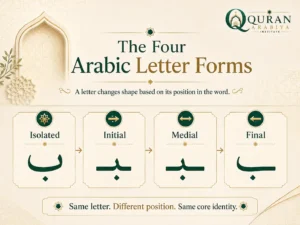
A letter’s position affects how it looks. The W3C describes four joining forms: isolated when a letter joins neither side, initial when it joins the following letter, medial when it joins both sides, and final when it joins the preceding letter. Not every letter has all four usable forms because joining behavior differs. (W3C)
| Position | What it means | Example with ب |
|---|---|---|
| Isolated | No connection on either side | ب |
| Initial | Starts a connected segment | بـ |
| Medial | Connected on both sides | ـبـ |
| Final | Ends a connected segment | ـب |
Ask, “What part of the letter stays recognizable while the connectors change?” Research on Arabic literacy shows that positional variants are a meaningful visual feature of the script, and incorrect forms can slow or disrupt word recognition. (PubMed Central (PMC))
A Quick Connected-Form Recognition Test
Choose one familiar letter and find it in three positions inside short words. Cover the isolated chart while you read. If you can name the letter despite its changed connectors, recognition is becoming flexible. If you hesitate, compare the forms again, then retest with different neighboring letters rather than repeating the same example.
Learn the Six Letters That Break the Connection
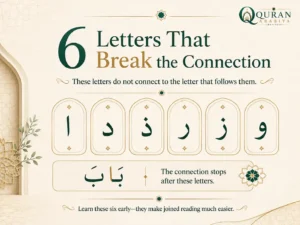
A useful shortcut is learning the letters that do not connect to the letter that follows them: ا، د، ذ، ر، ز، و. They may connect to a preceding letter when spelling allows, but they do not continue the joining stroke forward. Research likewise identifies six Arabic letters that do not connect to the following letter. (PubMed Central (PMC))
Consider بَاب. The first ب reaches the ا, but the ا does not connect forward to the final ب. The word therefore contains a visual break even though it remains one word.
Practise these six as a group. Put one between familiar letters and ask, “Does the chain continue after this letter?” This decision is more useful than memorizing a long chart without reading examples.
Read Connected Shapes Before Adding Speed
Start with two-letter combinations, then three-letter combinations, then short fully vocalized words. Your first goal is stable recognition: identify the underlying letters, notice where a connection stops, and attach the correct sounds.
- Read isolated letters in mixed order.
- Match letters to initial, medial, and final appearances.
- Join two letters that connect normally.
- Insert ا، د، ذ، ر، ز، or و and identify the break.
- Add Harakat and read aloud.
- Test the same rule in a new word.
If letters seem familiar alone but disappear inside words, review Know Arabic Letters but Can’t Read Quran? before increasing difficulty.
Add Harakat After the Joining Pattern Is Clear
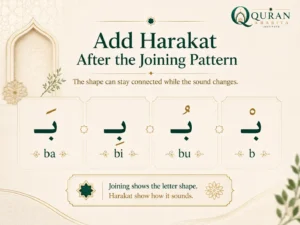
Joining answers, “Which letter is this and where does it connect?” Harakat answer, “How is it read here?” Keeping those jobs distinct reduces guessing. Arabic short vowels and other diacritical signs add information above or below the consonantal skeleton, increasing visual demands on beginning readers. (PubMed Central (PMC))
For example, بـ can appear as بَـ، بِـ، بُـ. The joining shape remains recognizable while the vowel changes the syllable. Practise one variable at a time, then mix them.
If short vowels are unstable, use Arabic Harakat for Beginners. When Sukoon, Shaddah, and Tanween become the next obstacle, continue with Sukoon Shaddah Tanween.
Common Joining Mistakes and How to Correct Them
Most errors come from recognition, direction, or overgeneralization. A teacher should identify the earliest point where reading breaks.
| Common mistake | Likely cause | Correction |
|---|---|---|
| Treating a connected form as a new letter | Isolated forms were learned alone | Compare one letter across positions |
| Joining after ا، د، ذ، ر، ز، و | Assuming every letter connects | Drill the six connection breakers |
| Reading left to right | Direction is not automatic | Track short words right to left |
| Losing dots | Attention follows only the main stroke | Contrast ب، ت، ث and similar families |
| Guessing familiar words | Memory replaces decoding | Use fresh combinations |
| Rushing | Speed masks errors | Return to accurate decoding |
Arabic has many visually similar letters distinguished by dots, while positional changes create additional variants. These features place real demands on visual attention and orthographic processing. (PubMed Central (PMC))
A 10-Minute Joining Practice Routine

Spend two minutes recognizing positional forms, two on non-connecting letters, two blending with Harakat, two reading unfamiliar short words, and two correcting missed items.
Keep a brief error list. If you repeatedly confuse ـهـ with ه or forget that ر breaks the connection, make that feature tomorrow’s first drill. Parents can point to one letter inside different words and allow a few seconds for self-correction before giving the answer.
When to Move From Joining Drills to Quran Words
Move forward when you can identify connected forms in unfamiliar examples, notice a connection break without prompting, and read simple vowelled combinations with fewer pauses. You do not need perfect speed; you need a joining system that still works when the example changes.
Then practise short Quranic words and controlled phrases with correction. Research on Arabic word reading shows that orthographic and phonological processing both contribute to accurate, fluent reading. (PubMed Central (PMC))
Conclusion
Learning connected Arabic becomes manageable when you stop treating every positional form as a separate symbol. Recognize the stable letter, learn the six connection breakers, add Harakat after the visual pattern is clear, and test new combinations. Once unfamiliar joined forms are reasonably accurate, move into short Quranic words so the skill becomes reading rather than chart study.
Frequently Asked Questions
Why do Arabic letters change shape inside words?
Arabic is cursive, so a letter’s form reflects whether it connects to neighboring letters. Its identity remains the same.
How many forms can an Arabic letter have?
A letter may have isolated, initial, medial, and final forms, but some letters cannot connect in every direction and therefore use fewer joining forms.
Which Arabic letters do not connect to the next letter?
The common six are ا، د، ذ، ر، ز، and و. They stop the joining stroke before the following letter.
Do I need to memorize every connected form?
You need to recognize them, but a large chart is not the only method. Compare forms, then practise them inside short combinations and words.
How do I practice how to join Arabic letters for Quran reading?
Start with two-letter combinations, add three-letter combinations, practise the six non-connectors, then add Harakat and test unfamiliar vowelled words.
Is joining letters the same as Tajweed?
No. Joining is mainly script decoding. Tajweed covers rules of Quranic recitation and pronunciation, so detailed Tajweed study usually comes after basic reading is usable.
Why can I read isolated letters but not connected words?
Your recognition may depend on the isolated shape. Practise each letter in initial, medial, and final positions until it stays recognizable inside words.
Should beginners write joined letters or only read them?
Reading is the main Quran-decoding goal, but simple writing can help some learners notice where connections begin and end.
When should I start reading from the Mushaf?
Start guided Mushaf reading when basic letters, common connected forms, main Harakat, and simple blending are stable enough for unfamiliar words.
Can children learn joining rules online?
Yes. Live instruction can show forms, hear the child read, isolate recurring mistakes, and test each correction with a new example.
References
- Open University — Introduction to Arabic: Joining Letters
- W3C — Arabic & Persian Layout Requirements: Joining Forms
- The Influence of Visual Attention on Letter Recognition and Reading Acquisition in Arabic
- Learning to Spell in Arabic: The Impact of Script-Specific Visual-Orthographic Features
- What Predicts Word Reading in Arabic?