An Islamic Golden Age course online should move beyond lists of famous names and claims that one civilization simply "invented everything." This course studies the conditions that allowed knowledge to flourish: translation, libraries and courts, education, trade, urban life, scholarly networks, instruments, texts and the interaction of people from different ethnic and religious backgrounds.
The result is a broader Islamic civilization Golden Age course that can examine mathematics, medicine, optics, astronomy, literature, art and institutions while still asking careful historical questions about evidence, transmission, regional diversity and the many ways scholars built on earlier knowledge and produced new work.
An Islamic Golden Age course online should begin with the conditions that make knowledge possible: cities, libraries, patrons, schools, hospitals, paper, trade, translation networks, scholars and communities that value learning. Famous discoveries make more sense when the learner can see the institutions and problems around them.
This approach avoids the weakness of many Muslim Golden Age history pages, where ten names and ten inventions are listed without explaining how scholarship actually moved from one generation or region to another.
A careful Muslim scholars and inventions history section should replace unsupported "first ever" lists with case studies that show the problem a scholar addressed, the method or text involved, what was genuinely new and how knowledge later travelled or changed.
An Islamic Golden Age course online should begin with the conditions that make knowledge possible. Famous discoveries make more sense when the learner can see the institutions and problems around them. The aim is to connect the detail to its wider chronology and historical context.
Scholars working in Arabic engaged with Greek, Persian, Indian and other knowledge traditions. Translation was followed by commentary, criticism, correction, synthesis and original investigation. The story is therefore more than 'Muslims preserved Greek books for Europe.'
A history of Islamic science and culture course can show how knowledge changed when it entered new languages, institutions and practical problems.
The section should finish with one short recap in the learner’s own words so the new detail stays connected to the wider historical framework.
The intellectual life of classical Islamic civilization included Arabs, Persians, Central Asians and others, and scholars from Muslim, Christian, Jewish and other communities. Arabic often functioned as a major scholarly language even when the scholar was not ethnically Arab.
This distinction makes classical Islamic civilization course content more accurate and more interesting: civilization is a network of people and institutions, not an ethnic invention list.
The intellectual life of classical Islamic civilization included Arabs, Persians, Central Asians and others, and scholars from Muslim, Christian, Jewish and other communities. Arabic often functioned as a major scholarly language even when the scholar was not ethnically Arab. The aim is to connect the detail to its wider chronology and historical context.
Instead of claiming hundreds of inventions, the course can investigate a few well-supported cases. Al-Khwarizmi helps explain algebraic and computational traditions; Ibn al-Haytham provides a window into optics and experimentation; medical authors and hospitals show clinical learning; astronomers reveal the relationship between observation, instruments, calendars and practical religious needs.
Each case study should answer three questions: What problem was being addressed? What earlier knowledge was available? What did the scholar or institution add, change or systematize?
Islamic civilization Golden Age course content should not imply that civilization equals STEM. Literature, philosophy, theology, law, art, architecture, book culture, education and urban life all shaped the period and interacted with scientific work.
Museums and surviving manuscripts/objects can help learners see material culture alongside written intellectual history.
A useful study habit is to keep a short cause → event → consequence note. That makes chronology easier to remember without reducing history to dates.
Instead of claiming hundreds of inventions, the course can investigate a few well-supported cases.
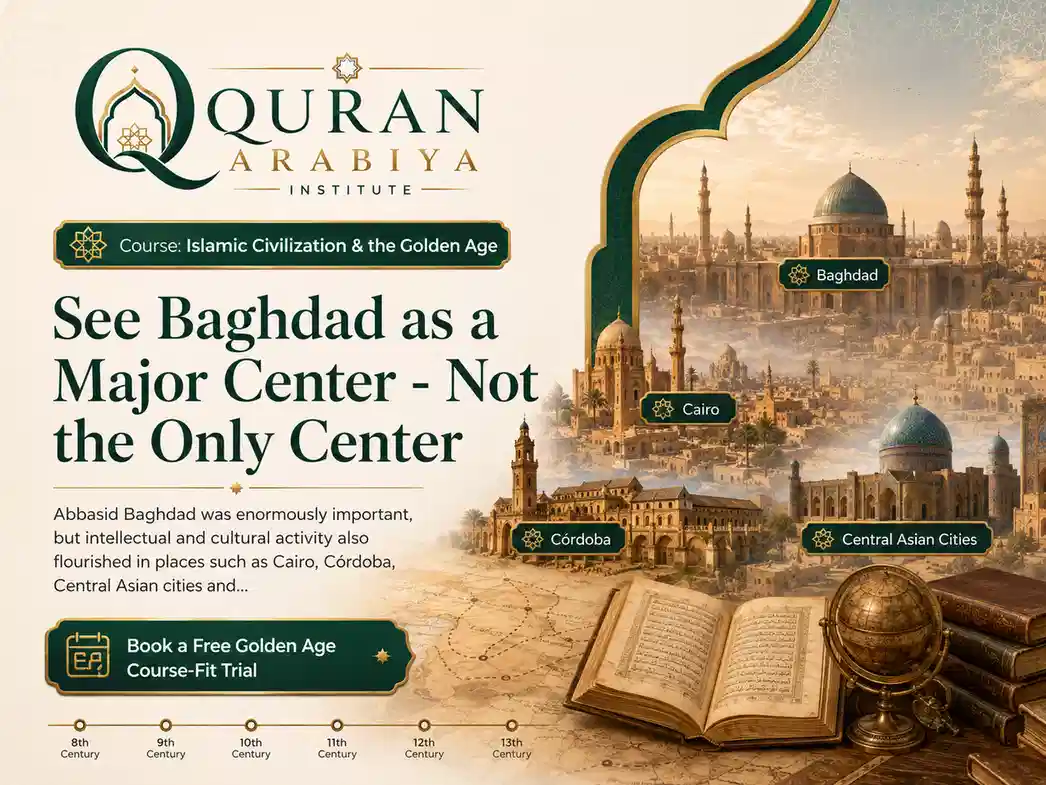
Abbasid Baghdad was enormously important, but intellectual and cultural activity also flourished in places such as Cairo, Córdoba, Central Asian cities and other regional centers at different times. The exact geography changes across centuries.
This keeps Muslim Golden Age history from becoming identical to Abbasid political history and helps the learner appreciate a wider network of Islamic civilization.
Texts, methods and instruments moved across languages and regions, including into Latin-reading Europe. The course can study these pathways carefully without claiming that one civilization single-handedly created the modern world.
Specific transmission stories are stronger than slogans. A student should be able to name a text, method, institution or translation path and explain the connection with appropriate caution.
Texts, methods and instruments moved across languages and regions, including into Latin-reading Europe. The course can study these pathways carefully without claiming that one civilization single-handedly created the modern world. The aim is to connect the detail to its wider chronology and historical context.
There is no single universally agreed date when intellectual life suddenly stopped. The 1258 sack of Baghdad is a major political rupture, but scholarship continued in many regions. Historians use different periodizations depending on the field and geography.
The course can therefore discuss change, fragmentation, new centers and long-term continuities instead of teaching a myth of instant decline.
Explain the institutional and social conditions that supported scholarship in classical Islamic civilization.
Describe translation, adaptation and original research as connected stages of knowledge production.
Discuss selected case studies in mathematics, medicine, optics, astronomy or related fields with source-aware language.
Recognize the multiethnic, multireligious and multi-regional character of the scholarly world.
Distinguish Golden Age intellectual/cultural history from Abbasid political chronology.
Discuss influence and decline without relying on exaggerated invention lists or one-date narratives.
Book a free trial and tell the academy whether your strongest interest is science, medicine, mathematics, scholars, art/culture or the wider civilizational story. The teacher can then recommend the right case-study depth and whether Abbasid political history should come first.
The term is a modern period label and its boundaries vary by historian and field. Many introductions emphasize roughly the 8th to 13th centuries, especially the Abbasid-era flourishing, but the course should explain that intellectual activity continued beyond a single cutoff date.
No. It covers institutions, translation, scholarship, science, medicine, mathematics, culture, cities and exchange. Claims about inventions should be specific and sourced.
They overlap strongly, especially around Baghdad, but they are not identical. The Golden Age page focuses on intellectual and cultural history across a wider Islamic civilization; Abbasid History focuses on dynasty, governance and political change.
No. The scholarly ecosystem was ethnically and religiously diverse. Arabic was a major language of scholarship, but contributors came from many backgrounds.
Yes where specific transmission can be explained responsibly. The course should avoid sweeping claims that cannot be tied to identifiable texts, translations, people or institutions.
Teens and adults interested in Muslim intellectual history, families seeking heritage education, and learners who know famous names such as al-Khwarizmi or Ibn al-Haytham but want a more accurate connected picture.
The starting point does not have to be lesson one. In a live one-to-one setting, the teacher can identify what is already clear, locate the first real gap and adjust the depth without changing the course’s central historical focus.
Chronology is used as an organizing spine rather than a memorization target. Timelines, cause-and-consequence notes and short recaps help the learner explain how one event prepares the next and why a turning point matters.
The course should distinguish well-established chronology from interpretive or disputed details and avoid turning a debated reading into a marketing promise. Where the source document flags caution, the teacher can explain that difference rather than flatten it into certainty.
Arabic is not assumed as a universal prerequisite for this category. If a selected text, edition or reading route requires a particular language level, that should be confirmed during the course-fit conversation before regular study begins.
The academic focus stays intact while explanation, pacing and depth can change. One-to-one teaching allows the teacher to spend more time on names, relationships, maps, source questions or analytical discussion according to the learner’s age and prior study.
The conversation can clarify age, prior knowledge, preferred depth, learning goal and suitable scheduling before the route is chosen. It is a starting-level discussion, not a promise of a fixed syllabus length or certificate.
Progress should become visible in explanation, sequence and context rather than page count alone. A useful checkpoint is whether the learner can explain the institutional and social conditions that supported scholarship in classical islamic civilization. describe translation, adaptation and original research as connected stages of knowledge production.
The next step depends on the intent this page deliberately does not absorb. Avoid ‘Muslims invented everything’ lists, false first-in-history claims, a single fixed Golden Age date range presented as universally agreed, and treating all contributors as Arab Muslims. Keep dynasty chronology brief and link to Abbasid. The teacher can use the final lessons to identify the most logical sibling course instead of stretching this page beyond its purpose.
If you are considering Islamic Golden Age course online, begin with the historical question you actually want answered and the depth you can sustain. The free trial can clarify your starting knowledge and route you into this course or a more specific sibling topic without turning disputed interpretation into a fixed promise.