The Umayyad Caliphate course online focuses on the Damascus-based dynasty that followed the Rashidun period, examining how a new political order formed, expanded and governed an increasingly diverse territory. Students study rulers and major events, but also administration, reform, social tensions, opposition and the conditions that eventually enabled the Abbasid Revolution.
This is a focused Umayyad history course rather than a compressed history of all Islam. The Rashidun transition is used only as necessary context, while the Abbasid story is reserved for its own specialist page.
An Umayyad Caliphate course online should not begin with a disconnected list of rulers. Students first need the transition: the later Rashidun crisis, Mu'awiya's position in Syria, the end of Ali's caliphate, Hasan's agreement and the emergence of a new political order centered in Damascus.
That bridge is enough to orient the learner; detailed Rashidun conflict belongs to the Rightly Guided Caliphs course. The Umayyad page owns what happens after the dynasty becomes the central political structure.
Students searching for the history of Umayyad dynasty or a Banu Umayyah course usually need both chronology and explanation: who held power, how institutions changed, where expansion occurred, what tensions developed and why the dynasty eventually lost the central caliphate.

An Umayyad Caliphate course online should not begin with a disconnected list of rulers. Students first need the transition: the later Rashidun crisis, Mu'awiya's position in Syria, the end of Ali's caliphate, Hasan's agreement and the. The aim is to connect the detail to its wider chronology and historical context.
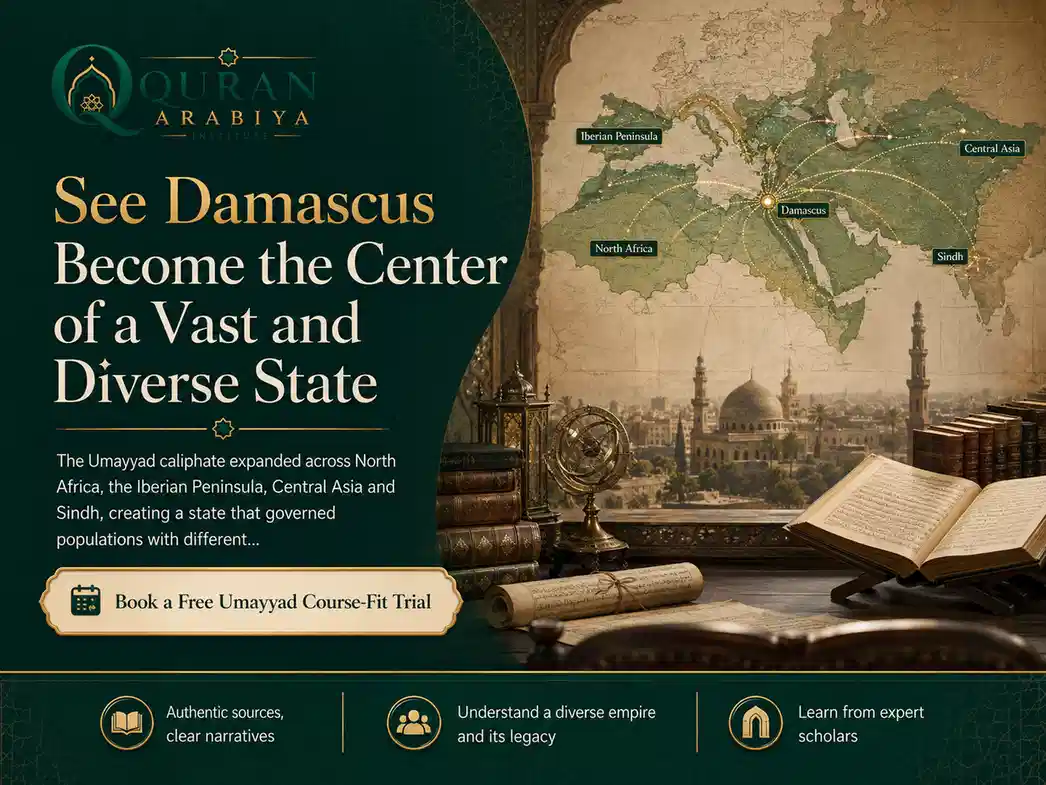
The Umayyad caliphate expanded across North Africa, the Iberian Peninsula, Central Asia and Sindh, creating a state that governed populations with different languages, religions and administrative traditions. A map is essential, but expansion is only the beginning of the question.
The deeper issue is how a Damascus-centered government tried to communicate, collect revenue, appoint officials and maintain authority across that scale.
The visual organizer is there to reduce cognitive load, not to replace explanation. Places become useful when the learner can explain why location changed the story.
The reign of Abd al-Malik provides a useful case study in centralization. Historical scholarship highlights administrative Arabization and coinage reform as part of a wider process through which the caliphate developed more distinct institutions and symbols.
Rather than memorizing reform dates, students can ask what problem each reform addressed and how language, currency and administration helped a large state operate.
The reign of Abd al-Malik provides a useful case study in centralization. Historical scholarship highlights administrative Arabization and coinage reform as part of a wider process through which the caliphate developed more distinct institutions. The aim is to connect the detail to its wider chronology and historical context.
History of the Umayyad dynasty is also the history of Arab tribal politics, non-Arab Muslim converts, Christian and Jewish communities, provincial elites, soldiers, scholars and urban populations. Social tensions did not have one simple cause and should not be reduced to a single slogan.
The teacher can introduce concepts such as mawali, regional rivalry and opposition movements at a level appropriate to the learner, showing how political and social pressures interacted.
The dynasty faced serious challenges, including the Second Fitna and later opposition from different political and religious groups. These events are sensitive and are interpreted differently across sources and Muslim traditions.
A responsible Umayyad history course explains chronology first, avoids sensationalism and distinguishes a documented event from a claim about motives.
The section should finish with one short recap in the learner’s own words so the new detail stays connected to the wider historical framework.
History of the Umayyad dynasty is also the history of Arab tribal politics.
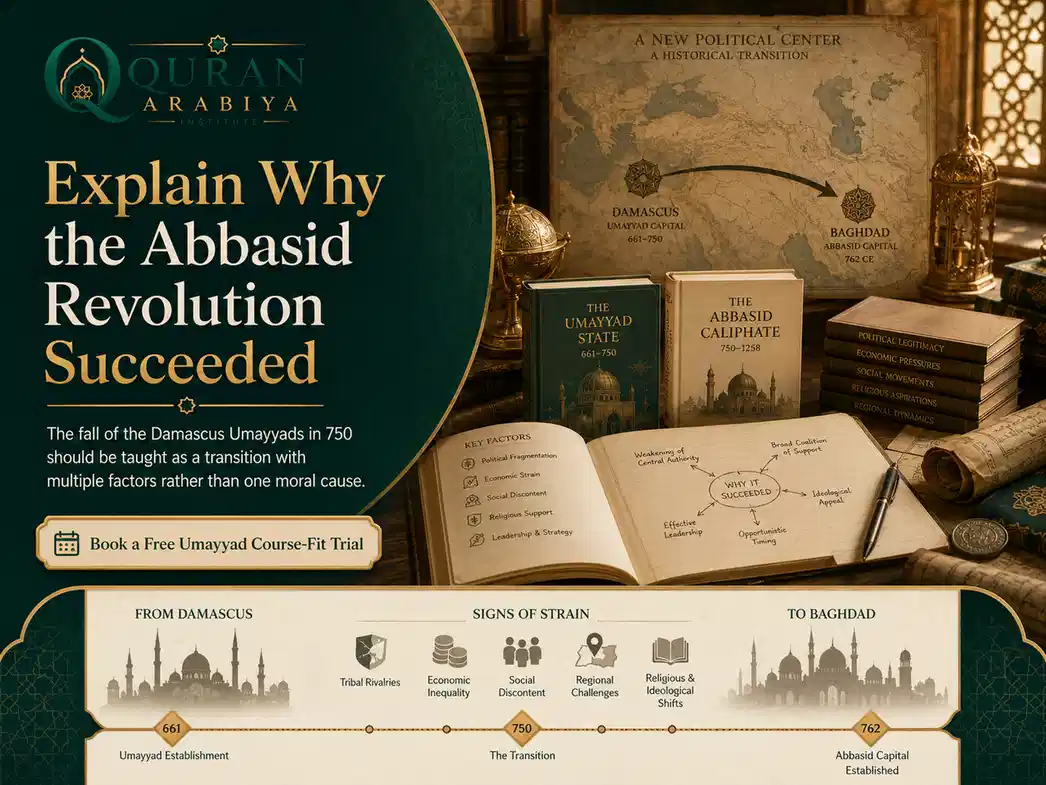
The fall of the Damascus Umayyads in 750 should be taught as a transition with multiple factors rather than one moral cause. Regional support, political opposition, social grievances, dynastic weakness and Abbasid organization can all be examined according to the approved syllabus.
The lesson ends by showing what changes when power shifts east toward Iraq. The Abbasid course then takes over rather than being summarized in detail here.
After the Abbasid overthrow, an Umayyad survivor established rule in al-Andalus, where the dynasty later developed its own emirate and caliphate. This continuation matters because it explains why 'Umayyad' appears in both Syrian and Spanish history.
The page should be clear that the Spanish Umayyads are a later polity, not the uninterrupted continuation of the Damascus caliphate as the same state.
Learners who want to learn Umayyad history online should leave the course able to distinguish the Damascus caliphate from the later Umayyad polity in al-Andalus, while still understanding why the western continuation matters to the dynasty's longer legacy.

Explain how Umayyad rule emerged from the end of the Rashidun period.
Locate the main geographic expansion and understand why scale created administrative challenges.
Describe selected state-building reforms, including language/administrative and coinage changes under Abd al-Malik.
Discuss major social and political tensions without reducing them to a single cause.
Explain the Abbasid transition and distinguish Damascus Umayyads from the later Umayyads of al-Andalus.
Book a free trial and explain whether your interest is political history, expansion, governance, contested early-Islamic events or the transition to Abbasid rule. The academy can recommend whether to start here or first build the Rashidun/beginner timeline.
The core specialist focus is the Damascus-based Umayyad Caliphate, conventionally dated 661-750 CE. The later Umayyads in al-Andalus can be introduced as a legacy/continuation rather than treated as the same state.
No. A strong course also studies governance, administration, social diversity, opposition, succession and the transition to Abbasid rule.
It is helpful because the Umayyad story grows directly out of the later Rashidun period, but the teacher can provide a concise bridge if needed.
Yes where relevant, using respectful, source-aware framing that separates chronology from later interpretation.
Abbasid History is the direct dynastic continuation, while the full Islamic history course can place both inside a wider timeline.
Teens and adults with basic early-Islamic chronology who want a dynasty-level deep dive rather than the full history of Islam.
The starting point does not have to be lesson one. In a live one-to-one setting, the teacher can identify what is already clear, locate the first real gap and adjust the depth without changing the course’s central historical focus.
Chronology is used as an organizing spine rather than a memorization target. Timelines, cause-and-consequence notes and short recaps help the learner explain how one event prepares the next and why a turning point matters.
The course should distinguish well-established chronology from interpretive or disputed details and avoid turning a debated reading into a marketing promise. Where the source document flags caution, the teacher can explain that difference rather than flatten it into certainty.
Arabic is not assumed as a universal prerequisite for this category. If a selected text, edition or reading route requires a particular language level, that should be confirmed during the course-fit conversation before regular study begins.
The academic focus stays intact while explanation, pacing and depth can change. One-to-one teaching allows the teacher to spend more time on names, relationships, maps, source questions or analytical discussion according to the learner’s age and prior study.
The conversation can clarify age, prior knowledge, preferred depth, learning goal and suitable scheduling before the route is chosen. It is a starting-level discussion, not a promise of a fixed syllabus length or certificate.
Progress should become visible in explanation, sequence and context rather than page count alone. A useful checkpoint is whether the learner can explain how umayyad rule emerged from the end of the rashidun period. locate the main geographic expansion and understand why scale created administrative challenges.
The next step depends on the intent this page deliberately does not absorb. Do not retell the Rashidun period or full Abbasid story. Avoid treating the dynasty as uniformly good or bad. Distinguish Umayyad Damascus (661-750) from the later Umayyad polity in al-Andalus. The teacher can use the final lessons to identify the most logical sibling course instead of stretching this page beyond its purpose.
If you are considering Umayyad Caliphate course online, begin with the historical question you actually want answered and the depth you can sustain. The free trial can clarify your starting knowledge and route you into this course or a more specific sibling topic without turning disputed interpretation into a fixed promise.