A Quranic Arabic grammar course becomes valuable when grammar stops being a list of labels and starts explaining what is happening inside an ayah. This course focuses on the relationships that make Quranic sentences work: subjects and predicates, verbs and their dependents, attached pronouns, particles, case relationships, phrase structure and the signals that connect one part of a sentence to another.
It is designed as a Quran grammar course online for learners who want disciplined language analysis without turning every lesson into a complete formal I'rab of an entire passage. The goal is to understand the rule, see it operating in Quranic context and then recognize it again elsewhere.
Vocabulary tells you what a word can mean; Nahw for Quran understanding asks what job that word is performing in this sentence. Is it a subject, predicate, object, adjective, possessed noun, complement or part of a larger clause? What governs it, and what does it govern?
This shift is fundamental. A learner may know every dictionary gloss in a short ayah and still misunderstand the relationship between the words. Grammar gives a structured way to test those relationships instead of guessing from translation.

Vocabulary tells you what a word can mean; Nahw for Quran understanding asks what job that word is performing in. Is it a subject, predicate, object, adjective, possessed noun, complement or part of a larger clause? The aim is to make the analysis repeatable in a fresh Arabic example rather than leave the rule as terminology remembered in isolation.
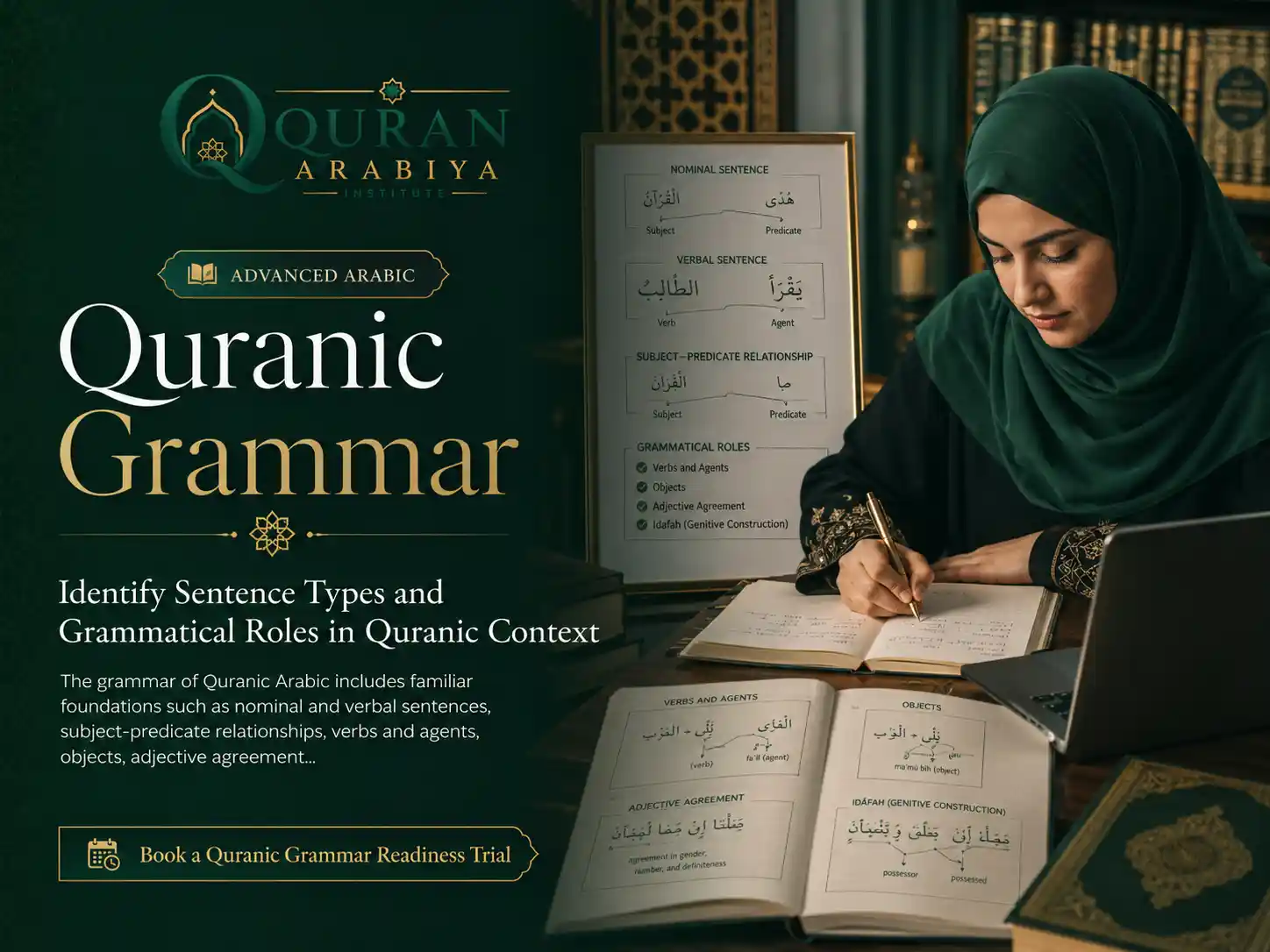
The grammar of Quranic Arabic includes familiar foundations such as nominal and verbal sentences, subject-predicate relationships, verbs and agents, objects, adjective agreement, idafah and different kinds of dependent elements. The course introduces these as analytical tools rather than isolated definitions.
Each concept should be tied to several Quranic examples. The learner first identifies the structure with guidance, explains why the role fits and then attempts a fresh example where the surface wording is different but the grammatical relationship is the same.
A useful check is whether the learner can explain the relationship, test it on a fresh example and correct the reasoning when the first analysis fails. That is stronger evidence than recalling the rule name alone.
The Arabic grammar of Quran verses often becomes clearer when the learner notices small but powerful signals: an ending that marks a role, an attached pronoun that points backward, or a particle that changes the grammatical state or mood of what follows.
The course trains students to slow down around these signals. Rather than merely reciting marfu', mansub or majrur, the learner should connect the marker to the syntactic reason behind it. Detailed word-by-word parsing is reserved for the dedicated I'rab course, but role awareness begins here.
The course trains students to slow down around these signals. Rather than merely reciting marfu', mansub or majrur, the learner should connect the marker to the syntactic reason behind. The aim is to make the analysis repeatable in a fresh Arabic example rather than leave the rule as terminology remembered in isolation.
A Quranic syntax course should help learners look beyond the English expectation of fixed word order. Arabic can foreground or delay elements, omit information understood from context and connect clauses in ways that become clearer only after the grammatical dependencies are identified.
Students compare related constructions and ask what changes when an element moves, a pronoun replaces a noun, a clause becomes subordinate or a particle enters. The aim is not to make rhetorical claims from grammar alone, but to see sentence architecture accurately.
A rule learned from one famous example can feel familiar without becoming transferable. For that reason, each major grammar point should return across different ayat and contexts. The learner has to locate the pattern again, explain what is constant and notice what has changed.
This produces a stronger kind of memory than memorizing a definition. Over time, the student begins to recognize a construction before the teacher names it.
A useful check is whether the learner can explain the relationship, test it on a fresh example and correct the reasoning when the first analysis fails. That is stronger evidence than recalling the rule name alone.

A rule learned from one famous example can feel familiar without becoming transferable. For that reason, each major grammar point should return across different ayat and contexts. The aim is to make the analysis repeatable in a fresh Arabic example rather than leave the rule as terminology remembered in isolation.
Beginners in analysis often try to label every letter and every ending immediately. A better sequence is layered: identify the main sentence, locate the core verb or subject-predicate relationship, attach obvious dependents, track pronouns and particles, then examine finer grammatical detail.
Layering reduces overload and makes mistakes easier to diagnose. It also creates a bridge to advanced I'rab, where the same logic can be expanded into a complete grammatical parse.
The technical term matters only if it helps the learner read more accurately. After analyzing a construction, the student should return to the phrase and ask what the grammar clarified: who is acting, what belongs to what, which idea is qualified, where a condition begins or how two clauses relate.
This keeps the subject connected to comprehension. It also prevents grammar from being confused with Tafsir; grammatical analysis can constrain and illuminate language, while wider interpretation requires additional knowledge.

The free trial can test whether you are ready for this level of analysis. A teacher may ask you to identify basic word classes, read a short Quranic phrase, locate a simple nominal or verbal relationship, recognize common pronouns or explain what a familiar particle is doing.
If those tasks are still difficult, the recommendation may be to begin with the broader Quranic Arabic or Arabic Grammar course. If they are comfortable, Quranic Grammar can start at the first point that adds real analytical depth.
What Progress Should Look Like
Identify common nominal and verbal structures in Quranic examples.
Explain the grammatical role of major sentence elements instead of relying only on translation.
Track common attached pronouns, particles and case relationships more reliably.
Apply a known grammar rule to a Quranic example that was not memorized in advance.
Know when to move from conceptual grammar study to the more intensive I'rab course.
Start With a Free Trial & Placement Lesson
Book a free trial to show the teacher what you can already do, where the current bottleneck is and what you want the course to unlock. The trial can be used as a real placement and learning sample: you participate in a short task, receive correction, and leave with a clearer recommendation for the next step rather than being forced into a fixed starting point.
Book a free trial to show the teacher what you can already do, where the current bottleneck is and what you want the course to unlock. The trial can be used as a real placement and learning sample: you participate in a short task, receive correction, and leave with a clearer recommendation for the next step rather than being forced into a fixed starting point.
Frequently Asked Questions
Quranic Arabic is the broader language-comprehension route, including vocabulary, expressions and essential grammar. Quranic Grammar concentrates on syntax, grammatical roles and relationships.
This course teaches and practices Quranic grammar concepts across selected examples. The I’rab course is an applied parsing program built around sustained grammatical analysis of 20 selected Surahs.
Some foundation is helpful. The free trial can determine whether your current Arabic and grammar awareness are sufficient or whether a broader foundation should come first.
No. Grammar helps explain language structure and can support understanding, but Tafsir addresses context, interpretation and wider meanings that grammar alone cannot establish.
No single course page should promise that. The focus is the grammar most useful for analyzing Quranic sentences, with more general or advanced classical grammar available in the dedicated Nahw, Sarf and text-based courses.
Teens and adults with basic Quranic Arabic or Fusha foundations who want to understand how grammatical roles, particles, pronouns, endings and sentence relationships shape Quranic language.
That does not automatically mean you need to restart from the beginning. The free trial can test reading comfort, sentence awareness and the prerequisite skill most relevant to this course, then route you to a foundation course only when the gap would block useful advanced study.
Traditional terminology matters because it gives the learner a precise analytical language, but memorizing labels is not the final test. The stronger outcome is being able to recognize the construction, explain why the term applies and use the same reasoning on a new example.
Examples can be selected where they support the stated language objective, but the page keeps its scope clear. Quranic language analysis is not presented as Tafsir, and a named-text course does not assume an unverified commentary, edition or fixed reading list.
It allows the teacher to see the exact step where analysis breaks down: vocabulary, form recognition, grammatical relation, parsing, rhetorical reasoning or reading stamina. The lesson can then spend time on that bottleneck and test it again in a fresh example before moving on.
The trial can check readiness, prior study, goals and the most useful starting point for this specific subject. It does not guarantee a certificate, fixed syllabus length, particular book edition or teacher qualification that has not been independently confirmed.
Progress should show up in analysis and transfer, not page count alone. A useful checkpoint is whether the learner can use the main skill with increasing independence.
If you are considering Quranic Arabic grammar course, begin with the analytical skill that is currently breaking down: form, sentence relation, parsing, rhetoric or reading transfer. The free trial can check readiness and route the learner without inventing an edition, commentary, certificate or fixed advanced outcome that has not been verified.