If you cannot speak or understand Arabic, you can still learn to read the Quran in its Arabic script. The key is separating reading from language comprehension. Reading starts with recognizing letters, attaching the right sounds, joining them into words, and following the vowel and recitation signs found in the Mushaf. This guide explains how to start reading Quran without knowing Arabic, what to learn first, when correction matters, and how to move from slow decoding toward steady recitation without turning the process into a full Arabic course.
Can You Read the Quran Without Understanding Arabic?
Yes. Reading Quranic Arabic and understanding Arabic are related but separate skills. A beginner can identify written letters, pronounce their sounds, follow vowel marks, and blend words before studying vocabulary or grammar. Many non-Arabic-speaking Muslims therefore begin with script reading and later add Arabic study for meaning as a separate learning goal.
Al-Muzzammil 73:4 directs the Prophet ﷺ to recite the Quran in a measured way. A beginner should therefore value control before speed. If understanding is also your goal, read a reliable translation alongside practice, then use Which Arabic Should I Learn? A Goal-Based Roadmap for Beginners to choose a suitable Arabic-learning path.
how to start reading Quran without knowing Arabic: the right learning order
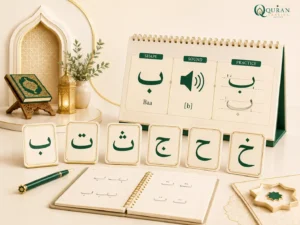
The most efficient order is letters, sounds, connected forms, vowel marks, simple blending, Quranic signs, short passages, and then fluency. Skipping ahead often creates guessing, while staying too long on isolated letters delays transfer. Move forward when the current skill works on unfamiliar examples rather than only on exercises you have memorized.
| Stage | What You Learn | Ready to Move On When |
|---|---|---|
| 1 | Letter shapes and sounds | You recognize letters outside alphabet order |
| 2 | Connected forms | You identify letters inside words |
| 3 | Harakat and signs | You read simple sound combinations independently |
| 4 | Joined words | You blend unfamiliar short words accurately |
| 5 | Mushaf reading | You attempt short Quranic lines with fewer guesses |
| 6 | Fluency and Tajweed | Decoding is usable while accuracy stays stable |
For complete beginners, Learn to Read Quran Online builds recognition, sound, blending, and transfer into Quranic text through live one-to-one practice. Learners who already decode but remain hesitant may fit the Quran Reading Fluency Course better because it targets smoother Mushaf reading after the foundation is usable.
Step 1: Learn Arabic Letters as Shapes and Sounds
Start by recognizing each letter visually and hearing its basic sound. Do not depend only on alphabet order; practice mixed letters so recognition becomes independent. Give extra attention to similar shapes, such as ب ت ث or ج ح خ, and to sounds that do not have an exact English equivalent.
Arabic is written from right to left, and many letters change appearance inside words. The Open University explains that Arabic is a cursive script and that letters may have independent, initial, medial, and final forms. If letters are easy but words still feel impossible, see Know Arabic Letters but Can’t Read Quran? Why It Happens and How to Fix It.
Step 2: Learn Joined Forms and the Main Reading Signs
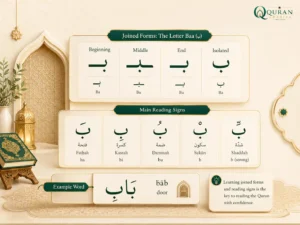
Once individual letters are stable, practice seeing them inside words. A familiar letter may look different when connected, so use short combinations first and vary the examples. This prevents memory from replacing decoding and trains your eyes to recognize the same letter across different positions while you read.
Then learn fatha, kasra, damma, sukoon, shaddah, and tanween. The Quranic Arabic Corpus notes that Quranic text is explicitly vowelized with diacritic marks, unlike ordinary Modern Standard Arabic writing where short vowels are often omitted. For focused blending practice, use How to Join Arabic Letters for Quran Reading: A Beginner’s Practical Guide.
Step 3: Practice Decoding Before You Chase Fluency
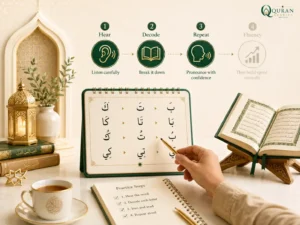
A beginner should be able to read a new combination, not only repeat a familiar page. Practice one pattern, receive correction, then test the same rule on a different word. If you can reproduce it independently, the skill is transferring. If you can read only after hearing the answer, memory may be replacing decoding.
A teacher can identify whether the real problem is letter recognition, sound production, joining, a missed vowel mark, or hesitation. Correcting that bottleneck is more useful than simply “practicing more.” Keep daily practice short and specific: one target, several examples, immediate correction, then one unfamiliar test.
Step 4: Move From a Qaida or Primer Into the Mushaf Gradually
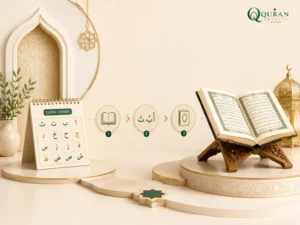
A Qaida or beginner primer reduces visual complexity so patterns can be learned in a controlled order. Finishing one, however, does not automatically make every Mushaf page easy. Quranic pages contain denser text, longer forms, stopping signs, and less predictable sequencing than the graded exercises used during foundation study.
Transition with short lines. Preview one difficult pattern, attempt the line yourself, receive limited correction, then try a similar unfamiliar line. The aim is reducing prompts. If you are unsure about readiness, read When to Move From Qaida to Quran: Signs You’re Ready to Start Reading.
Step 5: Build Accuracy, Then Fluency, Then Deeper Tajweed
Fluency means fewer unnecessary pauses while preserving letters and signs. It does not mean racing. Repeat short phrases enough to reduce hesitation, then test the same skill on unfamiliar text. If pace increases but vowels disappear or letters change, slow down, correct the pattern, and only then rebuild continuity.
The Prophet Muhammad ﷺ taught that the person who recites the Quran while finding it difficult receives two rewards. Difficulty is not a reason to stop. Once decoding becomes reliable, study What Is Tajweed? A Beginner’s Guide to Correct Quran Recitation for the next layer of recitation accuracy.
A Simple Weekly Practice Routine for Beginners
Use a routine small enough to repeat consistently. On each practice day, review one known skill, work on one current pattern, read a short unfamiliar example, and finish with a Quranic passage using what you practiced.
- Day 1: letter recognition and difficult sounds
- Day 2: connected forms and short vowels
- Day 3: sukoon, shaddah, tanween, or another sign
- Day 4: short-word blending
- Day 5: guided Mushaf reading and correction
- Weekend: light review and one fresh passage
Track recurring errors because they reveal your next target. For realistic expectations, read How Long Does It Take to Learn to Read Quran? A Realistic Beginner Timeline.
Reading the Quran and Understanding It Are Two Different Goals
You do not need conversational Arabic before learning Quran reading. Script decoding is one skill; vocabulary, grammar, and comprehension are another. Studying both is valuable, but combining everything at once can overwhelm a complete beginner.
Memorization is separate too. You may memorize short surahs while reading develops, but memory should not hide weak decoding. For hifz alongside reading, use How to Start Memorizing Quran: A Practical First 30 Days.
Conclusion
You can begin Quran reading without already knowing Arabic as a language. Build the skill in order: letters, sounds, connected forms, reading signs, unfamiliar words, guided Mushaf passages, and then fluency. Use translation for meaning, Arabic study for comprehension, and a teacher when recurring errors persist. Your next step is to identify the first unstable skill and practice until it works independently.
Frequently Asked Questions
Can I learn how to start reading Quran without knowing Arabic as an adult?
Yes. Adults can start from zero with letters, sounds, connected forms, vowel marks, and blending. The presentation may differ, but the core skills are the same.
Do I need Arabic grammar before reading the Quran?
No. Grammar supports understanding, not basic decoding. Learn Quranic Arabic reading first, then add grammar for comprehension.
Should I start with Noorani Qaida or another primer?
A structured primer can help, but choose according to your gap. Some learners need a full foundation; others need joining, signs, or Mushaf transfer.
How much should a beginner practice each day?
Use a short sustainable session. Review one old skill, practice one current target, then finish with an unfamiliar example.
Can I learn Quran reading only from videos or apps?
They support recognition and listening, but may miss personal errors. Live correction helps when the same mistake returns.
When should I start Tajweed?
Learn correct letter sounds and basic accuracy first. Study deeper Tajweed after decoding becomes stable enough for additional rules.
What if I know the letters but cannot join them?
Practice connected forms in unfamiliar words and learn which letters do not connect forward. Restart letters only if recognition is weak.
Should I use transliteration while learning?
Use it sparingly. Dependence on Latin letters can delay direct Arabic-script recognition.
How do I know when I am ready for Mushaf reading?
Begin guided Mushaf practice when you recognize common forms, follow main vowel signs, and blend simple unfamiliar words. Perfect fluency is unnecessary.
Can I memorize Quran before I read fluently?
Yes, but keep decoding practice separate. Test unfamiliar text so memorized passages are not mistaken for fluency.