

Once fatha, kasra, and damma make sense, three other marks often decide whether a beginner can read a word accurately: sukoon, shaddah, and tanween. Learning sukoon shaddah tanween helps you stop adding extra vowels, recognize doubled consonants, and hear the final “n” sound that appears with nunation. These marks are small, but they change pronunciation in important ways. This guide explains each one separately, compares them clearly, and shows how to practice them without rushing into advanced Tajweed rules before your basic decoding is stable.
What Sukoon Shaddah Tanween Mean in Quran Reading
Sukoon shows that a consonant has no short vowel after it. Shaddah shows consonant doubling, so the letter is held as two consonantal beats rather than read once. Tanween is a doubled vowel mark at a word ending that gives an underlying -an, -in, or -un sound. These marks belong to Arabic vocalization and are especially visible in fully vowelized Quranic text.
If the basic short vowels are still uncertain, review Arabic Harakat for Beginners first. Learners who need a complete foundation from letters through word reading may benefit from Learn to Read Quran Online. A learner who needs slower, highly structured decoding practice may instead find the Noorani Qaida Course Online a more natural starting point.
| Mark | Symbol | Basic job | Beginner sound idea |
|---|---|---|---|
| Sukoon | ْ | Removes the following short vowel | Close the consonant cleanly |
| Shaddah | ّ | Doubles the consonant | Hold the consonant as a doubled sound |
| Tanween | ً ٍ ٌ | Adds nunation at a word ending | -an, -in, or -un |
Sukoon: Read the Consonant Without Adding a Vowel
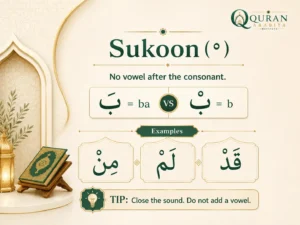
Sukoon, written ْ, marks the absence of a following short vowel. Unicode identifies U+0652 as ARABIC SUKUN and describes it as marking the absence of a vowel after the base consonant. For a beginner, the practical rule is simple: pronounce the consonant, then move directly to what follows instead of inventing “a,” “i,” or “u.”
Compare بَ (ba) with بْ (b). In a word such as مِنْ, the final نْ is closed without adding “na,” “ni,” or “nu.” One of the most common beginner errors is turning every consonant into a consonant-plus-vowel syllable. A teacher often corrects this by slowing the word, isolating the letter with sukoon, then rebuilding the full word.
Shaddah: One Written Letter Represents a Doubled Consonant
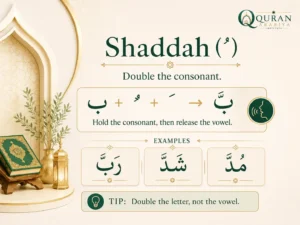
Shaddah, written ّ, marks consonant gemination or doubling. The Quranic Arabic Corpus represents shaddah by doubling the consonant in phonetic transcription, and Unicode classifies shaddah separately from the short-vowel marks. A useful beginner model is to think of the doubled consonant as a first consonant closed without a vowel followed immediately by the same consonant carrying the visible vowel.
For example, بَّ is not simply بَ said more loudly. The consonant itself is doubled. Ignoring shaddah can change the structure of a word and makes recitation sound clipped or inaccurate. When practicing, pause slightly into the doubled consonant, then release into its vowel. Do not exaggerate it into an unnatural long pause.
If connected letters themselves are still difficult to recognize, work through How to Join Arabic Letters for Quran Reading before expecting shaddah practice to feel automatic.
Tanween: Learn the Three Endings and the Final N Sound
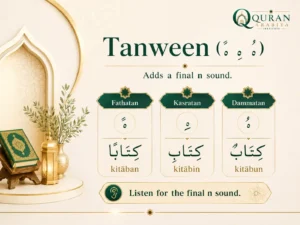
Tanween, or nunation, appears as doubled vowel marks: fathatan ً, kasratan ٍ, and dammatan ٌ. In basic isolated reading, they correspond to -an, -in, and -un. The Quranic Arabic Corpus lists those three phonetic values, while Arabic grammar references describe tanween as a noun-ending feature associated with nunation.
| Tanween type | Mark | Basic isolated reading |
|---|---|---|
| Fathatan | ً | -an |
| Kasratan | ٍ | -in |
| Dammatan | ٌ | -un |
A beginner should first hear and produce the final n-sound consistently. Later, Tajweed explains how noon sakinah and tanween interact with the next letter through rules such as izhar, idgham, iqlab, and ikhfa. Do not let those later rules prevent you from first recognizing what tanween is on the page.
Sukoon vs Shaddah vs Tanween: How to Tell Them Apart

The easiest distinction is to ask what the mark changes. Sukoon removes a vowel after one consonant. Shaddah doubles that consonant. Tanween adds a vowel-plus-n ending, usually at the end of a word. The Quranic Arabic Corpus notes that Quranic text contains explicit diacritics and is fully vowelized, so visual attention to these marks is part of accurate decoding.
When reading, do not identify a mark by shape alone. Say its job aloud: “no vowel,” “double consonant,” or “final n-ending.” This links the symbol directly to pronunciation and reduces guessing.
When marks appear together, shaddah can carry a short vowel or tanween. Do not treat the signs as competing instructions. Read the doubled consonant first, then release it with the accompanying vowel or ending. This layered reading becomes easier when you identify each mark before attempting the whole word aloud carefully.
Common Beginner Mistakes and Their Corrections
| Mistake | What it sounds like | Correction |
|---|---|---|
| Adding a vowel after sukoon | بْ becomes “ba” or “bu” | Close the consonant cleanly |
| Ignoring shaddah | Doubled letter is read once | Hold the consonant before releasing the vowel |
| Stretching shaddah like a long vowel | Consonant becomes an unnatural pause | Double the consonant, not the vowel |
| Dropping tanween | -un/-in/-an ending disappears | Practice the final n-sound clearly |
| Treating every tanween context identically | Tajweed context is ignored | Master recognition first, then learn context rules |
A teacher can diagnose these errors quickly by asking the learner to read unfamiliar examples. If the student reads memorized words correctly but misses the same marks in new words, the skill is not automatic yet.
A Practical 15-Minute Practice Routine
Spend five minutes distinguishing the three marks visually. Mix cards containing بْ, بّ, بٌ, بٍ, and بً rather than drilling one type in a block. Spend the next five minutes reading short combinations slowly. Use your finger or a pointer and say exactly what each mark requires before blending the sounds.
Use the final five minutes on unfamiliar words or one short Quran line. Do not measure success by speed. Measure whether you stopped inventing vowels, respected doubled consonants, and noticed tanween endings. If you are still building the full reading sequence, How to Start Reading Quran Without Knowing Arabic shows where these skills fit within a beginner pathway.
When Are You Ready to Move Beyond These Marks?
You are ready to progress when you can recognize sukoon, shaddah, and all three tanween forms in unfamiliar text without prompting, then pronounce them correctly while blending the word. You do not need fast recitation. You need reliable decoding that survives when the example changes.
Before moving fully from a primer into regular Mushaf reading, use When to Move From Qaida to Quran to check whether your letter recognition, joining, vowel signs, and basic blending are stable enough for denser Quran pages.
Conclusion
Sukoon, shaddah, and tanween solve three different reading problems: sukoon removes a following short vowel, shaddah doubles a consonant, and tanween adds an underlying -an, -in, or -un ending. Learn them separately, compare them often, and practice them in unfamiliar words rather than only memorized exercises. Once these marks become automatic, beginner Quran reading becomes more accurate and much less dependent on guessing.
Frequently Asked Questions
What is sukoon in Quran reading?
Sukoon shows that the consonant has no short vowel after it. Read the consonant cleanly without adding a, i, or u.
What does shaddah do to an Arabic letter?
Shaddah doubles the consonant. The letter should not be read as a normal single consonant or merely pronounced louder.
What are the three types of tanween?
They are fathatan ً, kasratan ٍ, and dammatan ٌ, producing the basic endings -an, -in, and -un in isolated reading.
Is sukoon the same as stopping at the end of a word?
No. Sukoon is a written mark showing no vowel after a consonant. Rules for stopping during Quran recitation are a broader subject.
Is shaddah a long vowel?
No. Shaddah lengthens or doubles the consonant, not the vowel. Long vowels are produced through different Arabic letters and rules.
Does tanween always sound exactly like n?
Tanween has an underlying n-sound, but Tajweed can change how it is realized depending on the following letter.
Should beginners learn Tajweed rules for tanween immediately?
First recognize and pronounce tanween reliably. Then add the Tajweed rules for noon sakinah and tanween with a qualified teacher.
Why do I keep adding a vowel after sukoon?
You may be used to practicing letters only with fatha, kasra, or damma. Slow down and drill consonant closure without an extra vowel.
How should I practice sukoon shaddah tanween together?
Mix examples rather than studying only one mark at a time. Identify the mark, state its job, pronounce it, then blend the word.
Can I move to Quran reading after learning these marks?
Yes, if your letters, connected forms, basic harakat, and blending are also stable. Start with short guided lines rather than dense pages.
References
- Unicode Standard 17.0 — Arabic Script and Tashkil. Unicode Standard 17.0 — Arabic Script and Tashkil
- Unicode Arabic Block — Fathatan, Dammatan, Kasratan, Shadda, and Sukun. Unicode Arabic Block
- Quranic Arabic Corpus — Documentation. Quranic Arabic Corpus — Documentation
- Quranic Arabic Corpus — Phonetic Transcription. Quranic Arabic Corpus — Phonetic Transcription
- LibreTexts — Arabic Diacritical Marks. LibreTexts — Arabic Diacritical Marks
- National Open University of Nigeria — Arabic Grammar I. Arabic Grammar I