EXPLORE THE QURAN ARABIYA COURSE DIRECTORY

Online Quran, Arabic & Islamic Studies Courses

Compare Quran, Arabic and Islamic learning routes in one place, then move to the individual course page for the exact level, curriculum and course-specific guidance. The catalogue is organized to help you choose by the skill you need next—not simply by the most familiar course name.
START WITH THE LEARNING INTENT

One catalogue. Three clear study worlds.

Quran, Arabic and Islamic learning can support one another, but they should not be merged into one vague pathway. Use the full catalogue first; the sections below then explain how to narrow the choices without duplicating any individual course page.
Current Courses
+ 0
Course Families
0
Study Worlds
0
FIND YOUR LEARNING PATH

Choose Your Goal. Start the Right Course.

ONLINE QURAN COURSES

Find the Right Online Quran Course by the Skill That Needs to Improve

After browsing All Courses, narrow the Quran catalogue by the learner’s current performance. The useful first question is not “Which Quran course is most popular?” but “What should become more reliable next?” That distinction keeps reading foundations, recitation, Tajweed, Hifz, revision and advanced Quran study connected without making them compete for the same learning intent.

Start from reading ability

Can the learner decode connected Quran text independently, or is the reading foundation still unstable?

Separate knowledge from performance

Knowing Tajweed terms is different from applying them consistently while reciting new verses.

Choose the next Quran task

Reading, correction, memorization, review and advanced recitation are related—but they are not the same course intent.
ONLINE ARABIC COURSES

Choose an Online Arabic Course by What You Want Arabic to Do

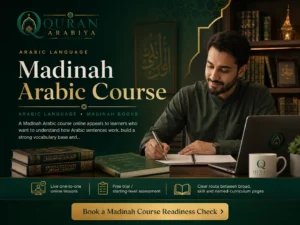
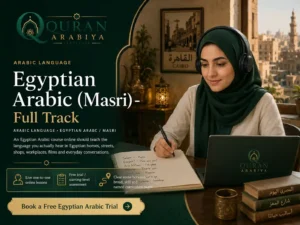
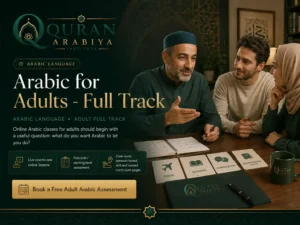
The Arabic catalogue works best when practical language use and specialist analysis are kept separate. A learner building Fusha, MSA, pronunciation, conversation or literacy needs a different starting decision from someone studying Nahw, Sarf, morphology, rhetoric or Quranic Arabic. Use All Courses to compare the exact routes after you identify which language task matters most.
Decide what Arabic should unlock

Speaking, formal communication, reading, writing and text analysis lead to different course families.

Keep Fusha broad when the goal is broad

A general Arabic learner should not be pushed into a specialist grammar route only because grammar appears inside Arabic.
Use advanced routes for advanced intent

Nahw, Sarf, rhetoric and I‘rab deserve their own course choice when analysis becomes the main objective.
ONLINE ISLAMIC STUDIES COURSES

Choose Online Islamic Studies by the Type of Knowledge You Want to Study

Islamic learning becomes easier to navigate when the catalogue first separates disciplines, named texts, historical study and learner-specific routes. This hub gives each family a clear place without repeating the detailed syllabus that belongs on the individual course page. Use All Courses to move from the broad subject type to the exact Fiqh, Hadith, Tafsir, Aqeedah, Seerah or History route.

Choose the discipline first

Fiqh, Aqeedah, Hadith and Tafsir belong to different learning questions even when they support one another.

Separate broad study from named texts

A general subject course and a course centered on a specific book should remain clearly distinguishable.

Keep history as history

Seerah and historical periods deserve a different navigation route from doctrinal, legal or interpretive sciences.
COURSE DIRECTORY FAQ

Frequently Asked Questions About Choosing Quran Arabiya Courses

Once you have narrowed the catalogue by subject, the remaining questions are usually about overlap, starting point and how the course families relate. These answers stay at directory level so they do not duplicate curriculum, teacher or pricing pages.
The current catalogue contains 82 course pages across Quran, Learn to Read Quran, Arabic Language, Advanced Arabic, Islamic Sciences and Islamic History.
Courses are grouped by learning intent rather than placed in one undifferentiated list. Quran routes separate reading foundations, recitation and Tajweed, Hifz and advanced study; Arabic separates practical language from specialist analysis; Islamic learning separates sciences from history and other focused routes.
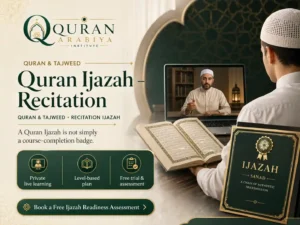
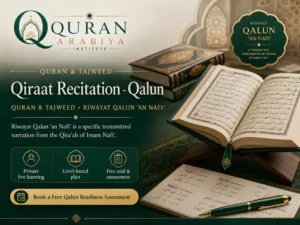
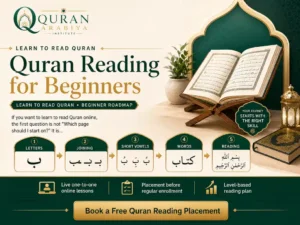
Learn to Read Quran focuses on the reading foundation: script recognition, Qaida work, decoding and fluency. Quran & Tajweed serves learners whose main goal is recitation, Tajweed, Hifz, revision, Ijazah-related study or Qira’at.
If the learner cannot yet decode connected Quran text reliably, a reading-foundation route is usually the clearer place to compare. If reading is established and the main problem is recitation accuracy or rule application, compare Tajweed and recitation routes.
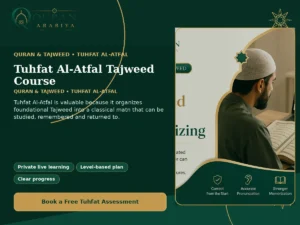
Arabic Language covers broad goals such as Fusha, MSA, speaking, reading, writing, pronunciation and structured curricula. Advanced Arabic is for specialist goals such as Nahw, Sarf, morphology, rhetoric, Quranic Arabic and I‘rab.
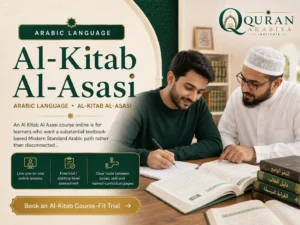
Yes. The catalogue includes named Arabic curricula as well as broader language and specialist-skill routes. Open the individual course page to confirm the exact purpose and scope of a named-text course.
Use the individual course page. This Courses hub is for discovery, segmentation and comparison; detailed curriculum, readiness, named materials and course-specific FAQs remain on the page for that course.
Chat with us